01 / 21

Biological
Feedback

How living systems use positive and negative feedback loops to maintain homeostasis, amplify signals, and regulate every process from blood sugar to childbirth.

AP Biology

What Is Feedback?

In biology, feedback occurs when the output of a system loops back to influence its own input. This creates a circular cause-and-effect chain that either stabilises or amplifies a physiological process.

There are two major types: negative feedback (resists change) and positive feedback (amplifies change). Understanding both is essential for AP Biology.

Homeostasis: The Goal of Feedback

Homeostasis is the maintenance of a stable internal environment despite external changes. Feedback loops are the primary mechanism organisms use to achieve this balance.

Stimulus
A change in the internal or external environment that triggers a response.
Receptor
Detects the change and sends information to the control centre.
Effector
Carries out the response that counteracts or amplifies the stimulus.

The Feedback Loop Model

Stimulus Receptor Control Centre Effector Feedback Loop: output returns to influence input

Negative Feedback: Restoring Balance

Negative feedback is the most common feedback mechanism. The effector's response opposes the original stimulus, pushing the variable back toward its set point. This dampens change and maintains homeostasis.

Set Point Stimulus Response opposes Negative Feedback Over Time Variable returns toward set point Time →

Positive Feedback: Amplifying Change

Positive feedback amplifies the original stimulus. The effector's response drives the variable further away from its starting point, creating a rapid escalation until an external event stops the loop.

Baseline Event stops loop Signal amplifies until external event intervenes Positive Feedback Over Time Time →

Predict the effect of constitutively active Wee1.

Active MPF activates Cdc25 and inhibits Wee1, reinforcing CDK1 activation. Wee1 adds an inhibitory phosphate to CDK1; Cdc25 removes it. Constitutively active Wee1 disrupts this loop; arrest is a prediction of the selected dominant-Wee1 model, not an unconditional outcome for every cell. Protein forms are generic illustrations, not measured structures or a molecular simulation; the circuit is independently authored.
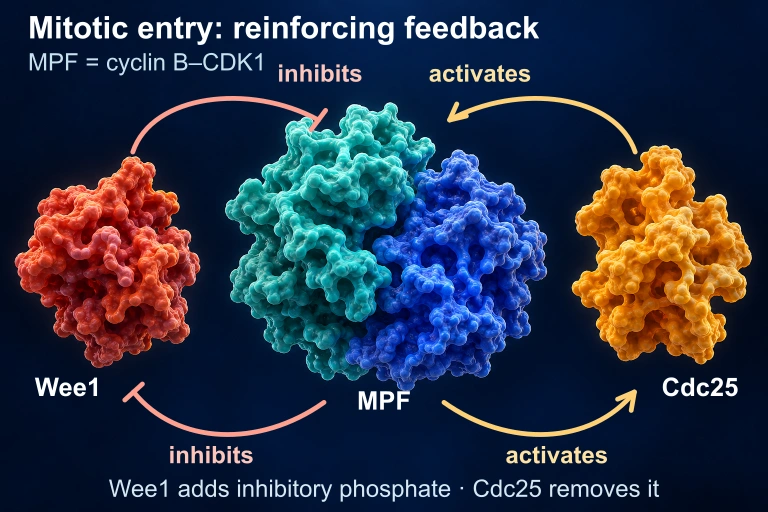
Generic protein-like forms show Wee1, MPF and Cdc25. Authored T-bars show Wee1 and MPF inhibiting one another; arrows show Cdc25 and MPF activating one another.
Active MPF activates Cdc25 and inhibits Wee1, reinforcing CDK1 activation. Wee1 adds an inhibitory phosphate to CDK1; Cdc25 removes it. Constitutively active Wee1 disrupts this loop; arrest is a prediction of the selected dominant-Wee1 model, not an unconditional outcome for every cell. Protein forms are generic illustrations, not measured structures or a molecular simulation; the circuit is independently authored.

Negative vs Positive Feedback

Negative Feedback Positive Feedback
Direction Opposes change Amplifies change
Goal Return to set point Drive to completion
Frequency Most common Rare
Self-limiting? Yes: built-in brake No: needs external stop
Example Blood glucose regulation Childbirth contractions

How to Identify Feedback Type

1
Identify the stimulus. What change initiated the response? (e.g., blood sugar rises)
2
Identify the response. What does the body do in reaction? (e.g., pancreas releases insulin)
3
Compare directions. Does the response oppose the stimulus or reinforce it?
4
Check for self-limitation. Does the loop stop on its own (negative) or require an external event (positive)?

Example: Blood Glucose Regulation

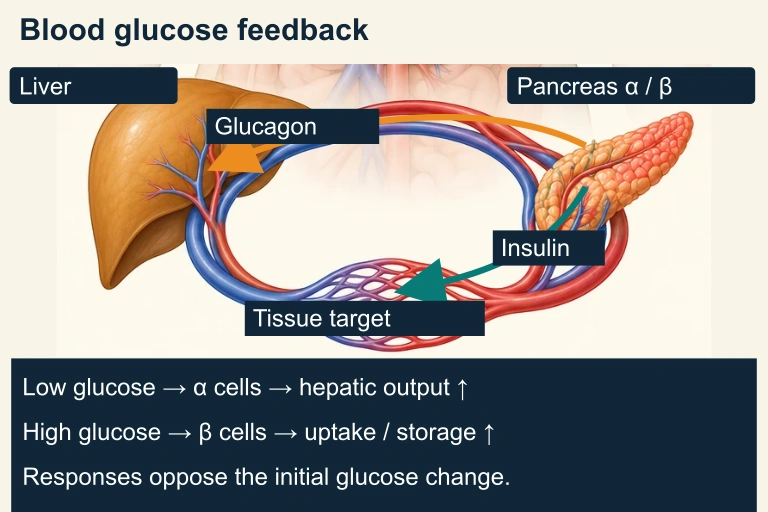
Normal Glucose Glucose rises Pancreas releases Insulin Cells absorb glucose Glucose drops Pancreas releases Glucagon Liver releases glucose
A rise in glucose stimulates beta-cell insulin and uptake or storage; a fall stimulates alpha-cell glucagon and hepatic output. These responses oppose the initial change. The contextual image is illustrative.
A rise in glucose stimulates beta-cell insulin and uptake or storage; a fall stimulates alpha-cell glucagon and hepatic output. These responses oppose the initial change.

Example: Thermoregulation

\(37\,^\circ\text{C}\)
Body too hot
\(\gt 37\,^\circ\text{C}\)
Sweat, vasodilation Heat loss increases Body too cold
\(\lt 37\,^\circ\text{C}\)
Shiver, vasoconstriction Heat retained Both responses push temperature back to the set point

Example: Childbirth Contractions

Baby pushes on cervix Nerve impulse to brain Pituitary releases Oxytocin Stronger Contractions + Amplifies Baby delivered: loop ends

More Positive Feedback Examples

Blood Clotting
Platelets at a wound release chemicals that attract more platelets. The cascade amplifies until the clot seals the wound.
Fruit Ripening
Ethylene gas released by a ripening fruit triggers neighbouring fruits to ripen faster, releasing even more ethylene.
Action Potentials
Once threshold is reached, sodium channels open, depolarising the membrane further, opening more sodium channels in a rapid cascade.

Worked Example: Identify the Loop

1
Stimulus: Blood calcium rises above normal.
2
Receptor/Control: Thyroid detects the increase.
3
Effector: Calcitonin signals bones to absorb calcium.
4
Result: Calcium drops (opposes the rise). This is negative feedback.

Worked Example: Lactation

1
Stimulus: Baby suckles at the breast.
2
Response: Prolactin released, milk production increases.
3
Direction: More milk = more suckling = more prolactin. Response amplifies stimulus.
4
Conclusion: Positive feedback. The loop ends when the baby stops nursing (external event).

Common Mistakes

✕ "Negative" means bad
Negative feedback is not harmful. "Negative" means the response opposes the change. It is the body's main tool for stability.
✕ "Positive" means beneficial
"Positive" means amplification, not a good outcome. Uncontrolled positive feedback can be dangerous (e.g., fever spirals).
✕ Confusing stimulus and response
The stimulus is the initial change, not the corrective action. Mix them up and you will misidentify the feedback type.

Summary: Feedback at a Glance

Feature Negative Feedback Positive Feedback
Effect on variable Reverses deviation Amplifies deviation
Outcome Homeostasis maintained Process driven to completion
Self-limiting ✓ Yes ✕ No
Examples Blood glucose, body temp, blood pressure, pH Childbirth, clotting, action potentials, lactation
Prevalence Very common Rare

Question 1 of 5

When blood pressure increases, baroreceptors in the aorta signal the brain, which slows the heart rate, causing blood pressure to decrease. What type of feedback is this?

Question 2 of 5

During blood clotting, platelets release chemicals that attract more platelets to the wound, forming a larger clot. The loop ends when the wound is sealed. This is an example of:

Question 3 of 5

Which component of a feedback loop detects the initial change in the environment?

Question 4 of 5

A student claims that positive feedback is more common than negative feedback in healthy organisms. Is this claim correct?

Question 5 of 5

In thermoregulation, when body temperature drops below \(37\,^\circ\text{C}\), the hypothalamus triggers shivering to generate heat. As body temperature rises back to \(37\,^\circ\text{C}\), shivering stops. What is the set point in this loop?