01 / 20

Evidence of
Evolution

Explore the multiple lines of evidence that support the theory of evolution: from fossils and anatomy to molecular biology and biogeography.

AP Biology

What Is Evolution?

Evolution is the change in allele frequencies in a population over successive generations. At its core, it explains how populations of organisms change over time through variations in heritable traits.

Charles Darwin and Alfred Russel Wallace independently proposed natural selection as the mechanism driving evolution. Today, we have converging evidence from at least six major fields of science.

Six Lines of Evidence

1. Fossil Record
Preserved remains show transitions between ancient and modern forms
2. Comparative Anatomy
Homologous and vestigial structures reveal shared ancestry
3. Molecular Biology
DNA and protein comparisons confirm evolutionary relationships
4. Biogeography
Geographic distribution of species matches evolutionary predictions
5. Embryology
Embryonic development reveals common developmental pathways
6. Direct Observation
Antibiotic resistance, Darwin's finches, and pesticide resistance

Explain why geographical proximity and ancestry can predict relatedness.

Illustrative source-to-island routes are separate from ancestry evidence; the living source is not a proven direct ancestor.
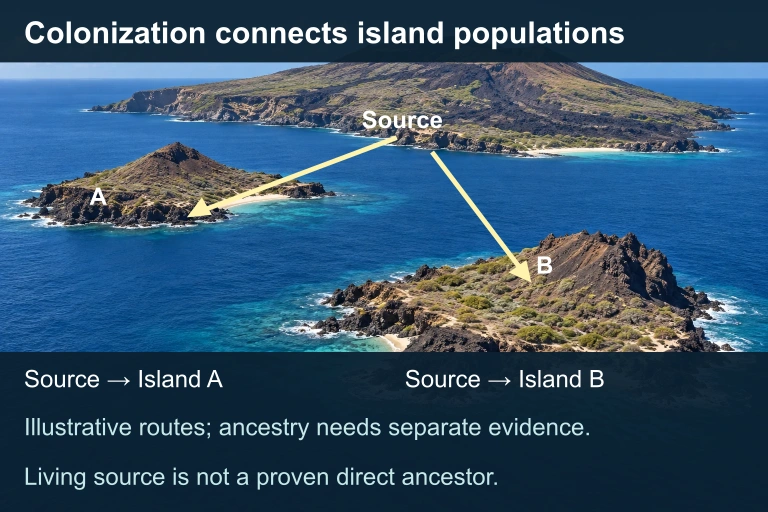
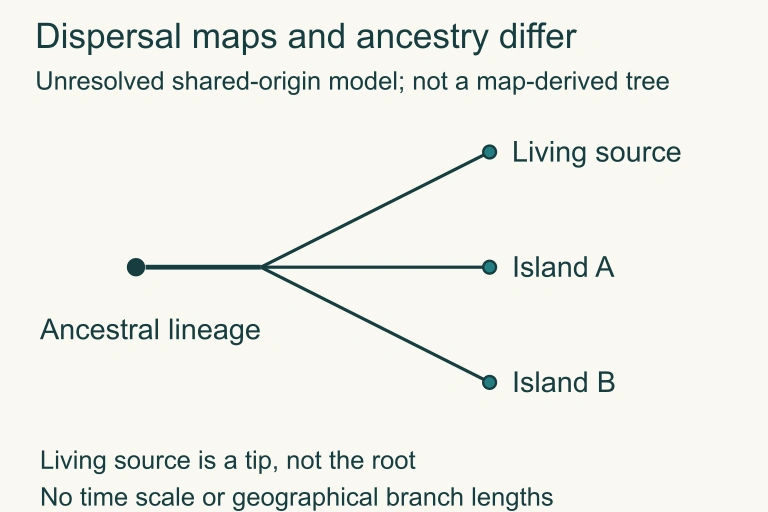
Illustrative source-to-island routes are separate from ancestry evidence; the living source is not a proven direct ancestor. The contextual image is illustrative.
Illustrative source-to-island routes are separate from ancestry evidence; the living source is not a proven direct ancestor.
Exact schematic
Exact schematic

Why Does This Evidence Matter?

In science, a theory gains strength when independent lines of evidence converge on the same conclusion. Evolution is supported by evidence from paleontology, genetics, anatomy, embryology, biogeography, and direct observation: all pointing to common descent.

No single piece of evidence "proves" evolution alone. The power lies in the convergence of multiple independent sources, each of which would be extremely unlikely under any alternative explanation.

The Fossil Record

Recent Tertiary Mesozoic Paleozoic Modern species, recent extinctions Mammals diversify, primates appear Age of dinosaurs, first birds & flowers First fish, amphibians, early reptiles Older Newer

Comparative Anatomy

Human Grasping Cat Running Whale Swimming Bat Flying Humerus Radius/Ulna + Digits
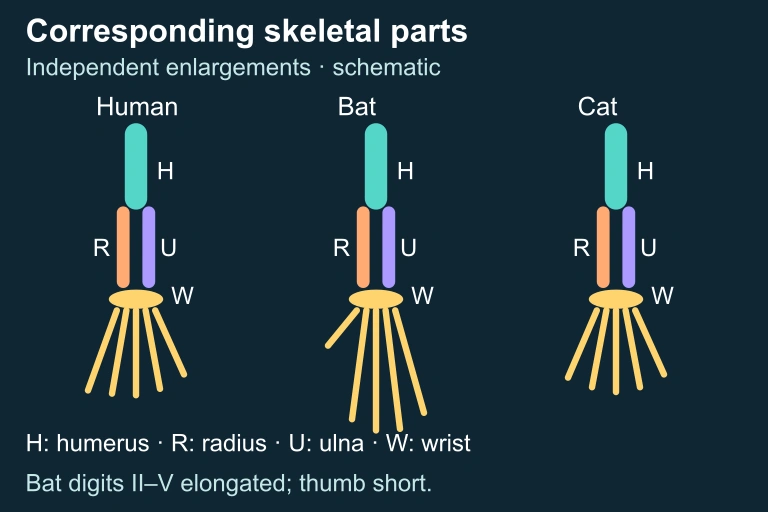
Corresponding skeletal parts
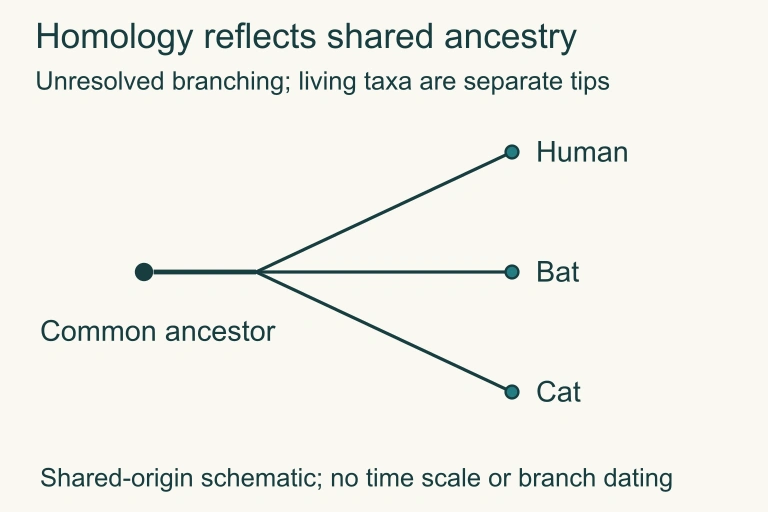
Shared origin schematic
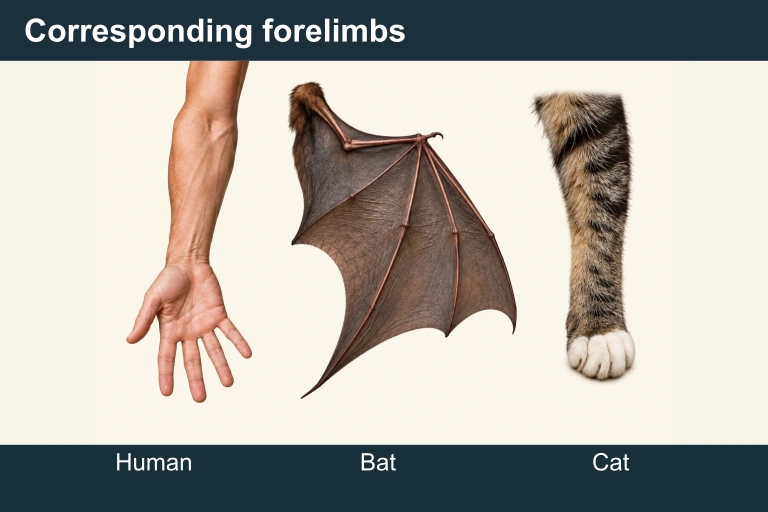
Human, bat and cat forelimb illustrations are compared. A separate schematic marks corresponding humerus, radius, ulna, wrist and five digits, with elongated bat digits and short thumb. An unresolved shared-ancestry companion has three living tips.
These independently enlarged forelimb topology schematics identify corresponding humerus, radius, ulna, wrist and five digits. They compare homology rather than exact bone shapes or proportions, and do not make living species ancestors of one another.

Homologous vs Analogous

Homologous Analogous
Definition Same structure, different function Different structure, same function
Origin Common ancestor Convergent evolution
Example Bat wing vs human arm Bat wing vs insect wing
Evidence for Divergent evolution Similar selection pressures
Bone structure Shared Not shared

Homologous forelimbs versus analogous wings
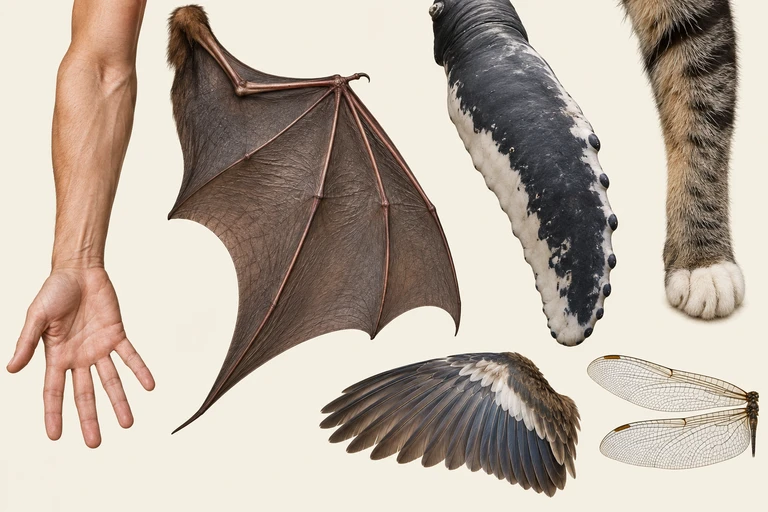
Human arm, bat wing, whale flipper and cat foreleg specimens accompany an authored proximal-to-distal skeletal correspondence diagram.Corresponding forelimb bones reflect shared ancestry despite different functions. Bird and bat forelimb bones are homologous, while bird and insect flight surfaces are analogous.

Same skeletal plan, different uses
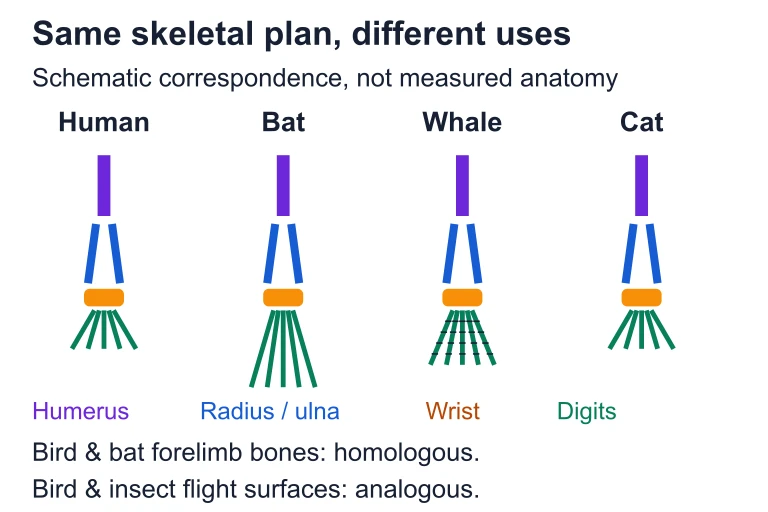
Same skeletal plan, different uses. Corresponding forelimb bones reflect shared ancestry despite different functions. Bird and bat forelimb bones are homologous, while bird and insect flight surfaces are analogous.Corresponding forelimb bones reflect shared ancestry despite different functions. Bird and bat forelimb bones are homologous, while bird and insect flight surfaces are analogous.

Molecular Evidence

All living organisms share the same genetic code (DNA and RNA). By comparing DNA sequences, amino acid sequences, or entire genomes, scientists can measure how closely related species are.

DNA Similarity to Humans Chimpanzee 98.7% Gorilla 95.7% Mouse 85% Fruit fly 60% Banana 50% More shared DNA = more recent common ancestor

Biogeography: Where Species Live

The geographic distribution of species provides strong evidence for evolution. Island biogeography is especially revealing: organisms on islands resemble species on the nearest mainland, not organisms in similar environments elsewhere.

Island Species
Galapagos finches resemble South American finches, not African ones, despite similar island habitats
Continental Drift
Marsupials dominate Australia because the continent isolated before placental mammals could outcompete them

Biogeographic history versus similar environments

Birds with differing beaks occupy a stylized mainland and island landscape.Geographic proximity and similar environments provide different kinds of evidence. Test inferred dispersal histories and ancestry with independent genetic and anatomical comparisons.

History and similarity are different
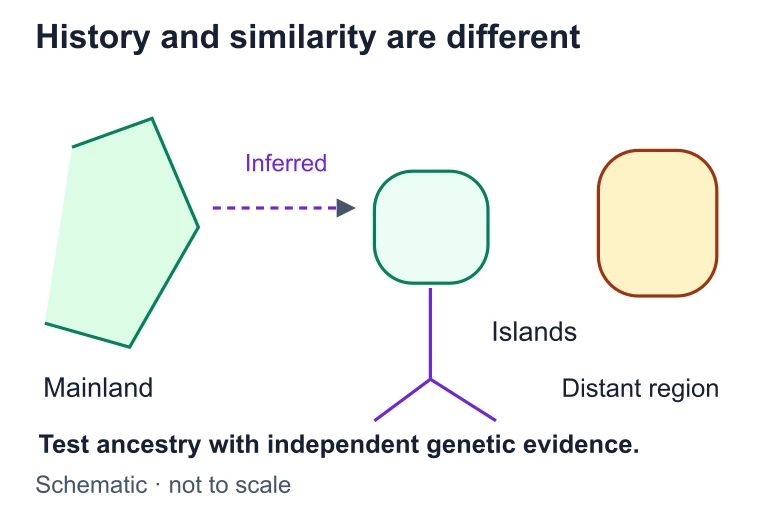
History and similarity are different. Geographic proximity and similar environments provide different kinds of evidence. Test inferred dispersal histories and ancestry with independent genetic and anatomical comparisons.Geographic proximity and similar environments provide different kinds of evidence. Test inferred dispersal histories and ancestry with independent genetic and anatomical comparisons.

Embryology and Development

Early Embryo Stage: Striking Similarities Fish Reptile Bird Human Pharyngeal arches (gill slits) Present in ALL vertebrate embryos In fish: become gills. In humans: become jaw, ear bones, throat structures

Direct Observation of Evolution

Evolution is not just historical: we can observe it happening in real time when selection pressures are strong and generation times are short.

Antibiotic Resistance
Bacteria with resistance alleles survive antibiotics and reproduce, increasing the frequency of resistance in the population
Peppered Moths
During the Industrial Revolution, dark-colored moths increased in frequency as soot darkened tree bark, favoring camouflage
Darwin's Finches
Beak size shifted measurably during droughts when only large, hard seeds were available, favoring birds with larger beaks

Vestigial Structures

Vestigial structures are anatomical features that have lost most or all of their original function through evolution. They are remnants of structures that were functional in an ancestor.

1
Human appendix: Reduced remnant of a larger cecum used for digesting cellulose in herbivorous ancestors
2
Whale pelvic bones: Tiny, non-functional hip bones embedded in muscle: evidence of land-dwelling ancestors
3
Human tailbone (coccyx): Fused vertebrae at the base of the spine: remnant of a tail in primate ancestors
4
Flightless bird wings: Ostriches and emus retain wings too small for flight, inherited from flying ancestors

How to Analyze Evidence

1
Identify the evidence type: Is this fossil, anatomical, molecular, biogeographic, embryological, or observational evidence?
2
State what it shows: Does it demonstrate common ancestry (homology), convergent evolution (analogy), or descent with modification?
3
Connect to a mechanism: Link the evidence to natural selection, genetic drift, gene flow, or mutation as the driving force
4
Explain the prediction: State what evolution predicts and how this evidence confirms that prediction
5
Rule out alternatives: Explain why the evidence cannot be explained by independent creation or coincidence

Example: Whale Evolution

Pakicetus ~50 MYA Land-dwelling 4 legs, small Ambulocetus ~49 MYA Semi-aquatic Webbed feet Dorudon ~40 MYA Fully aquatic Tiny hind limbs Modern Whale Present Fully aquatic Vestigial pelvis Transitional Fossils: Land to Sea Evidence types: Fossil + Anatomical + Molecular DNA confirms whales are most closely related to hippos (artiodactyls)

Example: Antibiotic Resistance

Before Antibiotic Drug After Antibiotic ✕ ✕ ✕ ✕ ✕ ✕ ✕ Time Resistant Population Susceptible bacteria Resistant bacteria Natural selection: resistant allele increases in frequency The bacteria did not "develop" resistance: resistant individuals were selected for

Common Mistakes

✕ "Organisms evolve on purpose"
Evolution has no direction or goal. Natural selection acts on existing variation: organisms don't "try" to evolve.
✕ Confusing homologous and analogous
Only homologous structures (same origin, different function) are evidence of common descent. Analogous structures arise independently.
✕ "Humans evolved from chimps"
Humans and chimps share a common ancestor. Neither species "came from" the other: both diverged from a shared lineage.

Question 1 of 5

The forelimbs of a bat, a whale, and a human all contain the same set of bones (humerus, radius, ulna) despite serving different functions. These structures are best described as:

Question 2 of 5

A population of bacteria is exposed to an antibiotic. After several generations, nearly all surviving bacteria are resistant. Which statement best explains this observation?

Question 3 of 5

Whales possess tiny, non-functional pelvic bones embedded in muscle tissue. These bones are best classified as:

Question 4 of 5

Galapagos finches are most similar to finch species found on the South American mainland, not to similar-looking birds on other islands. This observation is best explained by:

Question 5 of 5

Humans share approximately 98.7% of their DNA with chimpanzees and approximately 85% with mice. Which conclusion is best supported by this molecular evidence?