Enzymes
Biological Catalysts
Explore how enzymes speed up reactions, the lock-and-key model, factors that affect activity, and enzyme kinetics for the AP Biology exam.
What Are Enzymes?
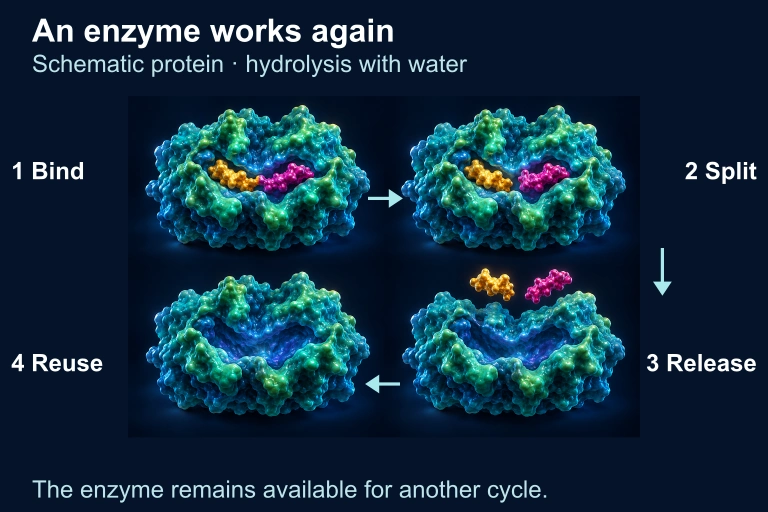
Enzymes are biological catalysts: proteins (and occasionally RNA molecules) that dramatically increase the rate of chemical reactions without being consumed. Nearly every metabolic process in a cell depends on enzymes to proceed fast enough to sustain life.
Essential Vocabulary
Lowering Activation Energy
Lock-and-Key vs Induced Fit
How Enzymes Work
Factors Affecting Enzyme Activity
Temperature and pH Curves
Michaelis-Menten Kinetics
Competitive vs Non-Competitive Inhibition
Inhibition Comparison
| Competitive | Non-Competitive | |
|---|---|---|
| Binding Site | Active site | Allosteric site |
| Resembles Substrate? | Yes | No |
| Effect on \(V_{max}\) | Unchanged | Decreased |
| Effect on \(K_m\) | Increased (apparent) | Unchanged |
| Overcome by more \[S\]? | Yes | No |
| Example | Malonate inhibiting succinate dehydrogenase | Heavy metals binding enzyme |
Allosteric Regulation
Many enzymes have allosteric sites: regulatory binding sites separate from the active site. When a molecule binds an allosteric site, it changes the enzyme's conformation, either activating or inhibiting catalysis.
Feedback Inhibition
Cofactors and Coenzymes
Many enzymes require non-protein helpers to function. These helpers assist in catalysis by accepting or donating electrons, functional groups, or atoms.
Example: Reading a Kinetics Graph
Example: Temperature Experiment
A student tests an enzyme (extracted from human saliva) at five temperatures and measures reaction rate. The results are shown below:
| Temperature | Rate (units/min) |
|---|---|
| \(10^\circ C\) | 12 |
| \(20^\circ C\) | 28 |
| \(37^\circ C\) | 54 |
| \(50^\circ C\) | 18 |
| \(70^\circ C\) | 2 |
Common Mistakes
Enzyme Summary
| Concept | Key Detail |
|---|---|
| Role | Biological catalysts that lower \(E_a\) |
| Structure | Globular proteins with a specific active site |
| Model | Induced-fit (enzyme molds around substrate) |
| \(V_{max}\) | Maximum rate when all active sites are saturated |
| \(K_m\) | \[S\] at half-\(V_{max}\): measures enzyme-substrate affinity |
| Competitive Inhibitor | Binds active site: increases apparent \(K_m\), \(V_{max}\) unchanged |
| Non-Competitive Inhibitor | Binds allosteric site: decreases \(V_{max}\), \(K_m\) unchanged |
| Feedback Inhibition | End product inhibits first enzyme in a pathway |
How to Approach Enzyme Problems
Question 1 of 5
Enzymes increase the rate of a reaction by:
Question 2 of 5
A competitive inhibitor affects enzyme kinetics by:
Question 3 of 5
An enzyme has an optimal pH of 2. This enzyme is most likely found in which location?
Question 4 of 5
In feedback inhibition of a metabolic pathway, which enzyme is typically inhibited by the end product?
Question 5 of 5
An enzyme is heated to 80 \(^\circ C\) and then cooled back to 37 \(^\circ C\). The enzyme shows no catalytic activity. The most likely explanation is: