01 / 21

Environmental Effects
on Phenotype

Explore how environmental factors shape the observable traits of organisms: from temperature and nutrition to light and pH: and why genotype alone doesn't tell the whole story.

AP Biology

What Is a Phenotype?

A phenotype is the set of observable characteristics of an organism: its appearance, structure, behavior, and biochemical properties. Phenotypes result from the interaction between an organism's genotype and its environment.

Genotype
The genetic makeup: the specific alleles an organism carries for a given trait.
Phenotype
The observable expression of genes: how traits actually appear in the organism.

The Phenotype Equation

Genotype (G) + Environment (E) = Phenotype (P)

In quantitative genetics, the phenotypic value of a trait can be expressed as: \( P = G + E \), where G represents the genetic contribution and E represents the environmental contribution. Some models also include a \( G \times E \) interaction term.

Why Does Environment Matter?

Genes provide a blueprint, but the environment determines how that blueprint is executed. Environmental factors can influence gene expression at multiple levels: transcription, translation, protein folding, and metabolic activity.

1
Gene expression regulation: Environmental signals can activate or silence genes through epigenetic modifications.
2
Enzyme activity: Temperature and pH directly affect the rate of enzymatic reactions that build phenotypic traits.
3
Resource availability: Nutrition, water, and light availability determine how much an organism can grow and develop.
4
Developmental plasticity: Many organisms can adjust their phenotype during development in response to environmental cues.

The Norm of Reaction

A norm of reaction is a graph showing the range of phenotypes a single genotype can produce across different environments. It illustrates that one genotype does not map to one phenotype: instead, there is a range of possible outcomes.

Environmental Variable Phenotype Genotype A Genotype B High plasticity Low plasticity

Plasticity vs. Canalization

Phenotypic Plasticity Canalization
Definition Ability of one genotype to produce different phenotypes in different environments Tendency to produce the same phenotype regardless of environment
Norm of Reaction Steep curve Flat curve
Adaptive Value Advantageous in variable environments Advantageous in stable environments
Example Hydrangea flower color changes with soil pH Human blood type: remains the same in any environment

Classic Examples in Nature

Himalayan Rabbits
Carry alleles for dark fur, but pigment only forms at cooler body temperatures: extremities (ears, nose, feet) are dark while the body stays white.
Hydrangea Color
Same genotype produces blue flowers in acidic soil (aluminum uptake) and pink flowers in alkaline soil.
Human Height
Strongly influenced by genetics, but nutrition during development can shift height by several inches up or down.

A nest cross-section tests environmental sex determination

Selected v2 places the shade canopy over the left nest only, with the right nest in sunlight and probes at comparable depths. Eggs do not visually identify sex.Compare independently replicated shaded and unshaded nests with matched depth and handling. Measure temperature through the sensitive incubation period and relate it to species-specific offspring sex ratios.

Test a temperature-sensitive phenotype
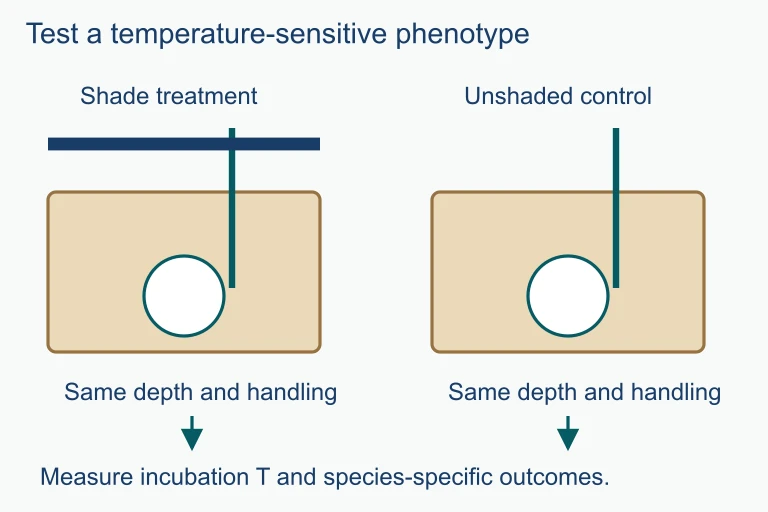
Test a temperature-sensitive phenotype. Compare independently replicated shaded and unshaded nests with matched depth and handling. Measure temperature through the sensitive incubation period and relate it to species-specific offspring sex ratios.Compare independently replicated shaded and unshaded nests with matched depth and handling. Measure temperature through the sensitive incubation period and relate it to species-specific offspring sex ratios.

Temperature and Coat Color

Warm body
\((\sim 37^\circ\text{C})\)
White fur Ear
\(< 33^\circ\text{C}\)
Ear
\(< 33^\circ\text{C}\)
Foot Foot Dark fur at extremities Mechanism Tyrosinase enzyme is temperature- sensitive. It is
active below \(33^\circ\text{C}\)
and inactive above
\(33^\circ\text{C}\).

Temperature-sensitive pigment expression in one genotype
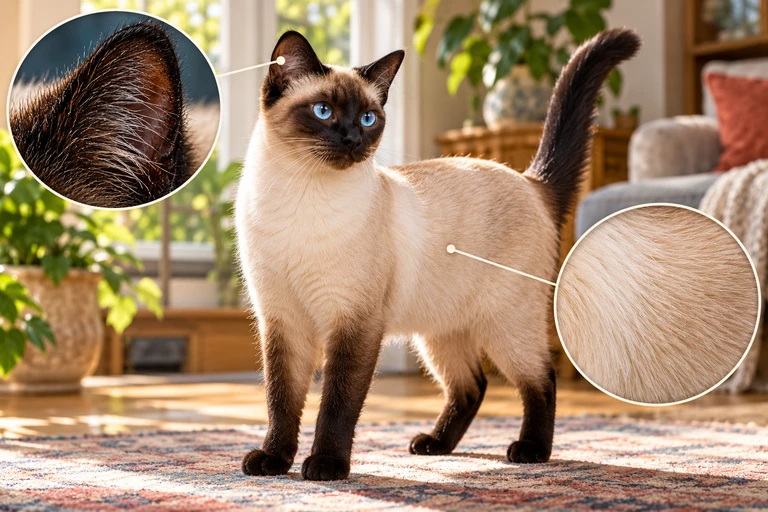
A Siamese cat with dark extremities and pale torso,with magnified fur details.A temperature-sensitive tyrosinase allele can produce more melanin in cooler extremities and less in the warmer torso. Temperature changes enzyme activity while the DNA sequence remains the same.

Same allele, different enzyme activity
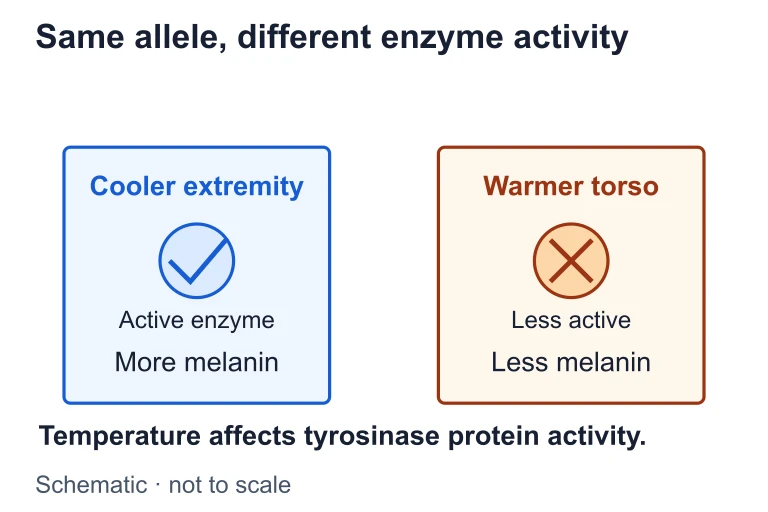
Same allele, different enzyme activity. A temperature-sensitive tyrosinase allele can produce more melanin in cooler extremities and less in the warmer torso. Temperature changes enzyme activity while the DNA sequence remains the same.A temperature-sensitive tyrosinase allele can produce more melanin in cooler extremities and less in the warmer torso. Temperature changes enzyme activity while the DNA sequence remains the same.
Nutrition and Development

Nutritional Quality Adult Height Low Moderate High "Tall" alleles "Short" alleles Overlap

With poor nutrition, both genotypes produce shorter individuals, and their phenotypes overlap. With adequate nutrition, the genetic difference becomes fully visible. This demonstrates how environment modulates the expression of genetic potential.

Epigenetics: The Molecular Link

Epigenetic modifications are chemical changes to DNA or histone proteins that alter gene expression without changing the DNA sequence. Environmental factors like diet, stress, and toxins can trigger these changes.

DNA Methylation
Methyl groups added to cytosine bases can silence gene expression. Diet supplies methyl donors (folate, B12).
Histone Modification
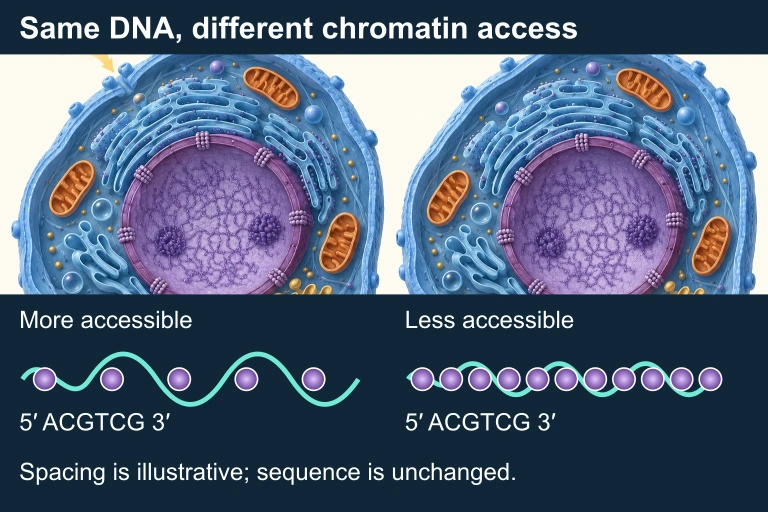
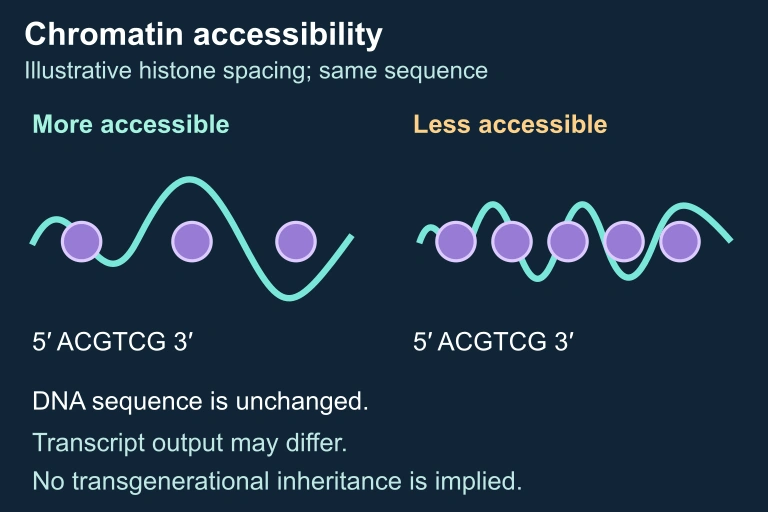
Acetylation or methylation of histone tails can loosen or tighten chromatin, making genes more or less accessible.
Chromatin accessibility can differ without changing the DNA sequence. The example is schematic and does not imply inheritance across generations. The contextual image is illustrative.
Chromatin accessibility can differ without changing the DNA sequence. The example is schematic and does not imply inheritance across generations.
Exact schematic
Exact schematic

Gene-Environment Interaction

A gene-environment interaction (\( G \times E \)) occurs when the effect of a genotype on phenotype depends on the environment, and vice versa. The full model becomes: \( P = G + E + (G \times E) \)

Environment Phenotype Env 1 Env 2 Crossover Genotype X Genotype Y

One genotype, several growing environments

Three light-controlled chamber bays contain similar broadleaf plants in pots, with larger leaves in the dim bay and smaller leaves in the bright bay; illustrated leaves are not measurements.After eight weeks at light intensities of 200, 600 and 1,000 µmol photons/m²/s, mean leaf areas are 45, 30 and 15 cm² for genotype X and 42, 38 and 35 cm² for genotype Y. Their nonparallel responses show genotype-by-environment interaction.

Light changes the phenotype
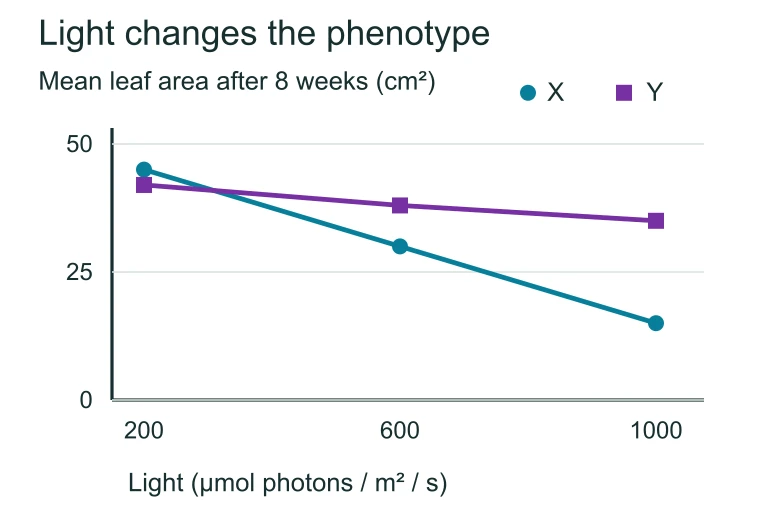
Light changes the phenotype. After eight weeks at light intensities of 200, 600 and 1,000 µmol photons/m²/s, mean leaf areas are 45, 30 and 15 cm² for genotype X and 42, 38 and 35 cm² for genotype Y. Their nonparallel responses show genotype-by-environment interaction.After eight weeks at light intensities of 200, 600 and 1,000 µmol photons/m²/s, mean leaf areas are 45, 30 and 15 cm² for genotype X and 42, 38 and 35 cm² for genotype Y. Their nonparallel responses show genotype-by-environment interaction.

More Real-World Examples

PKU
Individuals homozygous for the PKU allele develop intellectual disability only if they eat phenylalanine. A restricted diet prevents the phenotype entirely.
Flamingo Color
Flamingos are genetically white/grey. Their pink color comes from carotenoid pigments in their diet of brine shrimp and algae.
Crocodile Sex
In many reptiles, sex is determined by incubation temperature, not sex chromosomes: a clear case of environment shaping a fundamental phenotype.

How to Analyze Environmental Effects

1
Identify the trait: What phenotype are you examining? Is it continuous (height) or discrete (flower color)?
2
Determine the genotype: What alleles does the organism carry? Are individuals genetically identical (clones) or different?
3
Identify the environmental variable: What factor is changing? Temperature, nutrition, light, pH, altitude?
4
Compare phenotypes across environments: If genetically identical organisms show different phenotypes, the difference is environmental.
5
Check for G x E interaction: Do different genotypes respond differently to the same environmental change? If so, there is an interaction.

Worked Example: Yarrow Plants

A classic experiment by Clausen, Keck, and Hiesey (1940) grew genetically identical yarrow clones at three different altitudes: sea level, mid-elevation, and high elevation. The same genotype produced dramatically different heights.

Sea Level Tall Mid-Elevation Medium High Elevation Short Same Genotype (Clones)

Worked Example: Siamese Cats

Siamese cats carry the \( c^s \) allele that produces a temperature-sensitive form of tyrosinase: the same mechanism as Himalayan rabbits. The coolest body regions (face, ears, paws, tail) produce dark melanin.

Cool Regions
Face, ears, paws, tail. Temperature \( < 33^\circ\text{C} \). Tyrosinase is active: dark pigment produced.
Warm Regions
Body core. Temperature \( \sim 37^\circ\text{C} \). Tyrosinase is denatured: no pigment, fur stays light.

Common Mistakes

✕ Genes Determine Everything
Assuming phenotype is solely determined by genotype. Environment always plays a role, even if small.
✕ Confusing Plasticity with Mutation
Environmental phenotype changes are not mutations. The DNA sequence does not change: only gene expression does.
✕ All Traits Are Equally Plastic
Some traits (like blood type) are highly canalized. Others (like height) are very sensitive to environment. Plasticity varies by trait.

Question 1 of 5

Himalayan rabbits raised entirely in a cold environment (\( < 33^\circ\text{C} \)) would be expected to have:

Question 2 of 5

A researcher grows genetically identical plant clones in two different environments and observes different heights. This best demonstrates:

Question 3 of 5

An individual is homozygous for the PKU allele. Which statement is most accurate?

Question 4 of 5

On a norm of reaction graph, a flat line for a particular genotype indicates:

Question 5 of 5

Two genotypes have norms of reaction that cross each other on a graph. This is evidence of: