Elements of
Life
Discover the chemical elements that form the foundation of all living organisms, from carbon's versatility to the essential roles of trace elements.
What Are the Elements of Life?
Of the 92 naturally occurring elements, only about 25 are essential to living organisms. These elements combine in precise ways to build every molecule your body needs: from the water you drink to the DNA that encodes your genes.
The Big Six: CHONPS
Six elements make up approximately 99% of the mass of all living organisms. Biologists remember them with the acronym CHONPS.
Four bottles test which nutrient is limiting
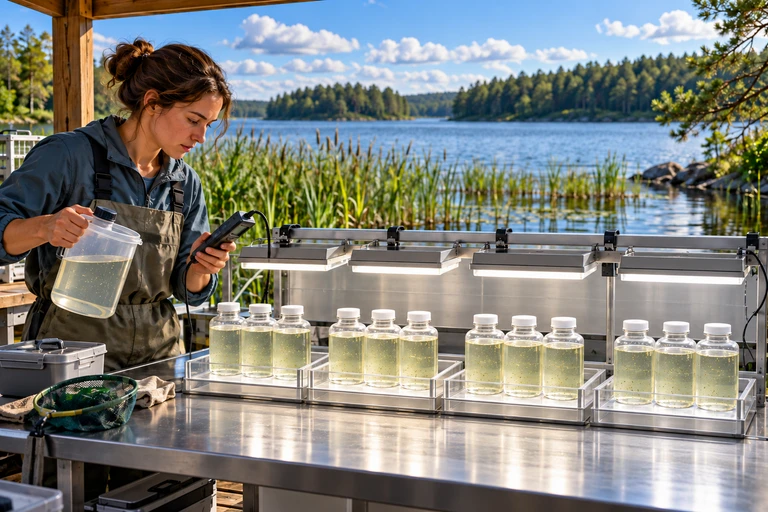 Compare control, nitrogen, phosphorus and combined nitrogen-plus-phosphorus additions using three independent vessels per treatment. Match starting organisms, water, light and measurement time; infer limitation from measured growth responses.
Nutrient limitation is a comparison
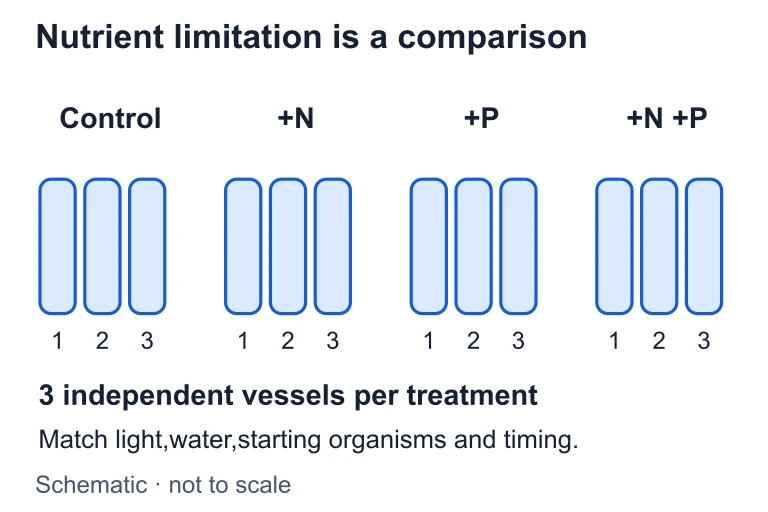 Compare control, nitrogen, phosphorus and combined nitrogen-plus-phosphorus additions using three independent vessels per treatment. Match starting organisms, water, light and measurement time; infer limitation from measured growth responses.
Responses decide the nutrient inference
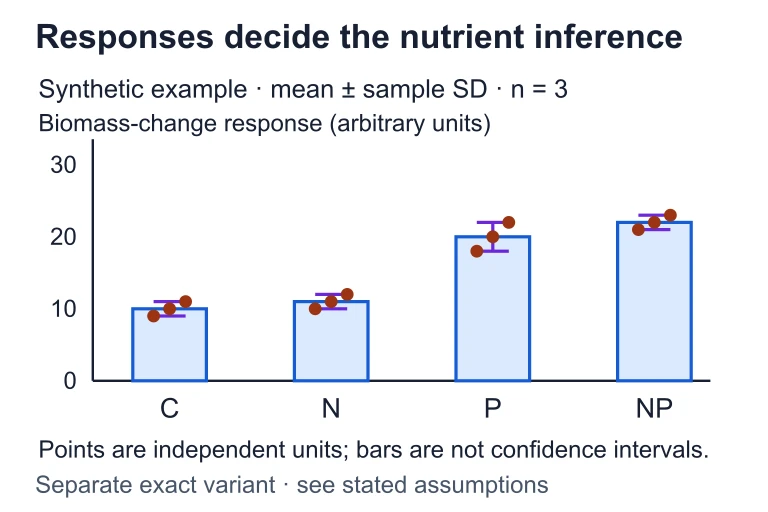 Compare treatment means and independent replicate responses to determine which nutrient addition changes biomass. Error bars show sample standard deviations for three independent units.
Elemental Composition of the Human Body
Why Carbon Is the Element of Life
The Four Biomolecules
Carbon's versatility gives rise to four categories of macromolecules essential to life. Each is built primarily from CHONPS elements.
Functional Groups and Chemical Behavior
The specific functional groups attached to carbon skeletons determine the chemical properties of organic molecules. Each group contains characteristic element combinations.
| Functional Group | Formula | Key Elements | Found In |
|---|---|---|---|
| Hydroxyl | \(-\text{OH}\) | O, H | Alcohols, sugars |
| Carboxyl | \(-\text{COOH}\) | C, O, H | Amino acids, fatty acids |
| Amino | \(-\text{NH}_2\) | N, H | Amino acids |
| Phosphate | \(-\text{PO}_4^{3-}\) | P, O | ATP, DNA |
| Sulfhydryl | \(-\text{SH}\) | S, H | Proteins (cysteine) |
Major vs Trace Elements
Elements essential to life fall into two categories based on the quantity required by organisms.
Water: The Universal Solvent
Water (\(\text{H}_2\text{O}\)) is composed of oxygen and hydrogen. Its polarity enables hydrogen bonding, which gives water its remarkable properties: high specific heat, cohesion, and solvent capability.
How Elements Build Biomolecules
Example: Elements in an Amino Acid
Example: Elements in ATP
Example: Elements in DNA
Ions and Cellular Function
Many essential elements function as ions (charged atoms) in biological systems. These ions are critical for nerve impulses, muscle contraction, and enzyme activity.
Common Mistakes
Summary: Elements and Their Roles
| Element | Symbol | % Body Mass | Key Biological Role |
|---|---|---|---|
| Oxygen | O | 65% | Water, respiration |
| Carbon | C | 18.5% | Organic molecule backbone |
| Hydrogen | H | 9.5% | Water, organic molecules, pH |
| Nitrogen | N | 3.2% | Amino acids, nucleic acids |
| Phosphorus | P | 1.0% | ATP, DNA/RNA backbone |
| Sulfur | S | 0.3% | Protein structure (disulfide bonds) |
Question 1 of 5
Which six elements make up approximately 99% of the mass of living organisms?
Question 2 of 5
What property of carbon makes it uniquely suited to form the backbone of biological molecules?
Question 3 of 5
A student claims that trace elements are not essential because they make up less than 0.01% of body mass. Which example best refutes this claim?
Question 4 of 5
Which element is found in nucleic acids and ATP but is not found in carbohydrates or most lipids?
Question 5 of 5
During dehydration synthesis, monomers are linked together. What is released as a byproduct of this reaction?