Effect of Density
on Populations
Explore how population density shapes growth rates, competition, and survival through density-dependent and density-independent factors.
What Is Population Density?
Population density measures the number of individuals per unit area or volume. It is one of the most fundamental descriptors of any population and directly influences how organisms interact with each other and their environment.
As density changes, so do the rates of birth, death, immigration, and emigration: the four processes that determine population size over time.
Why Density Matters
Exponential vs. Logistic Growth
The Logistic Model in Detail
Density-Dependent Factors
Density-dependent factors are biotic influences whose impact scales with population density. As a population becomes more crowded, these pressures intensify.
The forest becomes a randomized experiment
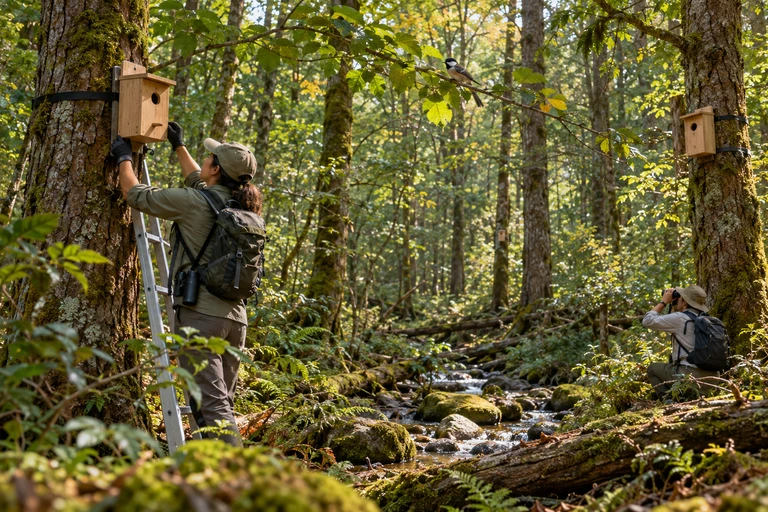 Independent forest plots are the treatment replicates in a nest-box experiment. Record reproductive output as well as occupancy, because immigration can increase occupancy without increasing reproduction.
Nest boxes: plots are the replicates
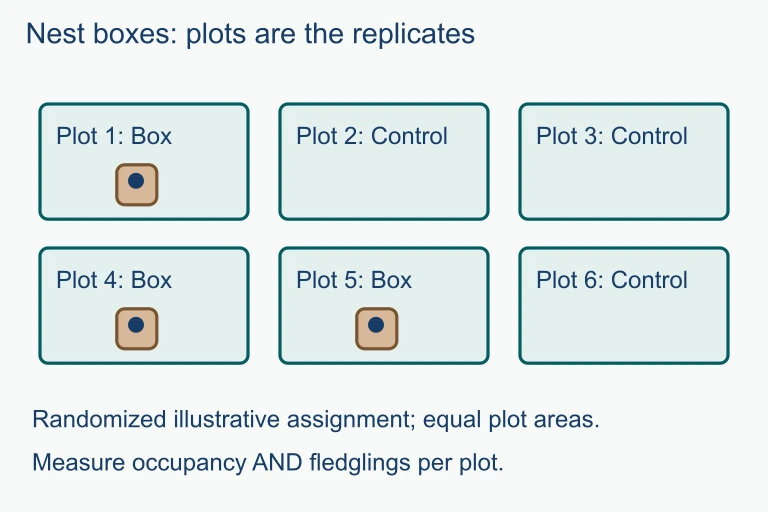 Independent forest plots are the treatment replicates in a nest-box experiment. Record reproductive output as well as occupancy, because immigration can increase occupancy without increasing reproduction.
Density-Independent Factors
Density-independent factors are abiotic events that affect population size regardless of how many individuals are present. Their severity does not change with density.
Dependent vs. Independent: Key Distinction
| Density-Dependent | Density-Independent | |
|---|---|---|
| Nature | Biotic | Abiotic |
| Effect scales with N? | Yes | No |
| Examples | Competition, disease, predation | Storms, fire, drought |
| Growth model link | Logistic (\( \frac{K-N}{K} \) term) | Can reset \( N \) suddenly |
| Acts as feedback? | Yes: negative feedback | No: random perturbation |
Carrying Capacity: \( K \)
Carrying capacity (\( K \)) is the maximum population size that an environment can sustain indefinitely. Populations may temporarily overshoot \( K \), then oscillate before stabilizing.
Per Capita Growth Rate and Density
How to Analyze Density Effects
Example 1: Deer Population
A deer population in a forest has \( r_{\max} = 0.5 \) per year and \( K = 1000 \). Currently \( N = 200 \).
Example 2: Near Carrying Capacity
Same deer population, but now \( N = 900 \). How does growth change?
Example 3: Maximum Growth Rate
At what population size does this deer herd grow fastest?
Common Mistakes
Summary at a Glance
| Concept | Detail |
|---|---|
| Exponential growth | \( \frac{dN}{dt} = r_{\max} N \): no density limit |
| Logistic growth | \( \frac{dN}{dt} = r_{\max} N \left(\frac{K-N}{K}\right) \) |
| Carrying capacity | \( K \): max sustainable \( N \) |
| Maximum \( \frac{dN}{dt} \) | Occurs at \( N = \frac{K}{2} \) |
| Density-dependent | Biotic; scales with \( N \) |
| Density-independent | Abiotic; unrelated to \( N \) |
Question 1 of 5
A population of rabbits experiences increased competition for burrow sites as the population grows. This is an example of a:
Question 2 of 5
In the logistic growth model, at what population size is \( \frac{dN}{dt} \) at its maximum?
Question 3 of 5
A volcanic eruption kills 40% of a lizard population regardless of the population's size. This is best classified as:
Question 4 of 5
A fish population has \( r_{\max} = 0.3 \), \( K = 2000 \), and current \( N = 1000 \). What is the population growth rate \( \frac{dN}{dt} \)?
Question 5 of 5
Which of the following statements about carrying capacity (\( K \)) is correct?