01 / 21

DNA
Replication

Explore the semiconservative mechanism by which cells copy their genetic information with remarkable speed and accuracy.

AP Biology

What Is DNA Replication?

DNA replication is the biological process by which a cell produces two identical copies of its DNA before cell division. Every time a cell divides, whether through mitosis or meiosis, the entire genome must be faithfully duplicated so each daughter cell receives a complete set of genetic instructions.

The Double Helix Structure

5' 3' 3' 5' Legend Strand 1 Strand 2 A-T pairs G-C pairs Antiparallel Strands run in opposite directions

Why Replication Matters

Growth
Multicellular organisms grow by producing new cells, each requiring a full copy of the genome.
Repair
Damaged or worn-out cells are replaced through division, which requires DNA to be copied first.
Reproduction
Sexual reproduction depends on meiosis, which begins with DNA replication to produce gametes.

The Semiconservative Model

Parent Daughter 1 Daughter 2 Original Original New

Key Enzymes in Replication

Helicase
Unwinds the double helix by breaking hydrogen bonds between base pairs at the replication fork.
Primase
Synthesizes a short RNA primer to provide a free \(3'\)-OH group for DNA polymerase to begin.
DNA Pol III
Primary enzyme that adds nucleotides in the \(5' \to 3'\) direction using the template strand.
DNA Pol I
Removes RNA primers and replaces them with DNA nucleotides.
Ligase
Seals nicks between Okazaki fragments on the lagging strand by forming phosphodiester bonds.
Topoisomerase
Relieves tension ahead of the replication fork by cutting and re-joining the DNA backbone.

The Replication Fork

Helicase Leading strand
(continuous, \(5'\to3'\))
Lagging strand (Okazaki fragments) RNA primers Topoisomerase (relieves tension) SSB proteins Fork movement
\(3' \to 5'\)
\(5' \to 3'\)

Leading vs Lagging Strand

Leading Strand Lagging Strand
Direction Toward the fork Away from the fork
Synthesis Continuous Discontinuous
Primers needed One Many (one per fragment)
Fragments None Okazaki fragments
Ligase needed? No Yes (to join fragments)
Speed Faster Slower

Origins of Replication

ORI ORI ORI Eukaryotic chromosome: multiple origins Bidirectional replication from each ORI ← Replication forks move both directions →
Prokaryotes
Single origin of replication on a circular chromosome. Replication is bidirectional and meets at a terminus.
Eukaryotes
Multiple origins on each linear chromosome. This allows the much larger genome to be copied within hours.

Step-by-Step Process

1
Initiation: Proteins recognize the origin of replication (ORI) and helicase unwinds the double helix, creating the replication fork.
2
Primer synthesis: Primase lays down a short RNA primer (~10 nucleotides) on each template strand to provide a \(3'\)-OH start point.
3
Elongation: DNA polymerase III adds complementary deoxyribonucleotides in the \(5' \to 3'\) direction on both the leading and lagging strands.
4
Primer replacement: DNA polymerase I removes RNA primers and fills the gaps with DNA.
5
Ligation: DNA ligase seals the nicks between Okazaki fragments on the lagging strand, creating a continuous backbone.

Proofreading and Error Repair

DNA polymerase has a built-in \(3' \to 5'\) exonuclease activity that acts as a proofreader. When an incorrect nucleotide is added, the enzyme reverses direction, removes the mismatch, and inserts the correct base.

Proofreading
DNA Pol III detects mismatches immediately after insertion and excises the wrong nucleotide.
Mismatch Repair
Post-replication enzymes scan for errors that escaped proofreading and correct them.
Nucleotide Excision
Repairs bulky lesions (e.g., thymine dimers from UV light) by cutting out a stretch of damaged DNA.

Telomeres and the End Problem

Generation 1 Generation 2 Generation 3 Senescence Coding DNA Telomeres (TTAGGG repeats) Telomerase Reverse transcriptase that extends telomeres using its own RNA template Active in: stem cells, germ cells, cancer cells

Example: Complementary Strand

Problem: A template strand has the sequence \(3'\text{-TACGGATCCA-}5'\). What is the sequence of the newly synthesized strand?

1
Identify base pairing rules: A pairs with T, G pairs with C.
2
Read the template \(3' \to 5'\) (this is the direction DNA polymerase reads): \(\text{T-A-C-G-G-A-T-C-C-A}\)
3
Write the complement \(5' \to 3'\) (direction of new strand synthesis): \(5'\text{-ATGCCTAGGT-}3'\)

Example: Okazaki Fragments

Problem: On which strand are Okazaki fragments produced, and why must ligase act on this strand but not the other?

1
Identify the lagging strand: Its template runs \(5' \to 3'\) toward the fork, so synthesis proceeds away from the fork.
2
Discontinuous synthesis: As the fork opens, new primers must be laid down repeatedly, creating short fragments (~1000-2000 nt in prokaryotes, ~100-200 nt in eukaryotes).
3
Ligase seals gaps: After DNA Pol I replaces primers with DNA, ligase forms phosphodiester bonds between adjacent fragments.
4
Leading strand is continuous: It only needs one primer and is synthesized in one unbroken piece: no gaps, no ligase needed.

Example: Meselson-Stahl Prediction

Problem: If bacteria grown in heavy nitrogen (\(^{15}\text{N}\)) are transferred to light nitrogen (\(^{14}\text{N}\)) medium, what DNA densities appear after two rounds of replication under the semiconservative model?

Gen 0 Heavy-Heavy Gen 1 Hybrid Hybrid Gen 2 Hybrid Light Hybrid Light
\(^{15}\text{N}\) (heavy)
\(^{14}\text{N}\) (light)
After 2 rounds: 50% hybrid, 50% light This result rules out conservative replication

Testing the semiconservative model

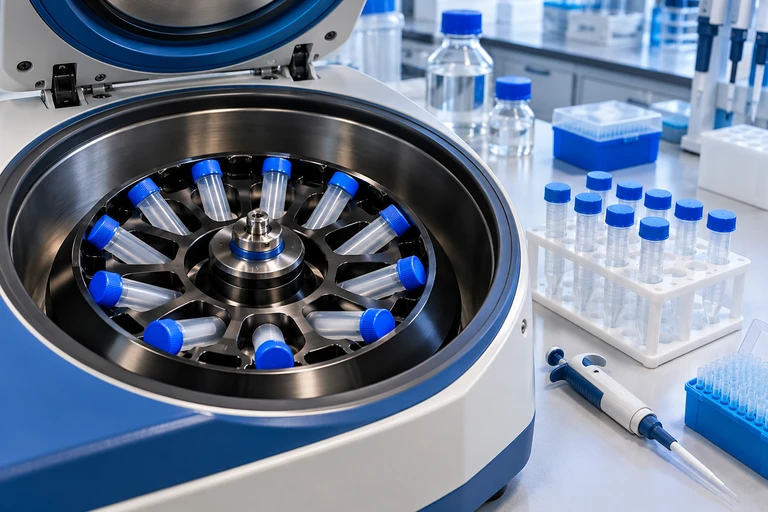
A laboratory scene shows a centrifuge and sample tubes beside molecular-research equipment.Density-gradient centrifugation separates extracted DNA by density, allowing nitrogen labeling to reveal the pattern of replication.

DNA densities across replication rounds
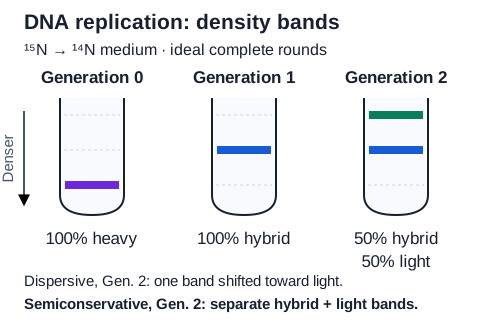
Three tubes show a lower heavy band in generation 0, one intermediate hybrid band in generation 1, and equal intermediate hybrid and upper light bands in generation 2. The downward arrow marks increasing density.After bacteria grown in ¹⁵N medium are transferred to ¹⁴N medium, one complete replication round gives all hybrid DNA. Two complete rounds give equal hybrid and light DNA bands, distinguishing semiconservative replication from the single shifted band predicted by dispersive replication.Open full diagram

Common Mistakes

✕ "DNA Pol builds both directions"
DNA polymerase only synthesizes \(5' \to 3'\). The illusion of \(3' \to 5'\) synthesis comes from the lagging strand's discontinuous Okazaki fragments.
✕ "Primase uses DNA"
Primase synthesizes short RNA primers, not DNA. These are later replaced by DNA Pol I.
✕ "Helicase breaks covalent bonds"
Helicase breaks hydrogen bonds between complementary bases. Topoisomerase handles the covalent backbone to relieve supercoiling.
✕ "Replication is conservative"
Meselson-Stahl proved it is semiconservative: each daughter helix keeps one old strand and one new strand.
✕ "Telomeres are junk DNA"
Telomeres are essential protective caps. Their shortening is linked to aging and cell senescence.

Question 1 of 5

Which enzyme is responsible for unwinding the double helix at the replication fork?

Question 2 of 5

Why is the lagging strand synthesized discontinuously as Okazaki fragments?

Question 3 of 5

In the Meselson-Stahl experiment, after one round of replication in \(^{14}\text{N}\) medium, what density of DNA was observed?

Question 4 of 5

If a template strand reads \(3'\text{-AATTGCCG-}5'\), what is the sequence of the newly synthesized complementary strand?

Question 5 of 5

Which of the following best explains why eukaryotic chromosomes have multiple origins of replication?