01 / 21

Disruptions in
Ecosystems

Explore how invasive species, human activities, and natural disasters alter the delicate balance of ecological communities and the flow of energy and matter.

AP Biology

What Is an Ecosystem Disruption?

An ecosystem disruption is any event that significantly alters the structure, composition, or function of an ecological community. These disruptions can shift population sizes, change species interactions, and redirect the flow of energy and matter through trophic levels.

Three Categories of Disruption

Natural Events
Wildfires, volcanic eruptions, hurricanes, droughts, and disease outbreaks that have occurred throughout Earth's history.
Human Activities
Habitat destruction, pollution, overexploitation of resources, and climate change driven by fossil fuel combustion.
Invasive Species
Non-native organisms introduced to new environments where they outcompete, prey upon, or parasitize native species.

How Disruptions Alter Energy Flow

Producers Primary Consumers Secondary Consumers Tertiary Consumers disruption
\( \sim 10\% \) of energy transfers between each trophic level

Removing or reducing a trophic level disrupts the transfer of energy up the food chain. Since only about 10% of energy passes from one level to the next, a disruption at lower levels has outsized effects on higher consumers.

The Keystone Species Concept

A keystone species is an organism whose impact on its community is disproportionately large relative to its abundance. Removing a keystone species triggers a trophic cascade: a chain reaction of population changes that ripples through the food web.

Herbivore Plant A Bird Keystone Insect Plant B Algae Remove the keystone, the whole arch collapses

Keystone predation and indirect effects
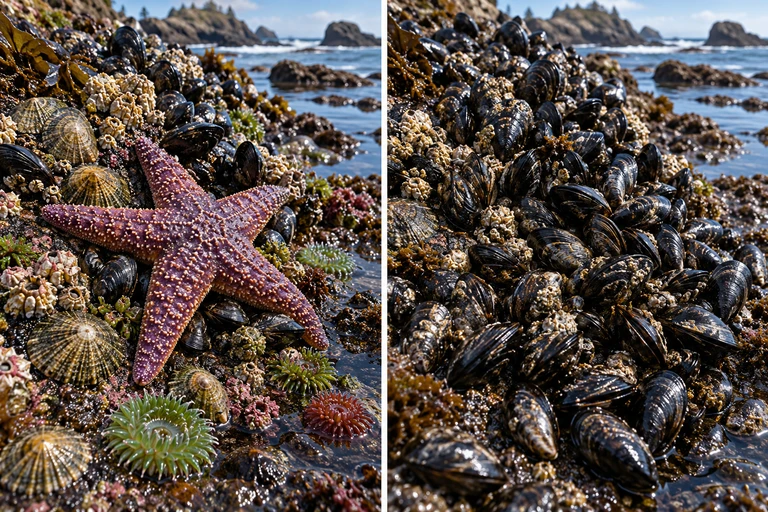
Foreground sea star has five arms; left rock contains several sessile forms while right is mussel dominated. Composition is a conceptual comparison, not historical data. Separate exact panel: Two negative causal links connect sea stars to mussels and mussels to other sessile taxa, yielding a positive indirect effect on other taxa.Sea-star predation can reduce mussel dominance and indirectly release other sessile species from competition. A removal experiment compares treated and control plots through time.

A predator can release competitors
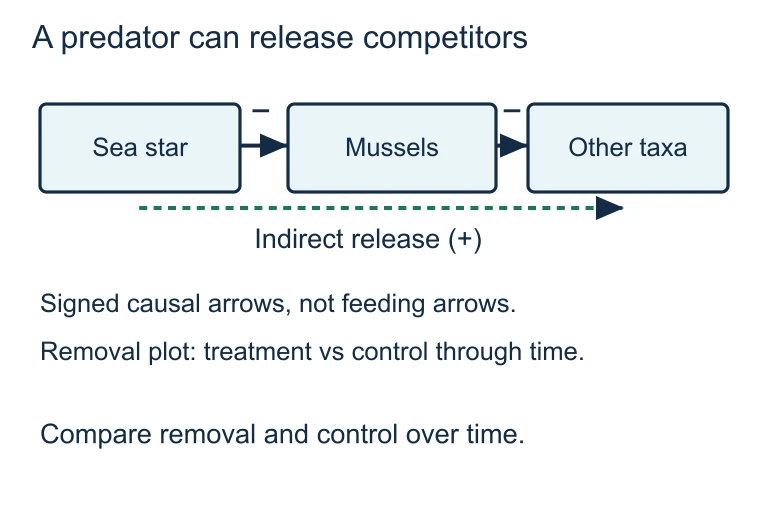
A predator can release competitors. Sea-star predation can reduce mussel dominance and indirectly release other sessile species from competition. A removal experiment compares treated and control plots through time.Sea-star predation can reduce mussel dominance and indirectly release other sessile species from competition. A removal experiment compares treated and control plots through time.

Trophic Cascades: Top-Down Effects

1
Top predator removed: Wolves eliminated from Yellowstone in the 1920s.
2
Mesopredator / herbivore boom: Elk populations surged without predation pressure.
3
Vegetation decline: Overgrazing destroyed willow and aspen along riverbanks.
4
Physical habitat change: Riverbanks eroded, stream channels widened, and beaver habitat was lost.

Top-Down vs Bottom-Up Control

Top-Down Bottom-Up
Driving force Predators regulate prey Nutrient/energy availability
Direction of effect Higher to lower trophic levels Lower to higher trophic levels
Classic example Wolf-elk-willow Fertilizer runoff algal bloom
Disruption trigger Predator removal/addition Nutrient spike or depletion
Population pattern Alternating trophic levels affected All levels affected in same direction

Invasive Species: Mechanisms of Disruption

Competition
Invasive species outcompete natives for food, light, or space (e.g., kudzu vine smothering native plants).
Predation
Native prey lack evolved defenses (e.g., brown tree snake decimating Guam's bird species).
Disease
Invasives introduce novel pathogens (e.g., chytrid fungus devastating global amphibians).

Bioaccumulation & Biomagnification

Top Predator Secondary Consumers Primary Consumers Producers 25 ppm 5 ppm 0.5 ppm 0.01 ppm Toxin concentration increases

Bioaccumulation: toxins build up within a single organism over time. Biomagnification: toxin concentration increases at each successive trophic level. Top predators suffer the most (e.g., DDT thinning raptor eggshells).

Eutrophication: A Bottom-Up Disruption

1
Excess nutrients (nitrogen, phosphorus) enter a water body from agricultural runoff or sewage.
2
Algal bloom: massive growth of photosynthetic algae on the surface blocks light to submerged plants.
3
Decomposer boom: dead algae sink and are consumed by aerobic bacteria, depleting dissolved oxygen.
4
Dead zone: hypoxic conditions kill fish, invertebrates, and other aerobic organisms, collapsing the food web.

Eutrophication causes hypoxia through respiration
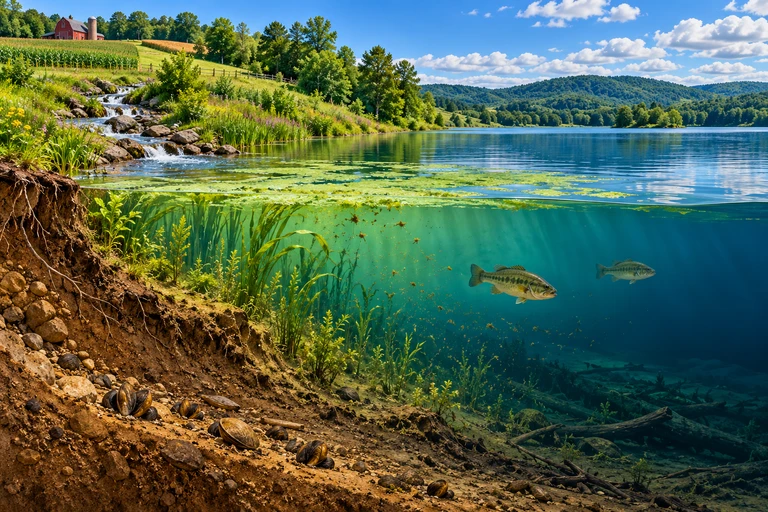
A farm stream enters a cutaway lake with a partial green surface bloom, settling brown flecks, living fish in upper water and mussels near the bottom.Nutrient enrichment can increase algal production. Sinking organic matter fuels aerobic decomposer respiration, which consumes dissolved oxygen; restricted mixing can worsen bottom-water hypoxia.

Respiration links a bloom to low O₂
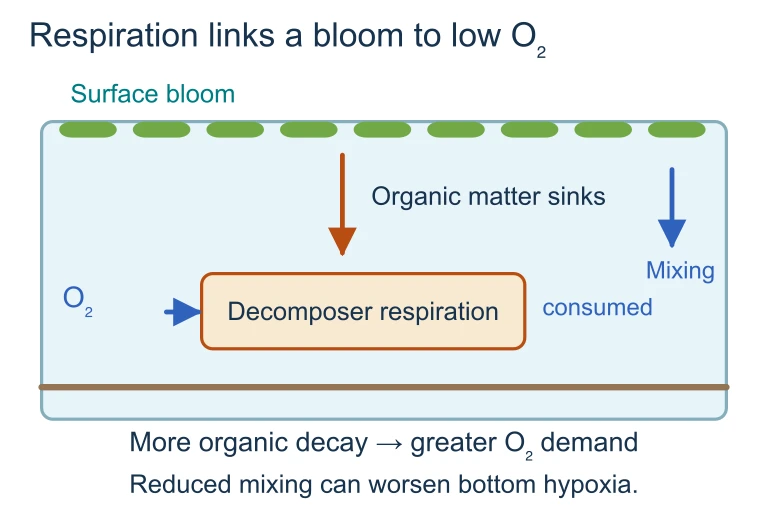
Respiration links a bloom to low O₂. Nutrient enrichment can increase algal production. Sinking organic matter fuels aerobic decomposer respiration, which consumes dissolved oxygen; restricted mixing can worsen bottom-water hypoxia.Nutrient enrichment can increase algal production. Sinking organic matter fuels aerobic decomposer respiration, which consumes dissolved oxygen; restricted mixing can worsen bottom-water hypoxia.
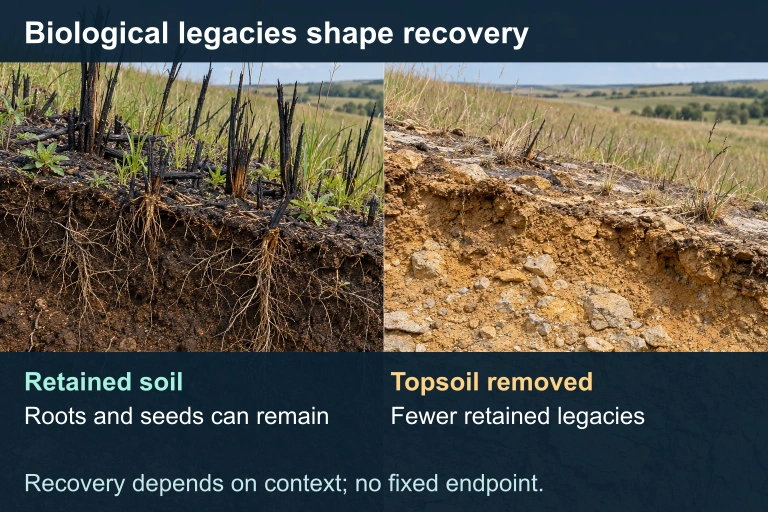
Recovery through Ecological Succession

Time Disturbance Bare rock / cleared land Pioneer Lichens, mosses, grasses Intermediate Shrubs, fast- growing trees Climax Stable, diverse community Biodiversity

After a disruption, ecosystems recover through succession: pioneer species colonize, build soil, and gradually give way to more complex communities. Primary succession starts from bare substrate; secondary succession follows disturbance to an existing community.

Retained soil can preserve roots and a seed bank; removed topsoil leaves fewer biological legacies. Recovery depends on context. The contextual image is illustrative.
Retained soil can preserve roots and a seed bank; removed topsoil leaves fewer biological legacies. Recovery depends on context.

How to Analyze Any Ecosystem Disruption

1
Identify the disruption: What changed? Is it biotic (invasive species, disease) or abiotic (fire, pollution, climate)?
2
Locate it in the food web: Which trophic level or species is directly affected?
3
Trace the cascade: Follow the effects up (top-down) or down (bottom-up) the trophic levels.
4
Predict population changes: Use arrows: predator removed = prey increases = prey's food decreases.
5
Consider feedback loops: Does the system self-correct (negative feedback) or amplify (positive feedback)?

Example 1: Sea Otter Removal

Sea Otters Removed Sea Urchins ↑↑ Kelp Forests ↓↓

Example 2: Fertilizer Runoff & Dead Zones

Fertilizer Runoff Algal Bloom Decomposer Bloom Oxygen Depletion (Dead Zone)
Dissolved \( \text{O}_2 \)
Time Hypoxic threshold

A lake can stay turbid after the initial disturbance ends
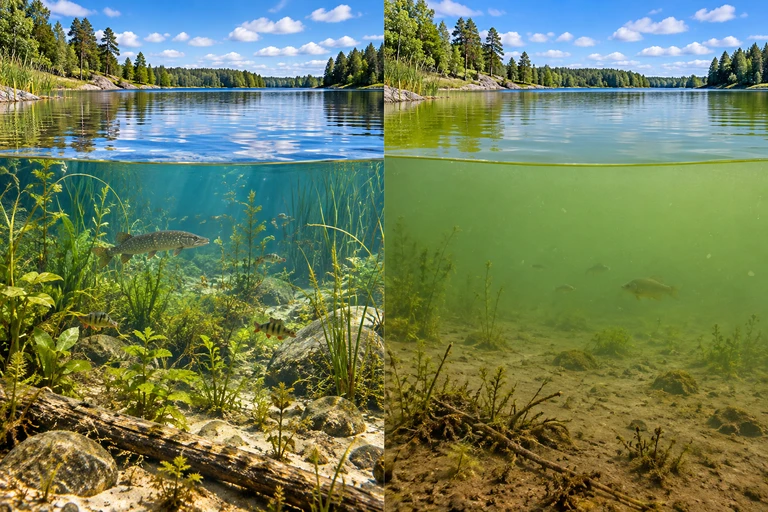
Matched shallow basins show submerged vegetation in clearer water versus sparse vegetation and suspended material in turbid water. Scene alone does not establish persistence or alternative attractors. Separate exact panel: A signed feedback loop links submerged plants negatively to sediment resuspension, resuspension positively to turbidity and turbidity negatively to plants.Submerged plants reduce sediment resuspension; resuspension raises turbidity, and turbidity suppresses plant growth. This reinforcing loop can maintain a turbid shallow lake; evidence of hysteresis requires more than persistence alone.

A reinforcing shallow-lake loop
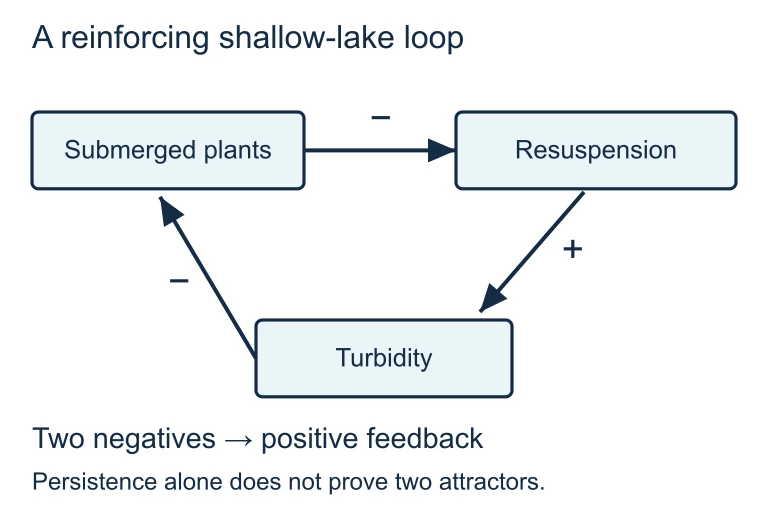
A reinforcing shallow-lake loop. Submerged plants reduce sediment resuspension; resuspension raises turbidity, and turbidity suppresses plant growth. This reinforcing loop can maintain a turbid shallow lake; evidence of hysteresis requires more than persistence alone.Submerged plants reduce sediment resuspension; resuspension raises turbidity, and turbidity suppresses plant growth. This reinforcing loop can maintain a turbid shallow lake; evidence of hysteresis requires more than persistence alone.

Example 3: Invasive Cane Toads in Australia

In 1935, cane toads (Rhinella marina) were introduced to Australia to control sugarcane beetles. Instead, they spread rapidly across the continent, disrupting native food webs in multiple ways:

Toxic Defense
Native predators (quolls, snakes, goannas) die after eating toxic toads. Predator populations crash.
Competition
Cane toads outcompete native frogs for food and breeding sites, reducing native amphibian diversity.
Prey Depletion
Voracious appetites reduce insect populations, affecting insectivorous birds and lizards.

Common Mistakes on the AP Exam

✕ Confusing Cascade Direction
Saying predator removal causes a "bottom-up cascade." Predator removal = top-down. Nutrient changes = bottom-up.
✕ Mixing Up Accumulation Terms
Bioaccumulation is within one organism; biomagnification is across trophic levels. They are not interchangeable.
✕ Ignoring Indirect Effects
Only tracing one step in a food web. AP questions expect you to follow the chain through multiple trophic levels.

Question 1 of 5

In Yellowstone, the reintroduction of wolves led to a decrease in elk populations, which allowed streamside vegetation to recover. This is an example of:

Question 2 of 5

A pesticide is applied to a lake ecosystem. Which organism would be expected to have the highest concentration of the pesticide in its tissues?

Question 3 of 5

Excess nitrogen from agricultural runoff enters a lake. Which sequence of events most accurately describes the resulting disruption?

Question 4 of 5

A non-native plant is introduced to an island ecosystem. It grows rapidly, produces allelopathic chemicals that inhibit native plant growth, and has no natural herbivores on the island. This species is best described as:

Question 5 of 5

After a wildfire destroys a grassland, the first organisms to recolonize the area are mosses and grasses. Over decades, shrubs and then trees establish. This process is called: