Continuing
Evolution
Explore how natural selection, genetic drift, and other mechanisms continue to shape populations today: evolution is not a thing of the past.
What Is Continuing Evolution?
Evolution is not a historical event that stopped millions of years ago. Populations are still evolving right now. Any time allele frequencies in a population change over generations, evolution is occurring. This includes changes driven by natural selection, mutation, gene flow, genetic drift, and sexual selection.
Evidence of Ongoing Evolution
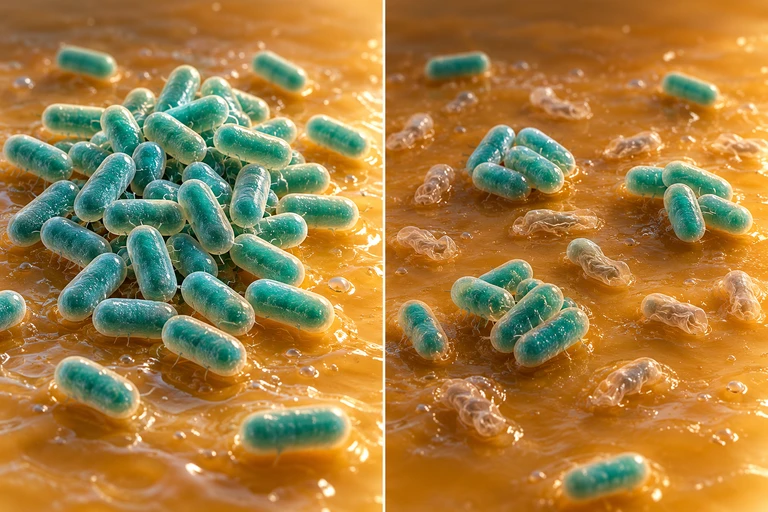
A bacterial colony before and after selective pressure
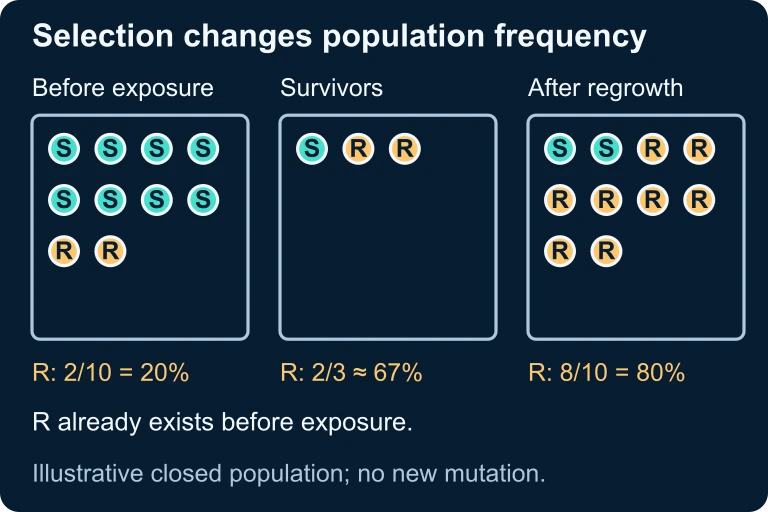
In a closed population with pre-existing resistance, differential survival and reproduction raise the resistant fraction from 20% before exposure to about 67% among survivors and 80% after regrowth.Selection changes population frequency
In a closed population with pre-existing resistance, differential survival and reproduction raise the resistant fraction from 20% before exposure to about 67% among survivors and 80% after regrowth.Mechanisms Driving Evolution Today
The Hardy-Weinberg Null Model
The Hardy-Weinberg principle describes a population that is not evolving. It serves as a null hypothesis: if observed allele frequencies deviate from predictions, at least one evolutionary mechanism is at work.
Visualizing Allele Frequency Shifts
Selection vs Drift: Key Distinction
| Natural Selection | Genetic Drift | |
|---|---|---|
| Mechanism | Differential survival and reproduction | Random sampling of alleles |
| Direction | Predictable: favors adaptive alleles | Random: no consistent direction |
| Effect of pop. size | Acts in populations of any size | Strongest in small populations |
| Leads to adaptation? | Yes: increases fitness | No: can fix harmful alleles |
| Example | Antibiotic-resistant bacteria | Bottleneck in cheetahs |
Why Continuing Evolution Matters
How to Detect Ongoing Evolution
Explain why preserved ancestors and replicated lineages strengthen inference.
A revived frozen ancestor and derived population are compared in a matched competition assay after acclimation. No fitness result is assumed.
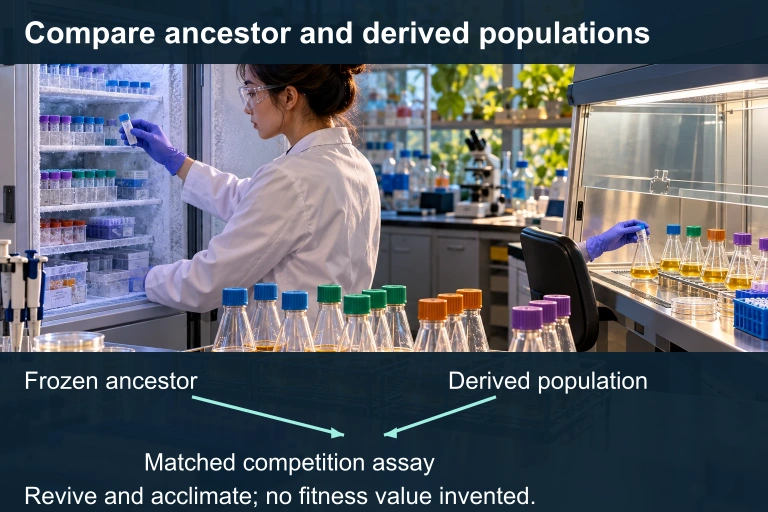
Frozen ancestors and twelve parallel futures

Frozen archives allow ancestral and descendant samples to be revived and compared in a common environment. Twelve independently maintained lineages provide replication while retaining the possibility of different evolutionary outcomes.Frozen archives support replicated comparisons
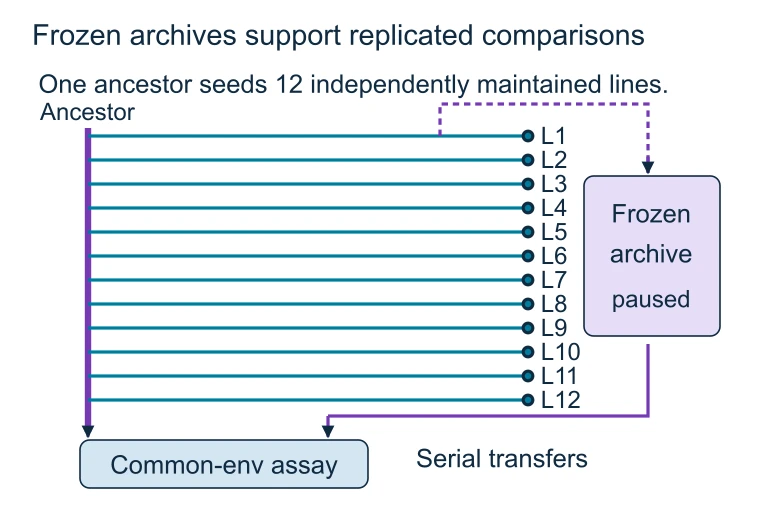
Frozen archives allow ancestral and descendant samples to be revived and compared in a common environment. Twelve independently maintained lineages provide replication while retaining the possibility of different evolutionary outcomes.Example: Antibiotic Resistance
A hospital tracks Staphylococcus aureus infections. In 2010, 5% of isolates were methicillin-resistant (MRSA). By 2020, 40% were resistant. Is this evolution?
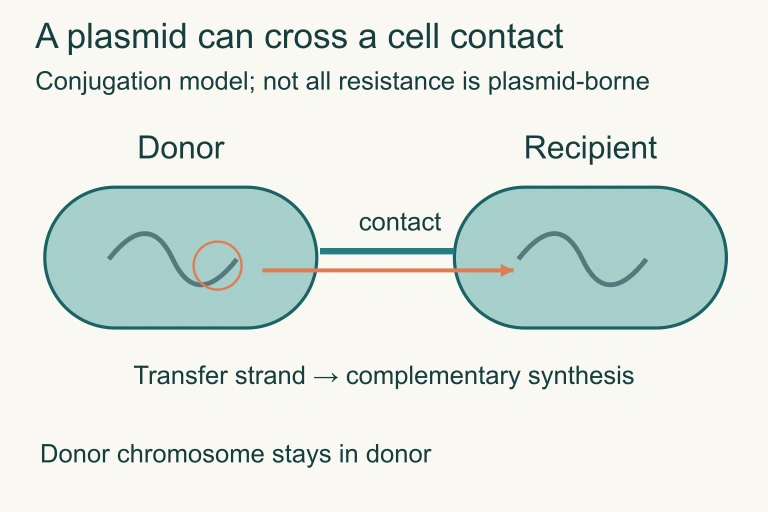
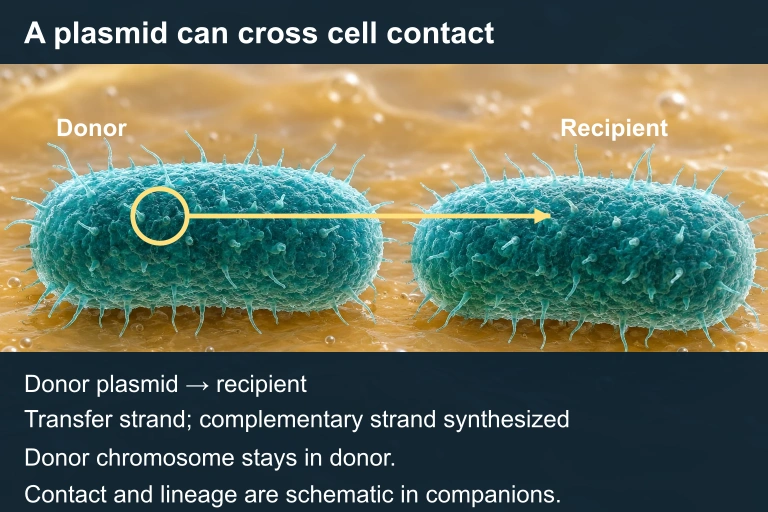
Distinguish horizontal acquisition from differential reproduction.
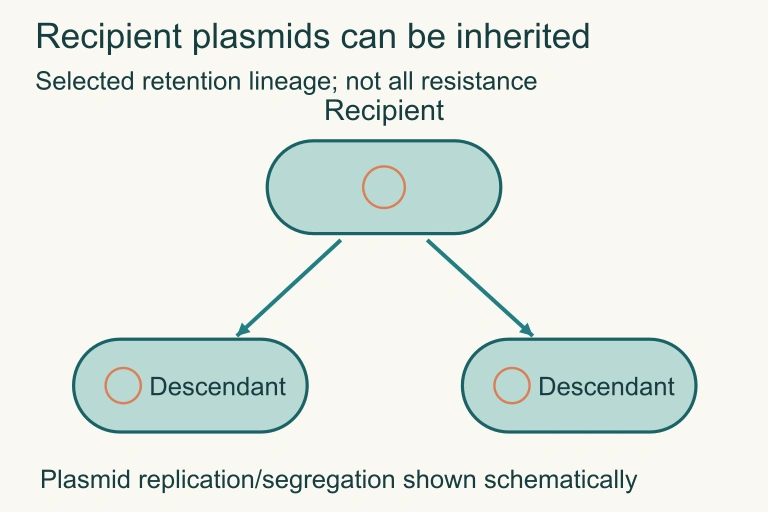
A plasmid transfer strand can pass through contact, followed by complementary strand synthesis. The donor chromosome stays in the donor; retention in descendants is a selected possibility.
Example: Bottleneck Effect
Example: Hardy-Weinberg Test
In a population of 500 wildflowers, flower color is controlled by one gene with two alleles. 320 are red (\(AA\) or \(Aa\)) and 180 are white (\(aa\)). Is the population in Hardy-Weinberg equilibrium?
Types of Natural Selection
Gene Flow and the Founder Effect
Common Mistakes
Summary of Evolutionary Mechanisms
| Mechanism | Effect on Allele Freq. | Random or Directed? |
|---|---|---|
| Natural Selection | Shifts toward adaptive alleles | Directed |
| Genetic Drift | Random fluctuation; fixation or loss | Random |
| Mutation | Introduces new alleles | Random |
| Gene Flow | Homogenizes populations | Directed (by migration) |
| Sexual Selection | Shifts toward preferred traits | Directed |
Question 1 of 5
A population of beetles shows a change in the frequency of a shell-color allele over 10 generations. Which statement best describes this observation?
Question 2 of 5
Which of the following is NOT a condition required for Hardy-Weinberg equilibrium?
Question 3 of 5
In a population, \( q^2 = 0.09 \). Assuming Hardy-Weinberg equilibrium, what is the frequency of heterozygous individuals (\( 2pq \))?
Question 4 of 5
A hurricane drastically reduces a large lizard population to just 12 individuals. The surviving group has different allele frequencies than the original population. This is an example of:
Question 5 of 5
Bacteria exposed to an antibiotic develop resistance over several generations. Which statement correctly explains this?