01 / 22

Community
Ecology

Explore how species interactions, biodiversity, and ecological dynamics shape the living communities around us.

AP Biology

What Is a Community?

A biological community consists of all the populations of different species that live and interact in a particular area at the same time. Unlike a population (one species), a community encompasses the full web of interspecific relationships.

Population
All individuals of one species in a given area
Community
All populations of different species interacting in a given area
Ecosystem
Community plus the abiotic factors (energy, nutrients, climate)

Types of Species Interactions

Community ecology centers on how species affect one another. These interactions can be positive (+), negative (−), or neutral (0) for each species involved.

Competition
\(−/−\)
Predation
\(+/-\)
Mutualism
\(+/+\)
Commensalism
\(+/0\)
Parasitism
\(+/-\)
Amensalism
\(-/0\)
\(+\) = benefits   \(−\) = harmed   \(0\) = unaffected
Species A / Species B

Why Community Ecology Matters

Understanding community interactions helps biologists predict how ecosystems respond to disturbances such as invasive species, habitat loss, or climate change. These principles are fundamental to conservation biology and ecosystem management.

The Competitive Exclusion Principle

Gause's Competitive Exclusion Principle states that two species competing for the exact same limiting resource cannot stably coexist: one will outcompete and eliminate the other.

Time Population Species A Species B Same Niche: Competitive Exclusion

Niche and Resource Partitioning

Fundamental Niche
The full range of conditions and resources a species could use in the absence of competition
Realized Niche
The portion of the fundamental niche a species actually occupies due to competition and other interactions

Resource partitioning and realized niches
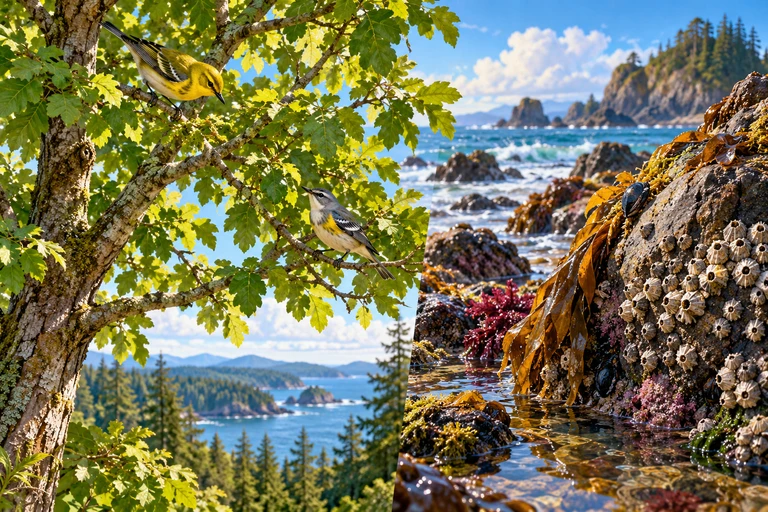
Two foraging birds in different portions of a tree, beside a separate rocky barnacle shore.Resource partitioning reduces overlap in resource use. A separate competitor-removal comparison tests whether competition limits a species’ realized distribution on the shore.

Partitioning can reduce resource overlap
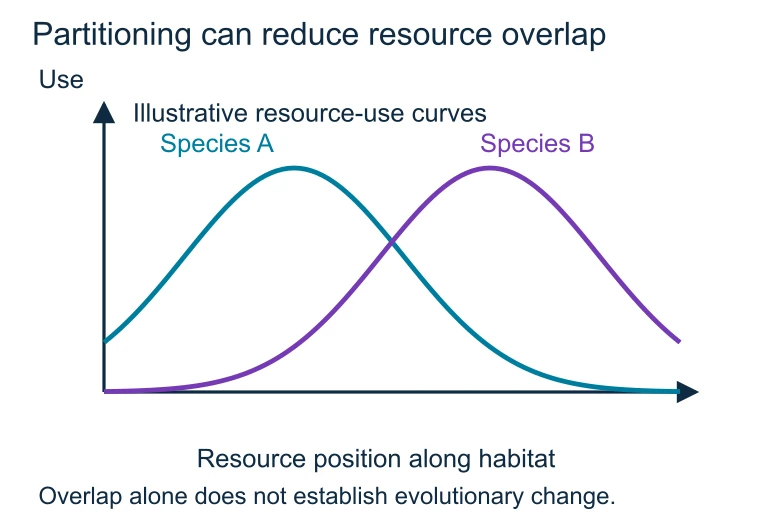
Partitioning can reduce resource overlap. Resource partitioning reduces overlap in resource use. A separate competitor-removal comparison tests whether competition limits a species’ realized distribution on the shore.Resource partitioning reduces overlap in resource use. A separate competitor-removal comparison tests whether competition limits a species’ realized distribution on the shore.

A removal experiment tests a niche limit
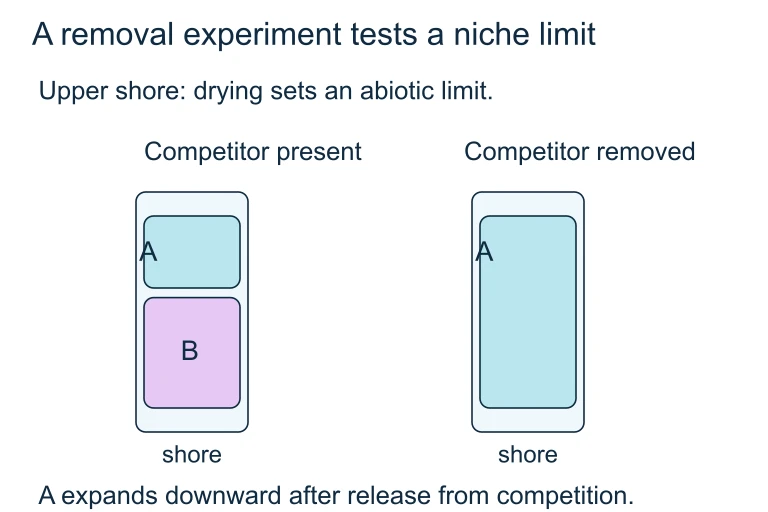
A removal experiment tests a niche limit. Removing a competitor allows a shore species to expand downward while its upper drying limit persists, distinguishing biotic and abiotic limits.Removing a competitor allows a shore species to expand downward while its upper drying limit persists, distinguishing biotic and abiotic limits.

Trophic Cascades and Predation

A trophic cascade occurs when predators suppress herbivore populations, indirectly benefiting primary producers. This top-down control can reshape entire communities.

Top Predator suppresses Herbivore releases Primary Producer Top-down control: predators indirectly increase plant biomass

Keystone Species

A keystone species has a disproportionately large effect on community structure relative to its abundance. Removing a keystone species triggers dramatic changes throughout the community.

Sea Otters
Control sea urchin populations, preventing urchins from overgrazing kelp forests
Wolves (Yellowstone)
Suppress elk grazing, allowing willow and aspen to regenerate along rivers
Sea Stars
Paine's classic study: removing Pisaster caused mussels to dominate and biodiversity collapsed

Keystone predation and indirect effects
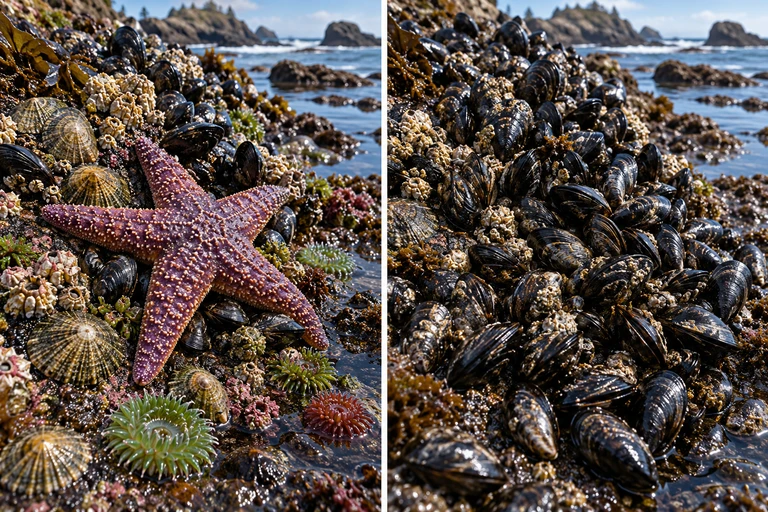
Foreground sea star has five arms; left rock contains several sessile forms while right is mussel dominated. Composition is a conceptual comparison, not historical data. Separate exact panel: Two negative causal links connect sea stars to mussels and mussels to other sessile taxa, yielding a positive indirect effect on other taxa.Sea-star predation can reduce mussel dominance and indirectly release other sessile species from competition. A removal experiment compares treated and control plots through time.

A predator can release competitors
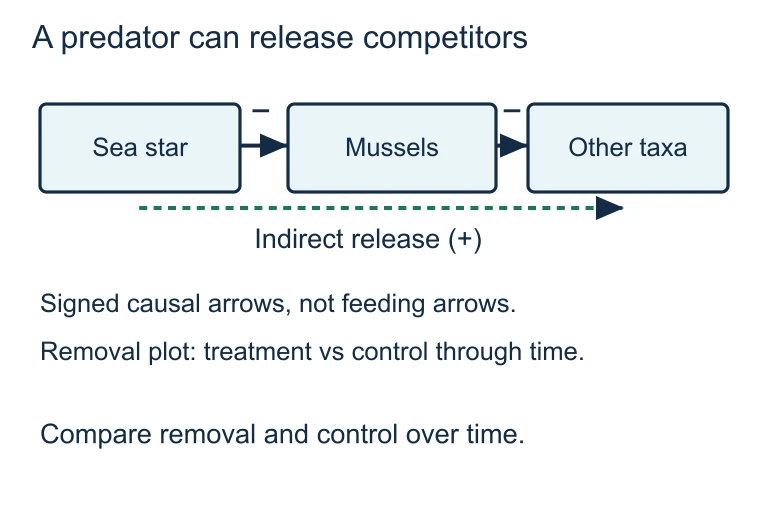
A predator can release competitors. Sea-star predation can reduce mussel dominance and indirectly release other sessile species from competition. A removal experiment compares treated and control plots through time.Sea-star predation can reduce mussel dominance and indirectly release other sessile species from competition. A removal experiment compares treated and control plots through time.

Mutualism vs Commensalism vs Parasitism

Mutualism Commensalism Parasitism
Effect \(+/+\) \(+/0\) \(+/-\)
Example Bee and flower Barnacle on whale Tick on deer
Host harmed? No No Yes
Obligate? Often yes Rarely Often yes
Coevolution Strong Weak Strong

Explain why both partners can benefit through different transferred resources.

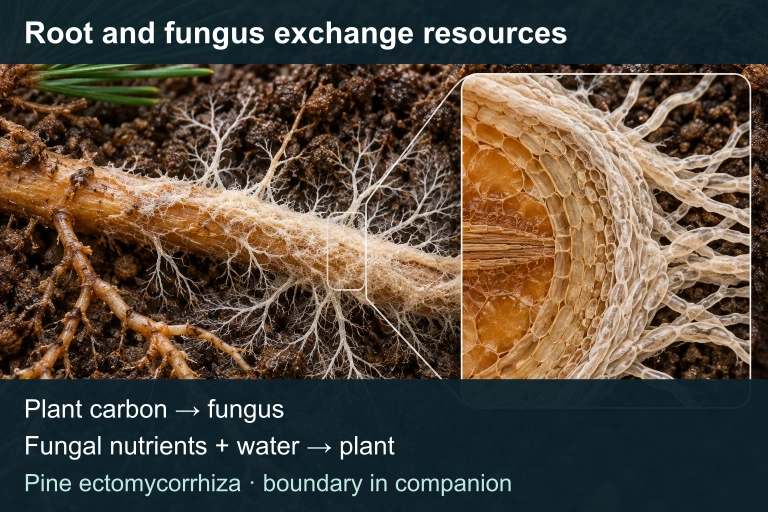
In a generic pine ectomycorrhiza, fungal hyphae surround the root and extend between outer root cells. Plant carbon moves toward the fungus while nutrients and water can move toward the plant; benefits depend on conditions.
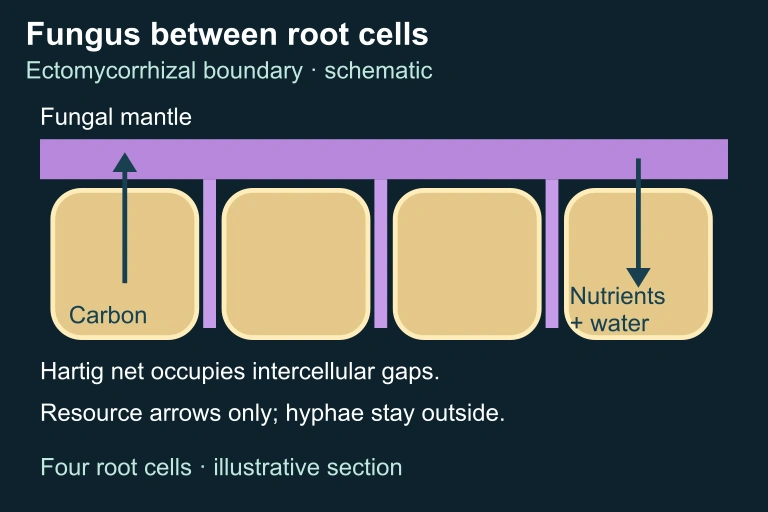
Ectomycorrhizal boundary
Root and fungal threads illustrate pine ectomycorrhiza. Plant carbon moves to the fungus and nutrients and water move to the plant. A companion depicts four root cells and a Hartig net in intercellular gaps.
In a generic pine ectomycorrhiza, fungal hyphae surround the root and extend between outer root cells. Plant carbon moves toward the fungus while nutrients and water can move toward the plant; benefits depend on conditions.

Ecological Succession

Ecological succession is the gradual process by which community composition changes over time. There are two main types:

Primary Succession
Begins on bare substrate with no soil (e.g., after a volcanic eruption or glacial retreat). Pioneer species like lichens colonize first.
Secondary Succession
Begins in an area where soil remains after a disturbance (e.g., after a fire or farm abandonment). Recovery is faster.

Succession depends on soil and biological legacies
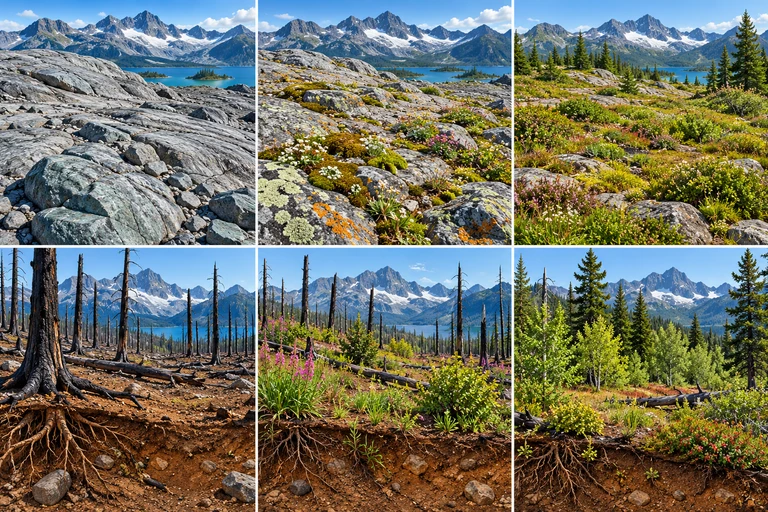
Two rows compare bare glacial rock becoming vegetated with burned woodland recovering above visible retained soil and roots; later patches contain mixed open vegetation and trees.Primary succession begins without developed soil; secondary succession retains soil and biological legacies. Climate, dispersal and later disturbance influence recovery and the communities that develop.

The starting substrate matters
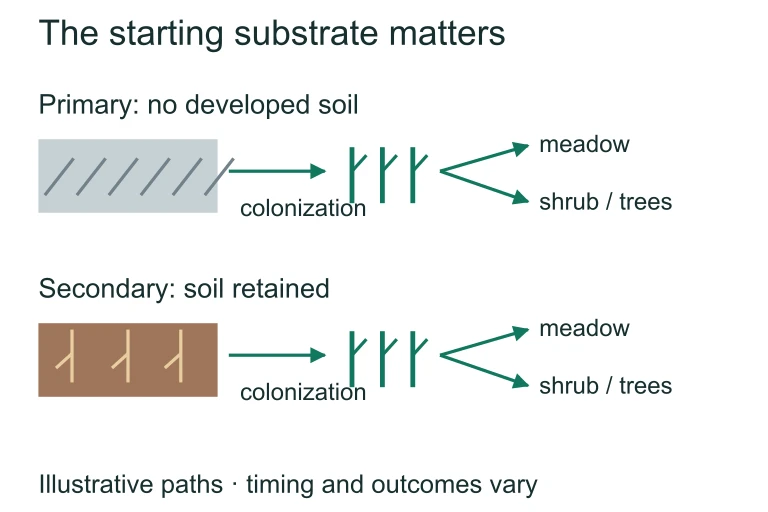
The starting substrate matters. Primary succession begins without developed soil; secondary succession retains soil and biological legacies. Climate, dispersal and later disturbance influence recovery and the communities that develop.Primary succession begins without developed soil; secondary succession retains soil and biological legacies. Climate, dispersal and later disturbance influence recovery and the communities that develop.

Stages of Secondary Succession

Time Disturbed Bare soil remains Pioneer Grasses, herbs, weeds Intermediate Shrubs, small trees, shade- intolerant spp. Climax Mature forest, high biodiversity, shade-tolerant species dominate Biodiversity

How to Analyze Community Interactions

1
Identify the species involved. List every species in the scenario and their roles (producer, herbivore, predator, decomposer).
2
Classify each interaction. For every pair, determine if each species is helped (+), harmed (−), or unaffected (0).
3
Trace indirect effects. Follow chains: if a predator is removed, what happens to its prey, and then to that prey's food source?
4
Consider density dependence. Effects often depend on population sizes. Competitive exclusion strengthens as populations grow toward carrying capacity.
5
Predict the outcome. State which populations increase, decrease, or remain stable. Support with named principles (Gause, trophic cascade).

Example: Food Web Analysis

Hawk Snake Frog Mouse Insects Plants

Example: Species Diversity Index

Ecologists measure community diversity using the Shannon Diversity Index:

Example: A community has 3 species with proportions 0.5, 0.3, and 0.2.

Example: Predator-Prey Cycles

The Lotka-Volterra model describes oscillating populations of predators and prey. When prey are abundant, predator populations grow; as predators increase, prey decline, causing predator decline in turn.

Time Population Prey Predator

Common Mistakes in Community Ecology

✕ Confusing Parasitism with Predation
Parasites typically do not kill the host immediately: they feed on it over time. Predators consume and kill prey outright. Both are \(+/-\), but differ in mechanism.
✕ Ignoring Indirect Effects
Students often predict only direct effects (removing a predator helps prey) and miss the cascade: increased prey then depletes producers.
✕ Primary vs Secondary Succession
Primary succession starts with no soil (volcanic rock, glacial retreat). Secondary starts with soil intact. Students often reverse these or forget the soil distinction.

Summary of Key Concepts

Concept Definition Key Example
Competitive Exclusion Two species sharing one niche cannot coexist Gause's Paramecium
Resource Partitioning Species divide resources to reduce competition Warblers foraging at different tree heights
Keystone Species Disproportionate community effect relative to abundance Sea stars, wolves, beavers
Trophic Cascade Predators indirectly affect lower trophic levels Wolves: elk: willows
Ecological Succession Gradual community change over time Forest regrowth after fire
Shannon Index Quantifies species diversity (richness + evenness) \( H' = -\sum p_i \ln p_i \)

Question 1 of 5

Two species of finches live on the same island and eat the same size seeds. According to the competitive exclusion principle, what is the most likely long-term outcome?

Question 2 of 5

In a kelp forest ecosystem, sea otters prey on sea urchins, which graze on kelp. If the sea otter population declines, what is the expected effect on the kelp?

Question 3 of 5

A bird species nests in tree cavities without affecting the tree. The bird benefits from shelter, but the tree is neither helped nor harmed. This interaction is best described as:

Question 4 of 5

A volcanic eruption covers an island in lava, destroying all soil and organisms. The recolonization process that follows is called:

Question 5 of 5

A community contains 2 species. Species A has 90 individuals and Species B has 10 individuals (100 total). A second community also has 2 species but with 50 individuals each. Which community has higher Shannon diversity \( H' \)?