Common
Ancestry
Explore the evidence for universal common ancestry, how phylogenetic trees map evolutionary relationships, and why shared traits reveal the deep history of life on Earth.
What Is Common Ancestry?
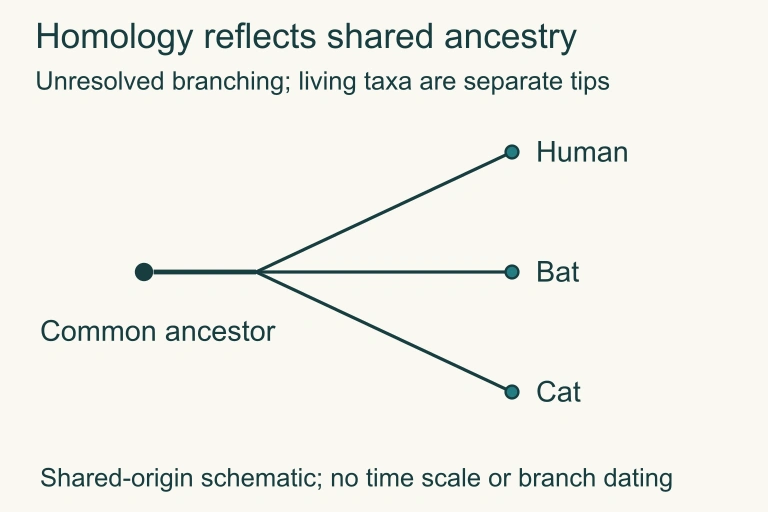
Common ancestry is the idea that all living organisms descended from a shared ancestor through a branching process of evolution. Over billions of years, populations diverged, accumulated genetic changes, and gave rise to the vast diversity of life we see today.
Lines of Evidence
Concordance of fossil, anatomy and molecular evidence
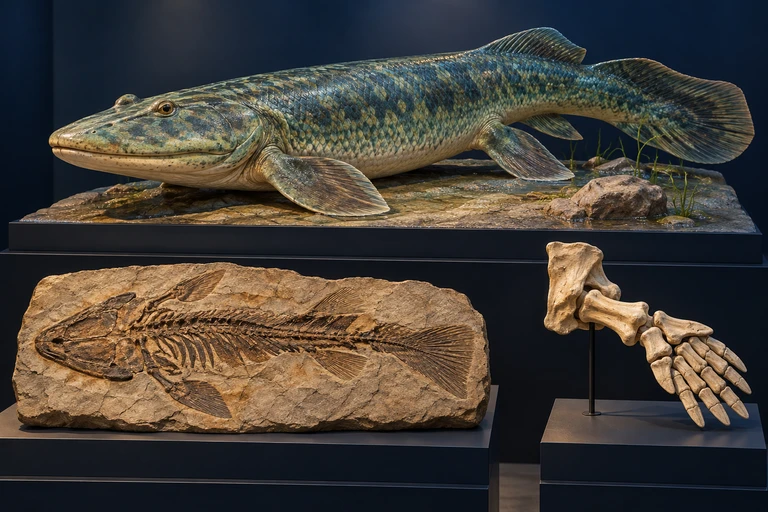
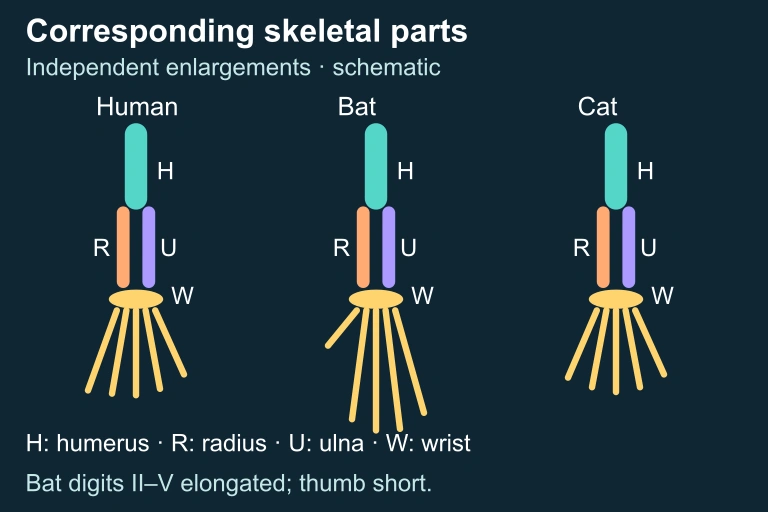
Compare fossils, corresponding anatomical structures and molecular sequences with a branching hypothesis. Tiktaalik is a transitional relative, without requiring it to be a direct ancestor of a particular living lineage.Evidence should fit a branching history
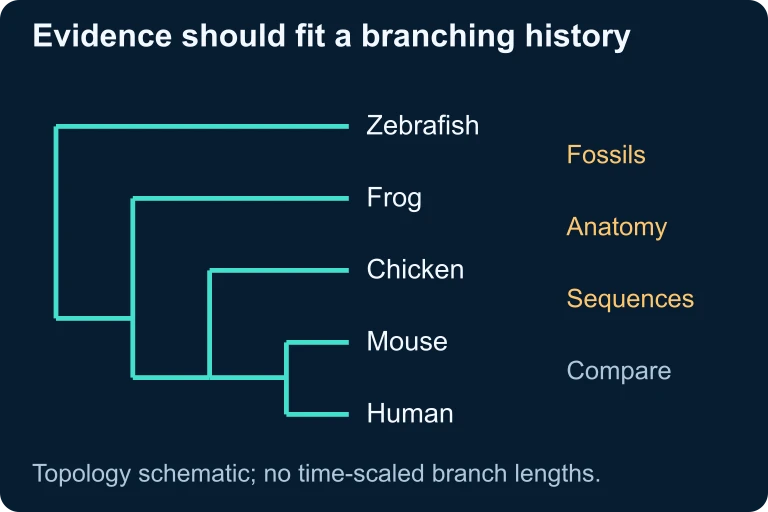
Compare fossils, corresponding anatomical structures and molecular sequences with a branching hypothesis. Tiktaalik is a transitional relative, without requiring it to be a direct ancestor of a particular living lineage.Shared bones do not make a direct ancestor
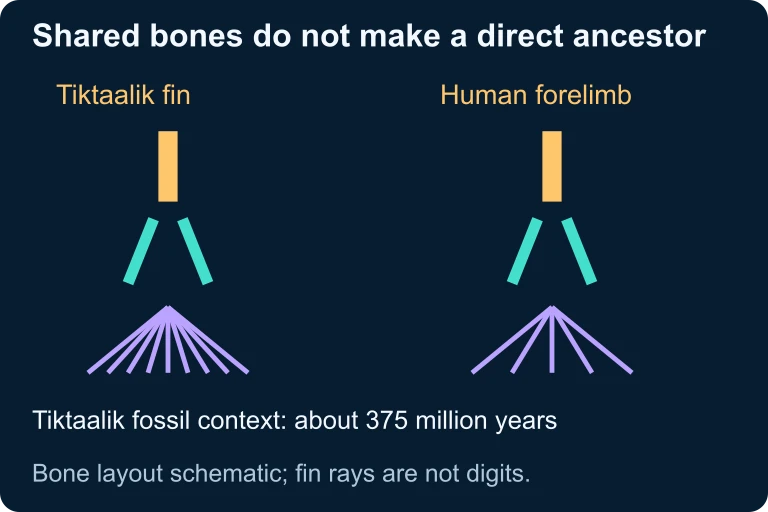
Tiktaalik lived about 375 million years ago and shares corresponding limb-bone regions with tetrapods. Fin rays differ from digits, and correspondence does not establish direct ancestry.A molecular comparison adds another test
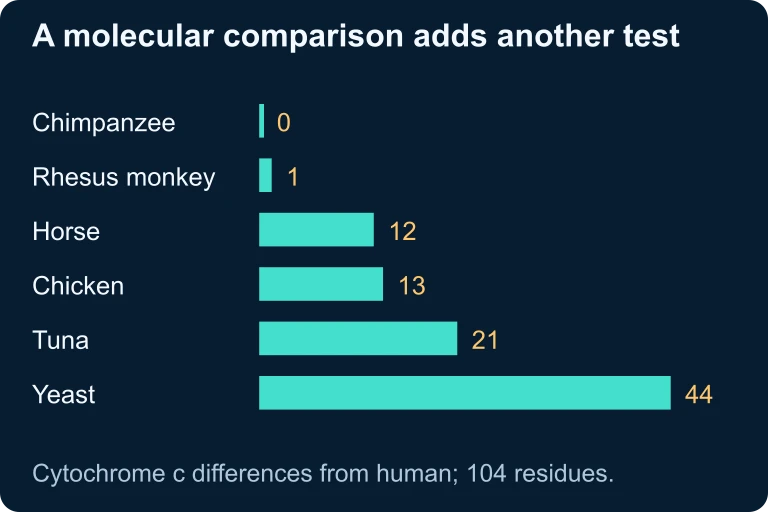
Compare the listed cytochrome c amino-acid differences from the human sequence across the same 104-residue protein.The Universal Genetic Code
From bacteria to blue whales, nearly every organism translates the same codons into the same amino acids. This universality is powerful evidence that all life shares a single origin.
Reading a Phylogenetic Tree
A phylogenetic tree is a branching diagram that represents hypothesized evolutionary relationships. Each node represents a common ancestor, and each branch tip represents an extant or extinct taxon.
Key Tree Vocabulary
Homology vs Analogy
| Homologous Structures | Analogous Structures | |
|---|---|---|
| Origin | Shared common ancestor | Independent evolution |
| Structure | Similar underlying anatomy | Different underlying anatomy |
| Function | May differ (arm vs wing vs flipper) | Similar (bird wing vs insect wing) |
| Evidence for | Common ancestry (divergence) | Convergent evolution |
| Example | Human arm, whale flipper | Bird wing, butterfly wing |
Molecular Clocks
Because DNA mutations accumulate at roughly constant rates in neutral regions, scientists can estimate when two lineages diverged by counting the number of sequence differences between them.
How to Determine Relatedness
Example: Which Are Most Closely Related?
Example: DNA Sequence Comparison
Consider a short gene region from four species. Positions where nucleotides differ from Species A are highlighted.
| Species | Sequence | Differences from A |
|---|---|---|
| Species A | ATGCCTGA | 0 |
| Species B | ATGCATGA | 1 |
| Species C | ACGCATAA | 3 |
| Species D | GTACATAT | 5 |
Example: Homologous Forelimbs


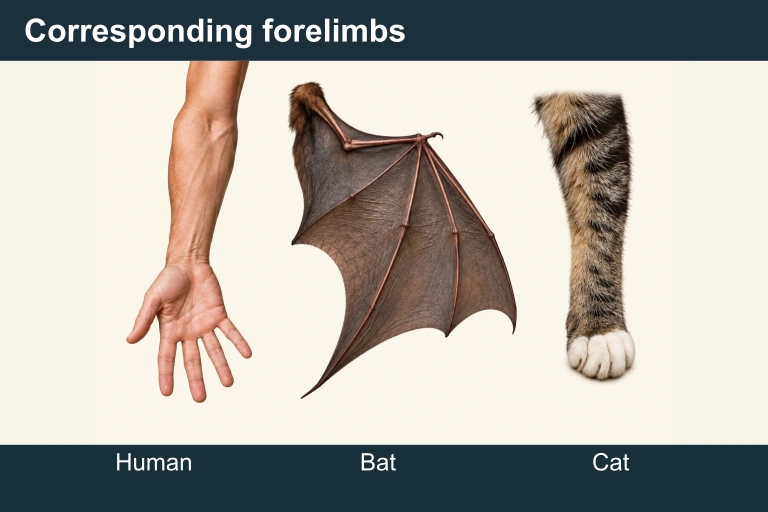
Homologous forelimbs versus analogous wings
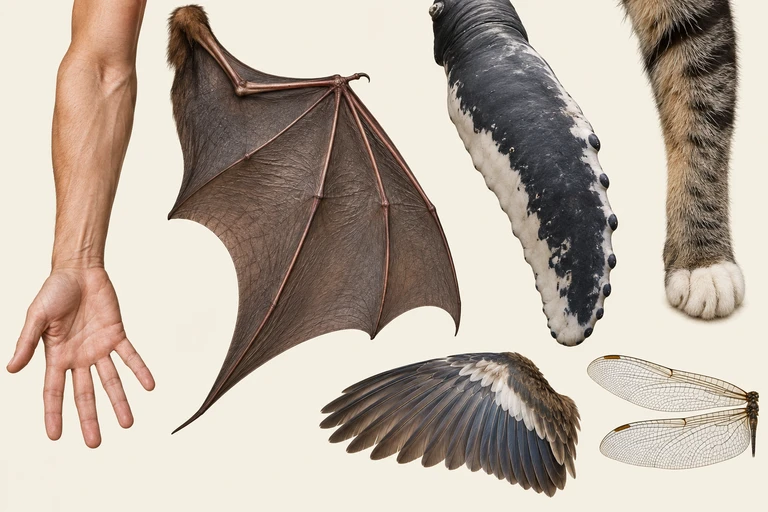
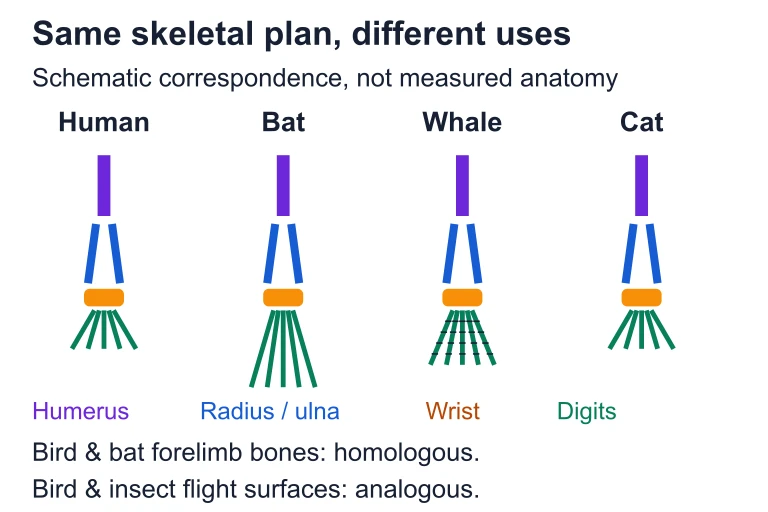
Corresponding forelimb bones reflect shared ancestry despite different functions. Bird and bat forelimb bones are homologous, while bird and insect flight surfaces are analogous.Same skeletal plan, different uses
Corresponding forelimb bones reflect shared ancestry despite different functions. Bird and bat forelimb bones are homologous, while bird and insect flight surfaces are analogous.Vestigial Structures & Biogeography
Endosymbiosis & Deep Ancestry
Mitochondria and chloroplasts have their own circular DNA, double membranes, and reproduce by binary fission: traits shared with free-living bacteria. This is strong evidence that eukaryotic cells arose from an ancient symbiotic relationship between prokaryotes.
Common Mistakes
Summary of Evidence
| Evidence Type | What It Shows | Example |
|---|---|---|
| Molecular | Shared DNA/proteins across species | Universal genetic code |
| Anatomical | Homologous structures from common plan | Vertebrate forelimbs |
| Fossil | Transitional forms in rock record | Tiktaalik (fish → tetrapod) |
| Embryological | Similar developmental stages | Pharyngeal pouches in vertebrates |
| Biogeographic | Distribution matches ancestry | Darwin's finches |
| Vestigial | Reduced ancestral features persist | Whale pelvic bones |
Question 1 of 5
Which of the following is the strongest evidence that all life shares a common ancestor?
Question 2 of 5
On a phylogenetic tree, two species are most closely related if they:
Question 3 of 5
The forelimbs of a human, whale, and bat have different functions but share the same set of bones. These structures are best described as:
Question 4 of 5
Scientists compare cytochrome c protein sequences across species. Species X and Y differ by 2 amino acids, while Species X and Z differ by 15 amino acids. What can you conclude?
Question 5 of 5
Which of the following correctly explains why mitochondria are considered evidence for endosymbiosis and common ancestry?