Cellular
Respiration
Discover how cells harvest chemical energy from glucose and convert it into ATP: the universal energy currency of life.
What Is Cellular Respiration?
Cellular respiration is a set of catabolic reactions that break down organic molecules such as glucose to release energy. Cells capture that energy by synthesizing ATP (adenosine triphosphate).
This process is essentially the reverse of photosynthesis and occurs in every living cell: plants, animals, fungi, and most prokaryotes.
Why Does ATP Matter?
Key Molecules to Know
The Three Stages of Aerobic Respiration
Stage 1: Glycolysis
Glycolysis ("sugar splitting") occurs in the cytoplasm and does not require oxygen. One 6-carbon glucose is split into two 3-carbon pyruvate molecules.
The Bridge: Pyruvate Oxidation
Before entering the Krebs cycle, each pyruvate must be oxidized in the mitochondrial matrix. This transition step links glycolysis to the citric acid cycle.
Stage 2: The Krebs Cycle
Also called the citric acid cycle, this stage occurs in the mitochondrial matrix. Each acetyl-CoA (2C) combines with oxaloacetate (4C) to form citrate (6C), which is systematically oxidized.
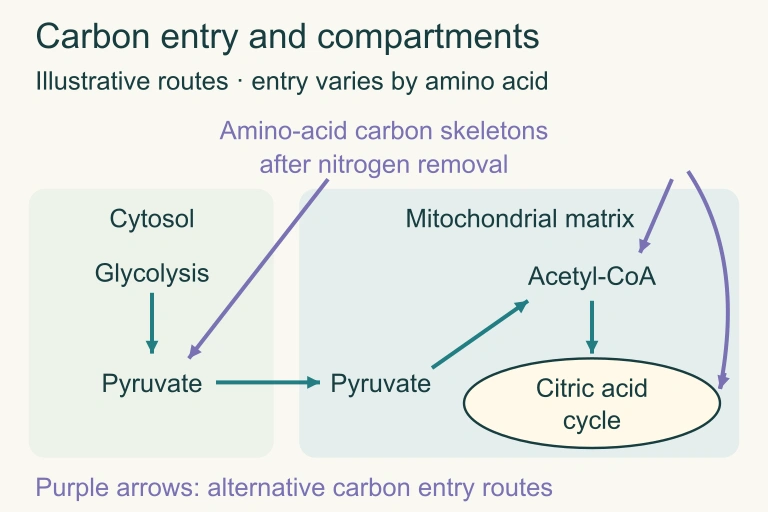
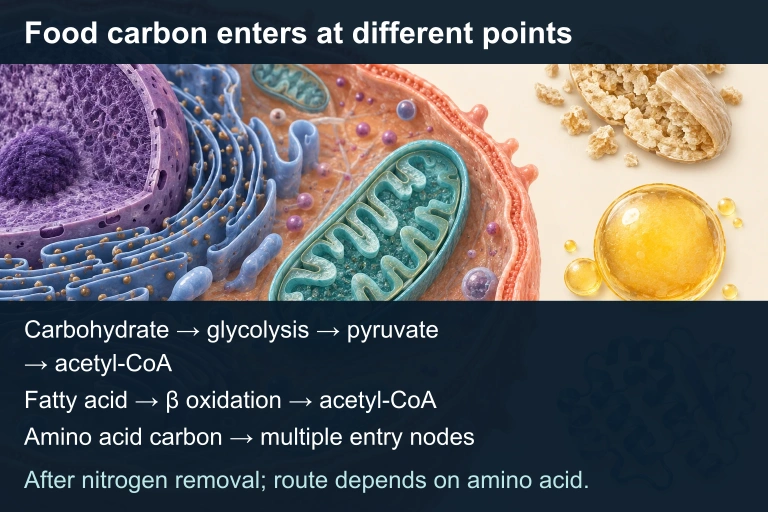
Identify why glucose is a model fuel rather than the only respiratory substrate.
Carbohydrates, fatty acids and amino-acid carbon skeletons enter metabolism at different points. Their diverse structures do not have one universal ATP yield.
Stage 3: Oxidative Phosphorylation
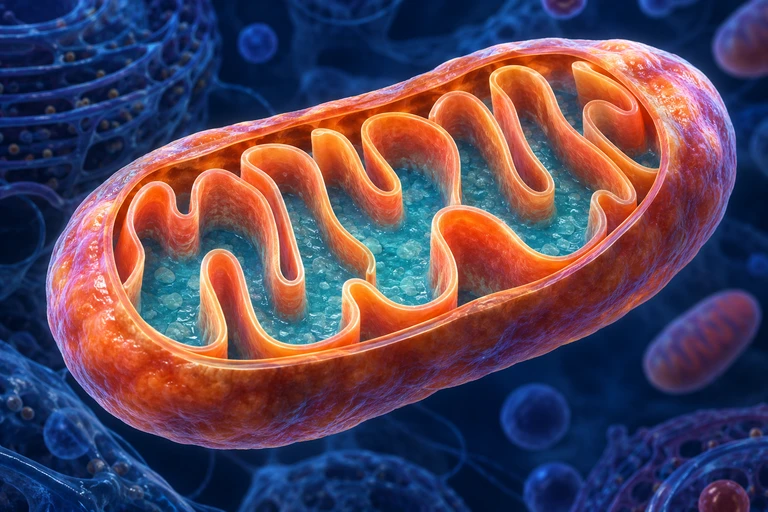
Inside a mitochondrial crista
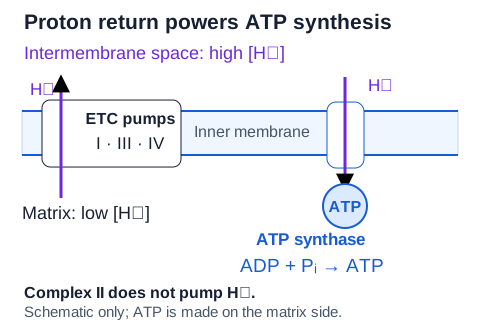
The folded inner mitochondrial membrane separates the matrix from the intermembrane space and provides the surface for oxidative phosphorylation.A proton gradient powers ATP synthesis
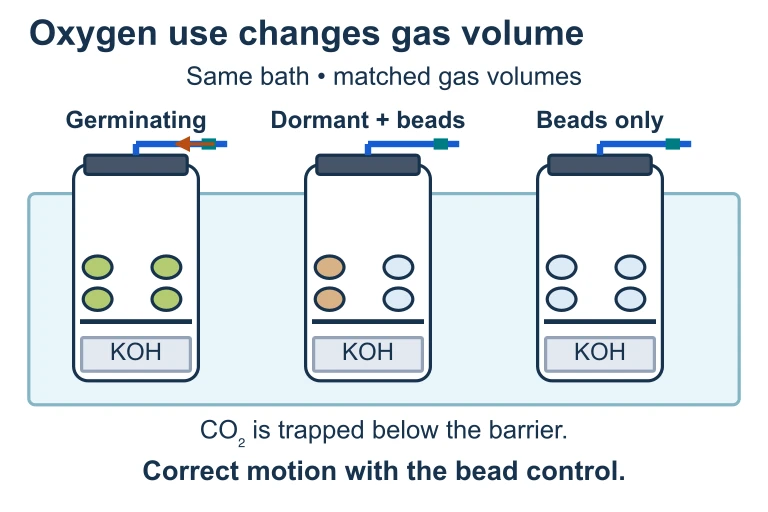
A sprouting seed makes invisible oxygen use measurable
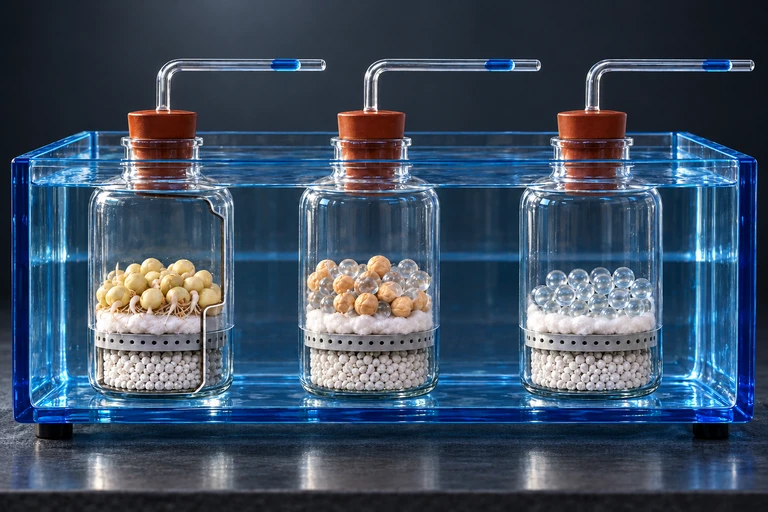
With carbon dioxide absorbed below a separating barrier, oxygen consumption reduces the enclosed gas volume and moves the capillary indicator toward the seeds. Matched chambers share a constant-temperature bath; the bead control measures physical drift.Oxygen use changes gas volume
With carbon dioxide absorbed below a separating barrier, oxygen consumption reduces the enclosed gas volume and moves the capillary indicator toward the seeds. Matched chambers share a constant-temperature bath; the bead control measures physical drift.ATP Accounting per Glucose
| Stage | ATP | NADH | \( \text{FADH}_2 \) | \( \text{CO}_2 \) |
|---|---|---|---|---|
| Glycolysis | 2 net | 2 | 0 | 0 |
| Pyruvate Oxidation | 0 | 2 | 0 | 2 |
| Krebs Cycle (x2) | 2 | 6 | 2 | 4 |
| Oxidative Phosphorylation | ~28 | consumed | consumed | 0 |
| Total | ~30-32 | 6 |
Aerobic vs Anaerobic Respiration
| Feature | Aerobic | Anaerobic (Fermentation) |
|---|---|---|
| Oxygen Required | Yes | No |
| ATP Yield per Glucose | ~30-32 | 2 (glycolysis only) |
| End Products | \( \text{CO}_2 + \text{H}_2\text{O} \) | \( \text{Ethanol} + \text{CO}_2 \) or Lactate |
| Location | Cytoplasm + Mitochondria | Cytoplasm only |
| ETC Used? | Yes | No |
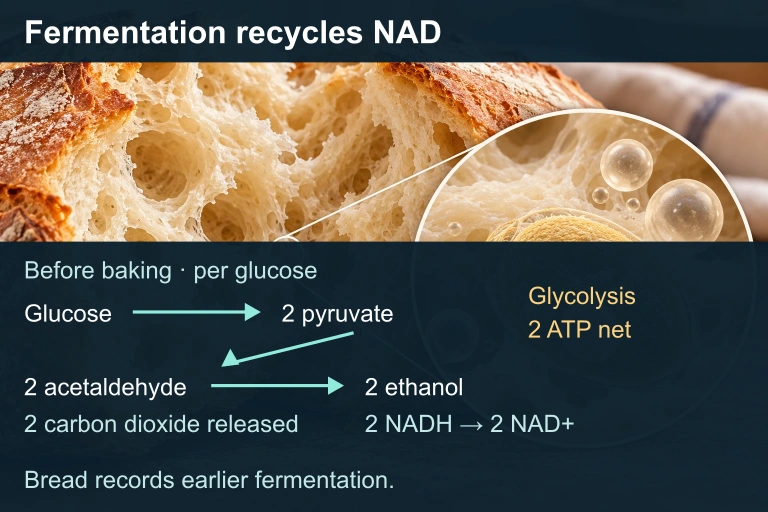
Two Types of Fermentation

How to Solve Cellular Respiration Problems
Example 1: NADH Yield
Example 2: Cyanide Poisoning
Common Mistakes
Question 1 of 5
What is the net ATP yield from glycolysis per glucose molecule?
Question 2 of 5
Where in the cell does the Krebs cycle take place?
Question 3 of 5
What is the primary purpose of fermentation?
Question 4 of 5
Which molecule serves as the final electron acceptor in the electron transport chain?
Question 5 of 5
If a poison blocks ATP synthase (Complex V) but the electron transport chain is still functional, what would you expect?