01 / 21

Cellular
Energy

Explore how cells capture, convert, and use energy through photosynthesis and cellular respiration to power life.

AP Biology

What Is Cellular Energy?

Every living cell needs energy to carry out essential functions: building molecules, transporting substances across membranes, moving, dividing, and signaling. This energy is stored and transferred in the chemical bonds of ATP (adenosine triphosphate).

Explain why simply placing an exergonic reaction nearby is not coupling.

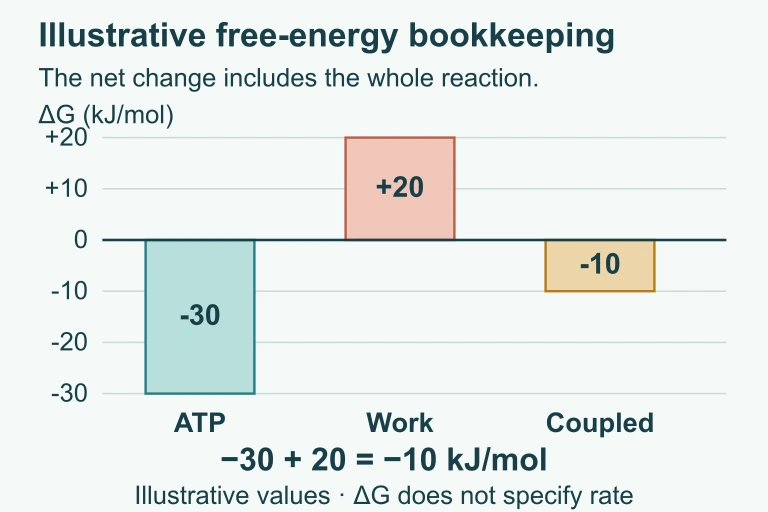
Hexokinase couples glucose phosphorylation to ATP chemistry by transferring the same terminal phosphoryl group in a shared enzyme-mediated step. ATP becomes ADP and glucose becomes glucose-6-phosphate; the enzyme is regenerated. In the illustrative ledger, −30 + 20 = −10 kJ/mol. Breaking a bond alone costs energy, and the sign of ΔG does not specify reaction speed.
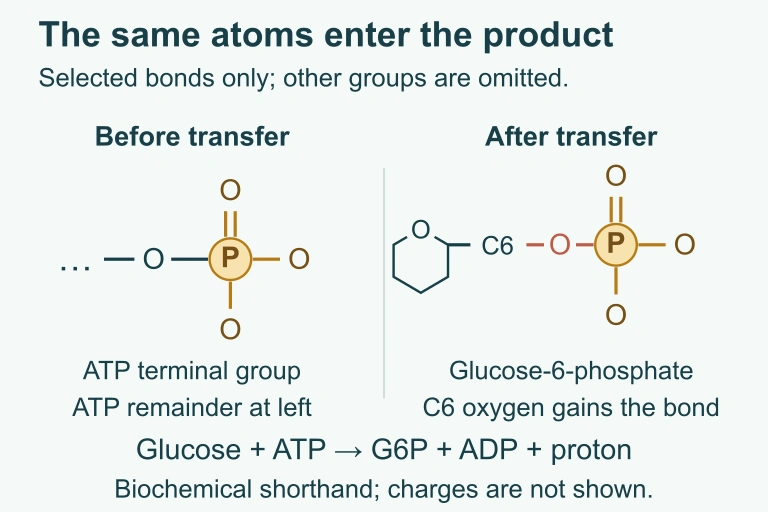
Selected atom map
Selected atom map
Illustrative free-energy bookkeeping
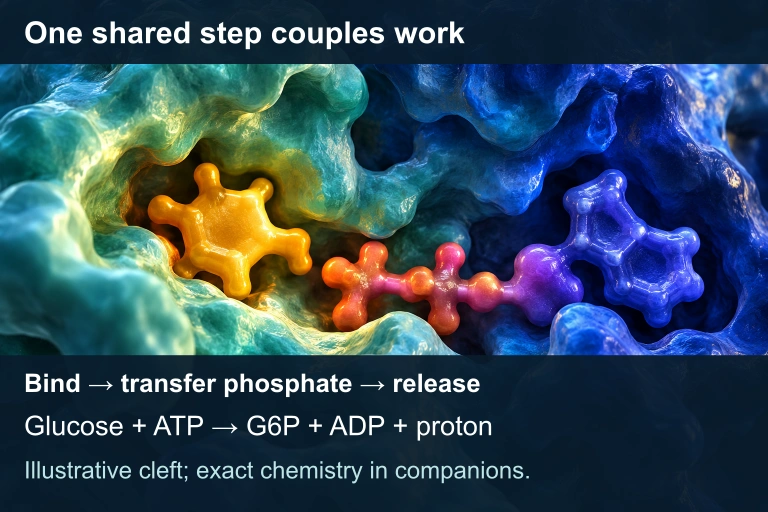
An illustrative enzyme cleft contextualizes binding, phosphate transfer and product release. The separate atom map follows the transferred group, and a separate chart shows illustrative free-energy bookkeeping.
Hexokinase couples glucose phosphorylation to ATP chemistry by transferring the same terminal phosphoryl group in a shared enzyme-mediated step. ATP becomes ADP and glucose becomes glucose-6-phosphate; the enzyme is regenerated. In the illustrative ledger, −30 + 20 = −10 kJ/mol. Breaking a bond alone costs energy, and the sign of ΔG does not specify reaction speed.
The Two Big Pathways

Photosynthesis
Converts light energy into chemical energy (glucose). Occurs in chloroplasts. Used by plants, algae, and some bacteria.
Cellular Respiration
Breaks down glucose to release energy stored as ATP. Occurs in mitochondria. Used by nearly all eukaryotes.

Energy Flow in Living Systems

Light Photosynthesis
\( \text{CO}_2 + \text{H}_2\text{O} \)
\( \text{C}_6\text{H}_{12}\text{O}_6 \)
\( \text{O}_2 \)
Cellular Respiration ATP

The Master Equations

Photosynthesis: Two Stages

Light Reactions
Location: Thylakoid membrane
Input: \( \text{H}_2\text{O} \), light, \( \text{NADP}^+ \), ADP
Output: \( \text{O}_2 \), ATP, NADPH
Splits water, generates ATP and NADPH via the electron transport chain.
Calvin Cycle
Location: Stroma
Input: \( \text{CO}_2 \), ATP, NADPH
Output: G3P (used to build glucose)
Fixes carbon using RuBisCO. Light-independent but depends on light reaction products.

Cellular Respiration: Three Stages

Glycolysis
Location: Cytoplasm
Splits glucose into 2 pyruvate. Produces 2 ATP and 2 NADH (net). Does not require oxygen.
Krebs Cycle
Location: Mitochondrial matrix
Oxidizes acetyl-CoA. Produces 2 ATP, 6 NADH, 2 \( \text{FADH}_2 \), and releases \( \text{CO}_2 \).
Oxidative Phosphorylation
Location: Inner mitochondrial membrane
ETC + chemiosmosis. Produces ~34 ATP. Requires \( \text{O}_2 \) as the final electron acceptor.

ATP Yield Per Glucose

Glycolysis 2 NET ATP Krebs Cycle 2 NET ATP Oxidative Phos. ~34 NET ATP Total: ~36-38 ATP per glucose Pyruvate
\( \text{NADH}/\text{FADH}_2 \)

Aerobic vs Anaerobic Respiration

Aerobic Anaerobic (Fermentation)
Oxygen Required? Yes No
Location Cytoplasm + Mitochondria Cytoplasm only
ATP Yield ~36-38 ATP 2 ATP
End Products \( \text{CO}_2 + \text{H}_2\text{O} \) Ethanol + \( \text{CO}_2 \) or Lactate
Examples Most eukaryotes Yeast, muscle cells (lactic acid)

Chemiosmosis and the Proton Gradient

\( \text{MATRIX (low H}^+) \)
\( \text{INTERMEMBRANE SPACE (high H}^+) \)
I III IV ATP Synthase
\( \text{H}^+ \)
\( \text{H}^+ \)
\( \text{H}^+ \)
\( \text{H}^+ \)
\( e^- \)
\( e^- \)
\( \text{O}_2 + e^- + \text{H}^+ \rightarrow \text{H}_2\text{O} \)
NADH →

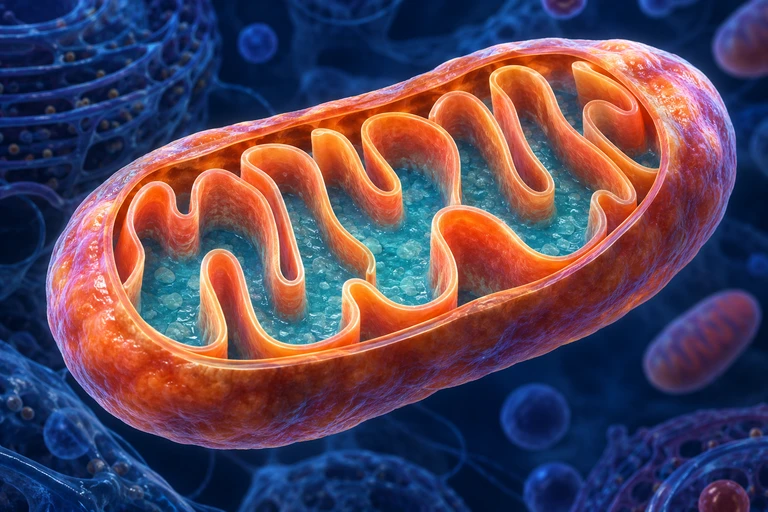
Inside a mitochondrial crista

A cutaway mitochondrion shows a continuous outer boundary and the folded inner membrane surrounding the matrix.The folded inner mitochondrial membrane separates the matrix from the intermembrane space and provides the surface for oxidative phosphorylation.

A proton gradient powers ATP synthesis
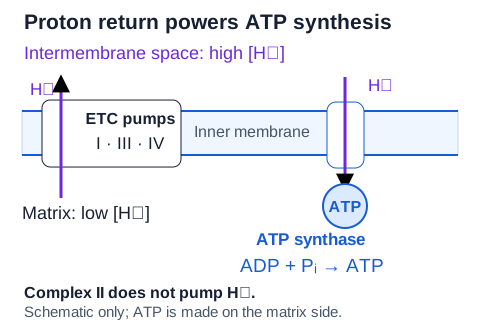
Across the inner membrane, arrows at Complexes I, III and IV point toward the intermembrane space. An arrow through ATP synthase returns toward the matrix, beside ADP plus phosphate and ATP labels. Complex II has no pumping arrow.Complexes I, III and IV pump protons from the matrix into the intermembrane space. Proton return through ATP synthase drives ATP production on the matrix side; Complex II does not pump protons.Open full diagram
How to Trace Energy Through a Cell

1
Identify the energy source. Is it sunlight (photosynthesis) or an organic molecule like glucose (respiration)?
2
Follow the electrons. Track electron carriers: \( \text{NADH} \), \( \text{FADH}_2 \), and \( \text{NADPH} \). They shuttle high-energy electrons between stages.
3
Count the ATP. Substrate-level phosphorylation (glycolysis, Krebs) vs oxidative phosphorylation (ETC). Most ATP comes from the ETC.
4
Identify inputs and outputs at each stage. What goes in? What comes out? Where does the carbon end up?
5
Connect to the big picture. Relate the pathway to the Laws of Thermodynamics: energy is conserved, but entropy increases.

Example: Tracking Glycolysis

\( \text{Glucose (C}_6) \)
Energy Investment: 2 ATP used
\( \text{Glucose splits into } 2 \times \text{G3P (C}_3) \)
Energy Payoff: 4 ATP + 2 NADH produced
\( 2 \text{ Pyruvate (C}_3) \)
NET: 2 ATP 2 NADH

Example: Krebs Cycle Accounting

Each glucose yields 2 acetyl-CoA molecules, so the Krebs Cycle turns twice per glucose. Per turn:

Per Turn
1 ATP (via GTP)
3 \( \text{NADH} \)
1 \( \text{FADH}_2 \)
2 \( \text{CO}_2 \) released
Per Glucose (×2)
2 ATP
6 \( \text{NADH} \)
2 \( \text{FADH}_2 \)
4 \( \text{CO}_2 \) released

Example: Fermentation Pathways

Alcoholic Fermentation
Organism: Yeast, some bacteria
Process: Pyruvate → Ethanol + \( \text{CO}_2 \)
Purpose: Regenerate \( \text{NAD}^+ \) for glycolysis
ATP: Only 2 (from glycolysis)
Lactic Acid Fermentation
Organism: Muscle cells, some bacteria
Process: Pyruvate → Lactate
Purpose: Regenerate \( \text{NAD}^+ \) for glycolysis
ATP: Only 2 (from glycolysis)
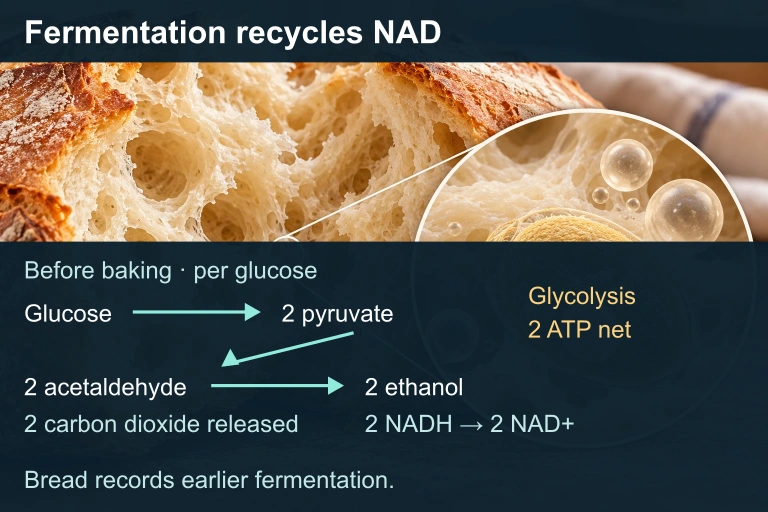
Bread context and an authored per-glucose sequence show glycolysis to two pyruvate, decarboxylation to acetaldehyde and carbon dioxide, ethanol formation, and oxidation of two NADH to two NAD+.
Yeast fermentation in dough releases CO₂ and regenerates NAD⁺ before baking. The baked crumb records earlier gas formation; living or actively fermenting yeast in finished bread is not implied. Net two ATP per glucose arise in glycolysis.

Common Mistakes

✕ "Fermentation makes ATP"
Fermentation only regenerates \( \text{NAD}^+ \). The 2 ATP come from glycolysis, not fermentation itself.
✕ "\( \text{O}_2 \) is made in respiration"
\( \text{O}_2 \) is a product of photosynthesis (water splitting). In respiration, \( \text{O}_2 \) is consumed as the final electron acceptor.
✕ "Plants don't respire"
All living cells, including plant cells, perform cellular respiration. Plants do both photosynthesis and respiration.

Summary Comparison

Feature Photosynthesis Cellular Respiration
Organelle Chloroplast Mitochondria
Reactants \( \text{CO}_2 + \text{H}_2\text{O} \) + light \( \text{C}_6\text{H}_{12}\text{O}_6 + \text{O}_2 \)
Products \( \text{C}_6\text{H}_{12}\text{O}_6 + \text{O}_2 \) \( \text{CO}_2 + \text{H}_2\text{O} \) + ATP
Energy Conversion Light → Chemical Chemical → Chemical (ATP)
Electron Carriers \( \text{NADPH} \) \( \text{NADH}, \text{FADH}_2 \)
\( \Delta G \) Endergonic (+) Exergonic (−)

Question 1 of 5

What is the net ATP yield from glycolysis per molecule of glucose?

Question 2 of 5

Where does the Calvin Cycle take place?

Question 3 of 5

What is the primary function of fermentation?

Question 4 of 5

In the electron transport chain, what is the final electron acceptor?

Question 5 of 5

Which stage of cellular respiration produces the most ATP?