01 / 20

Cell Structure
and Function

Explore the fundamental unit of life: how organelles work together to maintain cellular homeostasis, produce energy, and express genetic information.

AP Biology

What is a Cell?

A cell is the smallest structural and functional unit of all living organisms. Every organism, from bacteria to blue whales, is composed of one or more cells. This principle is the foundation of the Cell Theory.

Two Domains: Prokaryotic vs Eukaryotic

Prokaryotic
No membrane-bound nucleus. DNA in a nucleoid region. Smaller (\( 1\text{-}5 \, \mu\text{m} \)). Includes Bacteria and Archaea. Have ribosomes (70S) but lack complex organelles.
Eukaryotic
Membrane-bound nucleus encloses DNA. Larger (\( 10\text{-}100 \, \mu\text{m} \)). Include animals, plants, fungi, protists. Have 80S ribosomes and complex organelles.

The Plasma Membrane

Channel Peripheral Cholesterol Extracellular Fluid Cytoplasm Head Tails Glyco- protein

The Endomembrane System

The endomembrane system is a network of interconnected membranes that compartmentalize the cell and coordinate the production, processing, and transport of proteins and lipids.

Nucleus DNA, mRNA Rough ER Protein synthesis Smooth ER Lipid synthesis Golgi Apparatus Modify, sort, ship Vesicle Lysosome Digestion

Explain why internal transport complements compartment organization.

A kinesin motor and adaptor connect a cargo vesicle to a microtubule. ATP powers movement toward the plus end in this selected transport model.
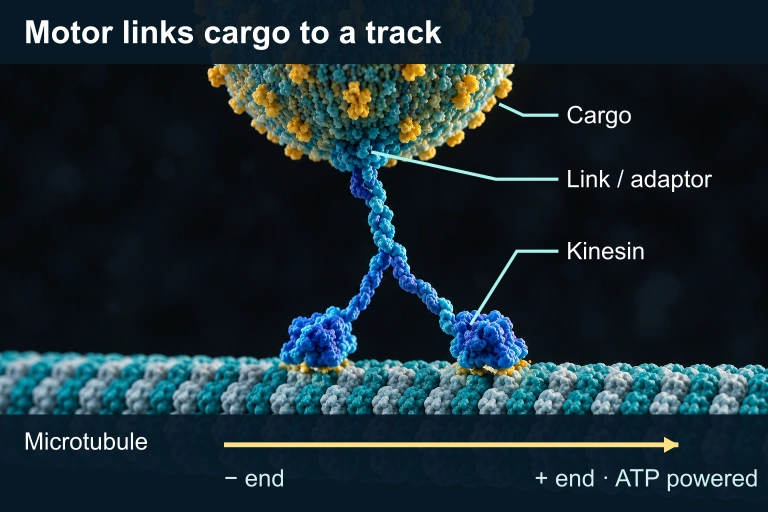
A schematic cargo vesicle connects through an adaptor to a two-headed kinesin motor on a microtubule. An arrow indicates ATP-powered movement toward the plus end.
A kinesin motor and adaptor connect a cargo vesicle to a microtubule. ATP powers movement toward the plus end in this selected transport model.

Mitochondria and Chloroplasts

Mitochondria
Site of cellular respiration. Double membrane with folded cristae. Converts glucose to ATP: \( \text{C}_6\text{H}_{12}\text{O}_6 + 6\text{O}_2 \to 6\text{CO}_2 + 6\text{H}_2\text{O} + \text{ATP} \). Has its own DNA.
Chloroplasts
Site of photosynthesis (plants and algae only). Double membrane with internal thylakoids. Converts light to sugar: \( 6\text{CO}_2 + 6\text{H}_2\text{O} \xrightarrow{\text{light}} \text{C}_6\text{H}_{12}\text{O}_6 + 6\text{O}_2 \). Has its own DNA.

The Central Dogma Inside the Cell

DNA Nucleus Transcription mRNA Cytoplasm Translation Protein Ribosome / ER

Animal vs Plant Cells

Feature Animal Cell Plant Cell
Cell Wall Absent Present (cellulose)
Chloroplasts Absent Present
Central Vacuole Small or absent Large, stores water
Centrioles Present Absent (most)
Lysosomes Present Rare (use vacuole)
Shape Irregular / round Fixed / rectangular

Bacterial, plant and animal cell comparisons
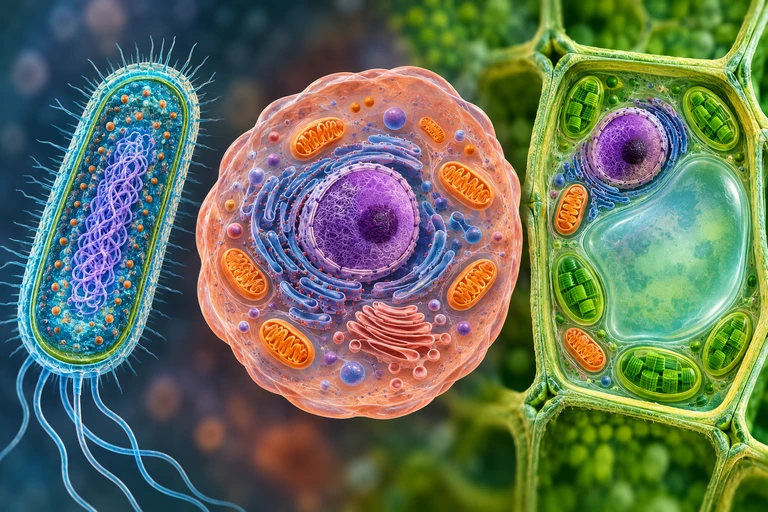
Cutaways of a bacterium,an animal cell and a plant leaf cell with contrasting internal architecture.Bacteria, animal cells and photosynthetic leaf cells share a plasma membrane, DNA and ribosomes. The bacterium lacks a membrane-bound nucleus; both eukaryotic examples contain mitochondria, and the leaf cell also contains chloroplasts.

Three cells, shared essentials
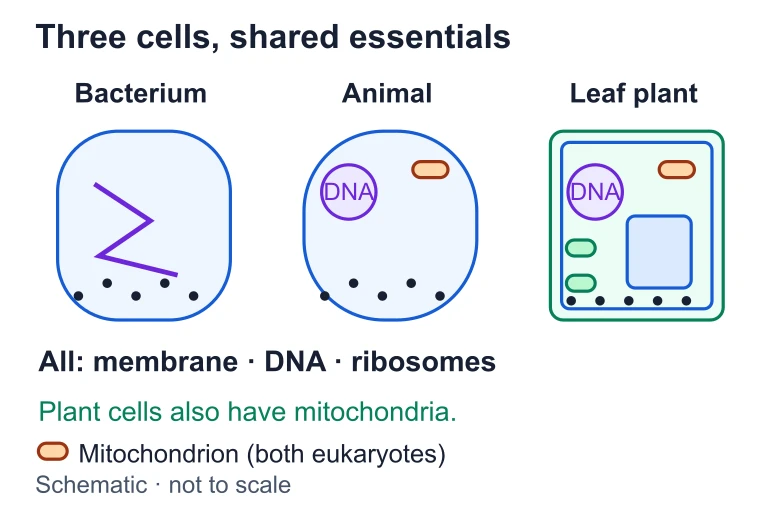
Three cells, shared essentials. Bacteria, animal cells and photosynthetic leaf cells share a plasma membrane, DNA and ribosomes. The bacterium lacks a membrane-bound nucleus; both eukaryotic examples contain mitochondria, and the leaf cell also contains chloroplasts.Bacteria, animal cells and photosynthetic leaf cells share a plasma membrane, DNA and ribosomes. The bacterium lacks a membrane-bound nucleus; both eukaryotic examples contain mitochondria, and the leaf cell also contains chloroplasts.

Organelle Quick Reference

Nucleus
Stores and protects DNA. Controls gene expression. Double membrane with nuclear pores.
Ribosome
Translates mRNA into protein. Free (cytoplasm) or bound (rough ER). Made of rRNA + protein.
Golgi
Modifies, sorts, and packages proteins into vesicles. cis face receives, trans face ships.
Lysosome
Contains hydrolytic enzymes (pH \(\approx 5\)). Digests worn-out organelles and engulfed material.
Vacuole
Storage and turgor pressure (plants). Food vacuoles in protists. Contractile vacuoles expel water.
Cytoskeleton
Network of microfilaments, intermediate filaments, and microtubules. Shape, movement, division.

Cell compartments as distinct chemical environments
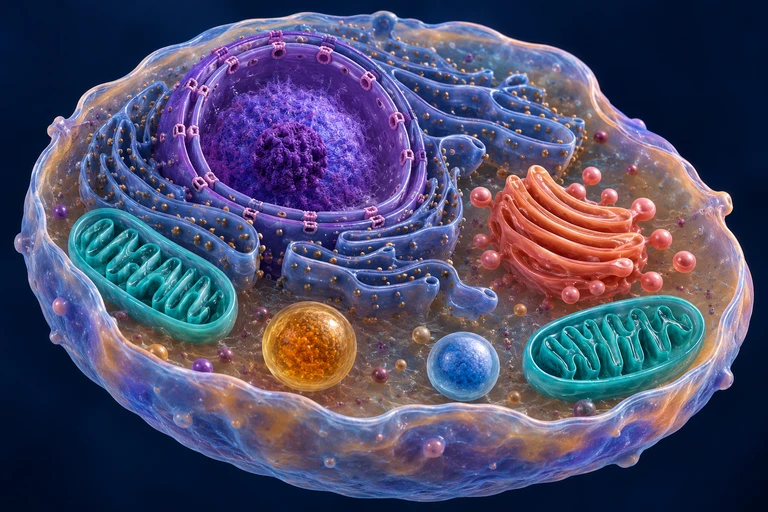
Animal-cell cutaway with purple nucleus and ER, coral Golgi, amber lysosome, blue peroxisome and teal mitochondria.Membranes separate cytosol from organelle lumens and maintain distinct chemical environments. The nuclear outer membrane connects with the endoplasmic reticulum; mitochondrial and peroxisomal protein import follows routes distinct from ER–Golgi vesicle traffic.

Boundaries maintain different spaces
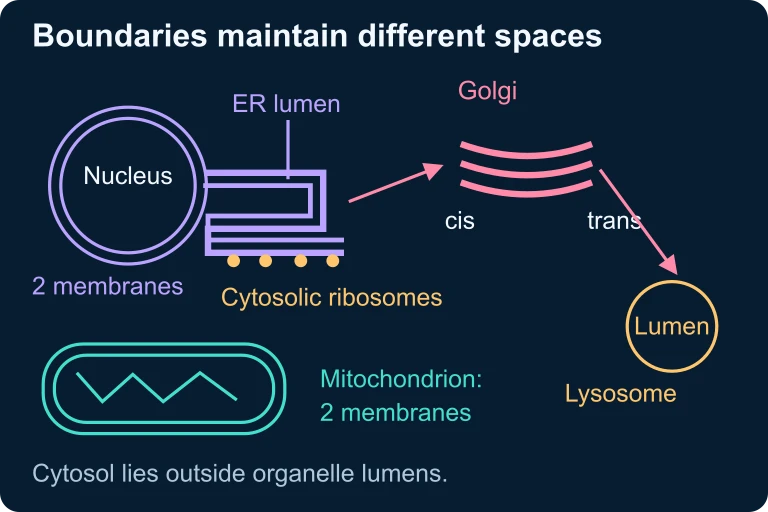
Boundaries maintain different spaces. Membranes separate cytosol from organelle lumens and maintain distinct chemical environments. The nuclear outer membrane connects with the endoplasmic reticulum; mitochondrial and peroxisomal protein import follows routes distinct from ER–Golgi vesicle traffic.Membranes separate cytosol from organelle lumens and maintain distinct chemical environments. The nuclear outer membrane connects with the endoplasmic reticulum; mitochondrial and peroxisomal protein import follows routes distinct from ER–Golgi vesicle traffic.

Vesicles and direct import are different routes
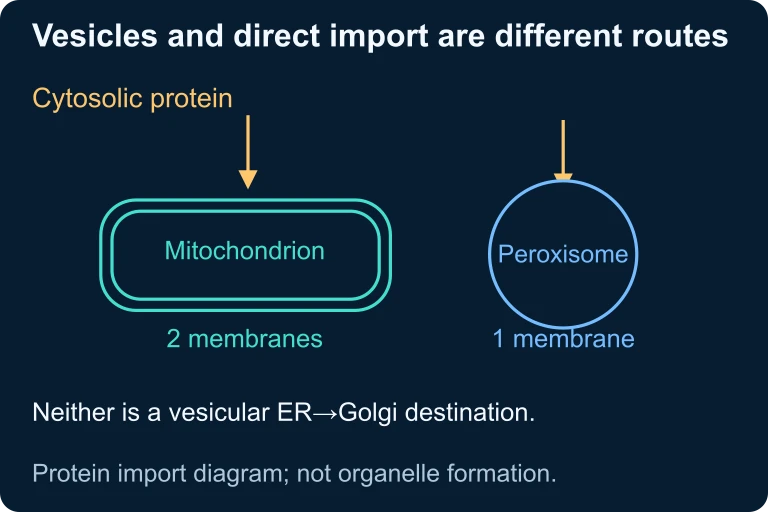
Vesicles and direct import are different routes. Mitochondrial and peroxisomal proteins can enter from the cytosol through direct-import routes distinct from ER–Golgi vesicle transport.Mitochondrial and peroxisomal proteins can enter from the cytosol through direct-import routes distinct from ER–Golgi vesicle transport.
How to Identify Organelles

1
Look at membranes. Double membrane? Nucleus, mitochondria, or chloroplast. Single membrane? ER, Golgi, lysosome, vacuole.
2
Check for internal structures. Cristae = mitochondria. Thylakoid stacks (grana) = chloroplast. Flattened cisternae = Golgi.
3
Consider the function described. ATP production = mitochondria. Protein folding = ER. Sorting/shipping = Golgi. Digestion = lysosome.
4
Note the cell type. If the question mentions photosynthesis or a cell wall, the cell is a plant cell. If centrioles or lysosomes are highlighted, think animal cell.

Example: Protein Secretion Pathway

Trace the path of a secreted protein (like insulin) from gene to export:

1
Nucleus: Gene is transcribed into mRNA, which exits through nuclear pores.
2
Rough ER: Ribosomes on the ER translate mRNA. The polypeptide enters the ER lumen and begins folding.
3
Transport vesicle: Budding vesicle carries protein from ER to the Golgi apparatus (cis face).
4
Golgi apparatus: Protein is modified (glycosylation, phosphorylation) as it moves cis to trans.
5
Secretory vesicle: Golgi buds off a vesicle that fuses with the plasma membrane, releasing the protein via exocytosis.
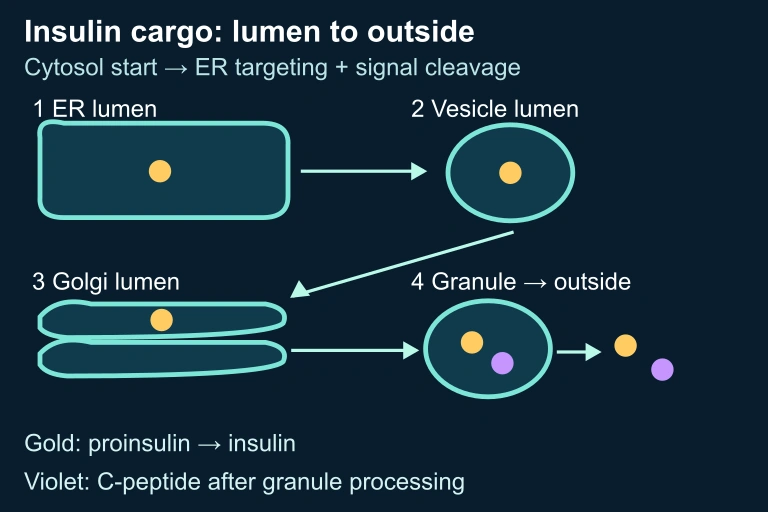
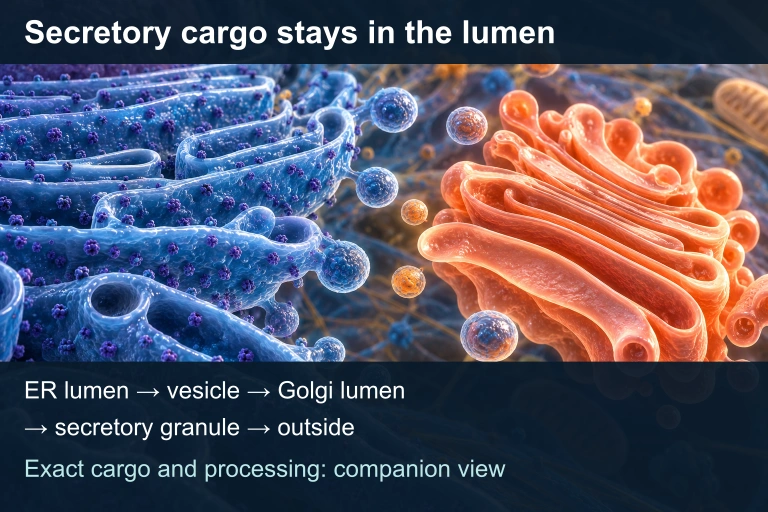
Lumen route and processing schematic
An illustrative ER and Golgi scene accompanies an authored schematic showing proinsulin in the ER, vesicle and Golgi lumen, granule processing into insulin and C-peptide, and release outside.
Translation begins in the cytosol and is targeted to the ER, where the signal peptide is cleaved. Secretory cargo stays in noncytosolic lumens as it travels through the Golgi and granules. Granule processing produces insulin and C-peptide, which are released outside.

Example: Surface Area to Volume

Why can't cells grow infinitely large? Consider a cube-shaped cell with side length \( s \):

Side \( s \) \( SA \) \( V \) \( SA/V \)
\( 1 \, \mu\text{m} \) \( 6 \) \( 1 \) 6.0
\( 3 \, \mu\text{m} \) \( 54 \) \( 27 \) 2.0
\( 6 \, \mu\text{m} \) \( 216 \) \( 216 \) 1.0

Example: Endosymbiosis Evidence

A researcher discovers a new single-celled eukaryote. She observes the following features under electron microscopy:

Observation 1
The organelle has a double membrane: inner membrane forms cristae-like folds.
Observation 2
It contains its own circular DNA and 70S ribosomes, distinct from the host's 80S ribosomes.
Observation 3
The organelle replicates independently via binary fission within the host cell.

Membrane Transport

Passive
No energy required. Moves down the concentration gradient. Includes diffusion, osmosis, and facilitated diffusion.
Active
Requires ATP. Moves against the concentration gradient. Includes pumps (e.g., \(\text{Na}^+/\text{K}^+\) ATPase) and bulk transport.

A plant cell presses against a wall while an animal cell changes shape
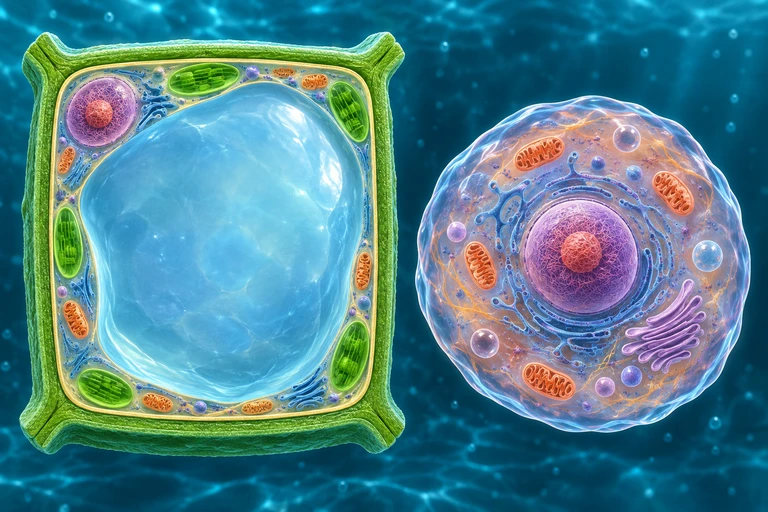
Plant wall is thick and distinct from inner membrane; large central vacuole and peripheral cytoplasm visible. Animal cell has flexible boundary and no wall. Separate exact panel: Paired plant states retain the same wall while the inner membrane is pressed outward or retracted; animal membrane has no surrounding wall.For nonpenetrating solutes, a plant wall limits expansion as water enters. Water loss retracts the protoplast from the wall during plasmolysis; animal cells lack this rigid wall.

Wall support changes the response
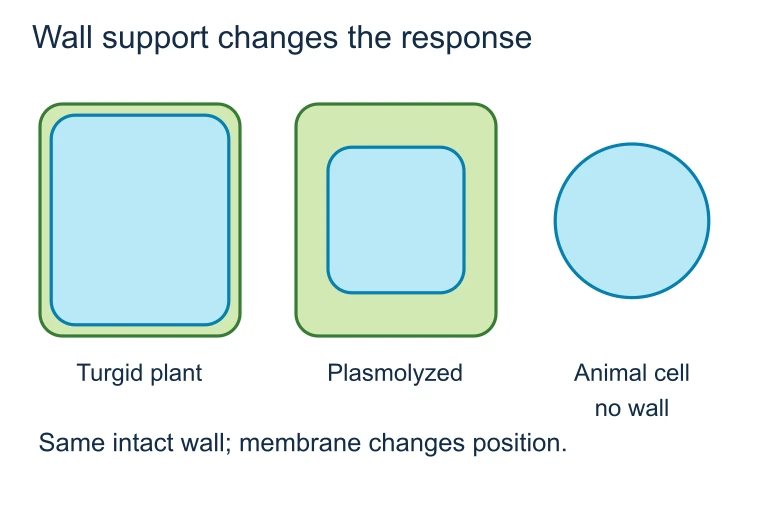
Wall support changes the response. For nonpenetrating solutes, a plant wall limits expansion as water enters. Water loss retracts the protoplast from the wall during plasmolysis; animal cells lack this rigid wall.For nonpenetrating solutes, a plant wall limits expansion as water enters. Water loss retracts the protoplast from the wall during plasmolysis; animal cells lack this rigid wall.

Common Mistakes

✕ Confusing ER types
Rough ER has ribosomes and makes proteins. Smooth ER lacks ribosomes and makes lipids / detoxifies. They are continuous but functionally distinct.
✕ All cells have every organelle
Red blood cells lack a nucleus and mitochondria. Prokaryotes lack all membrane-bound organelles. Always consider the cell type.
✕ Osmosis moves solute
Osmosis is the movement of water, not solute. Water moves toward the side with more solute (hypertonic). The membrane is permeable to water, not the solute.

Question 1 of 5

Which organelle is the primary site of ATP production in eukaryotic cells?

Question 2 of 5

A cell is placed in a hypertonic solution. What will happen to an animal cell?

Question 3 of 5

Which sequence correctly traces the secretory pathway for a protein destined for export?

Question 4 of 5

Which evidence best supports the endosymbiotic theory for the origin of mitochondria?

Question 5 of 5

A cube-shaped cell has side length \( s = 4 \, \mu\text{m} \). What is its surface area-to-volume ratio?