Cell Size
Surface Area to Volume
Explore why cells remain microscopically small, how the SA:V ratio governs exchange, and what happens when cells grow too large.
Why Are Cells Small?
Most cells are between 1 and 100 micrometers in diameter. This isn't a coincidence: cell size is constrained by the physical laws governing diffusion and surface exchange. A cell must import nutrients and export wastes fast enough to sustain its metabolic needs.
Key Definitions
Visualizing the SA:V Ratio
The SA:V Principle
For a cube with side length \( s \):
For a sphere with radius \( r \):
In both cases, the SA:V ratio is inversely proportional to the linear dimension. Larger cells have less surface per unit volume.
SA:V Decreases as Size Grows
Biological Consequences
Prokaryotic vs. Eukaryotic Cell Size
| Prokaryotes | Eukaryotes | |
|---|---|---|
| Typical size | \( 0.1 – 5 \; \mu\text{m} \) | \( 10 – 100 \; \mu\text{m} \) |
| SA:V ratio | Very high | Moderate |
| Internal membranes | Absent | Extensive (ER, Golgi, etc.) |
| Compensation strategy | Small size alone | Compartmentalization |
| Metabolic rate | Higher per unit volume | Lower per unit volume |
Adaptations to Increase SA:V
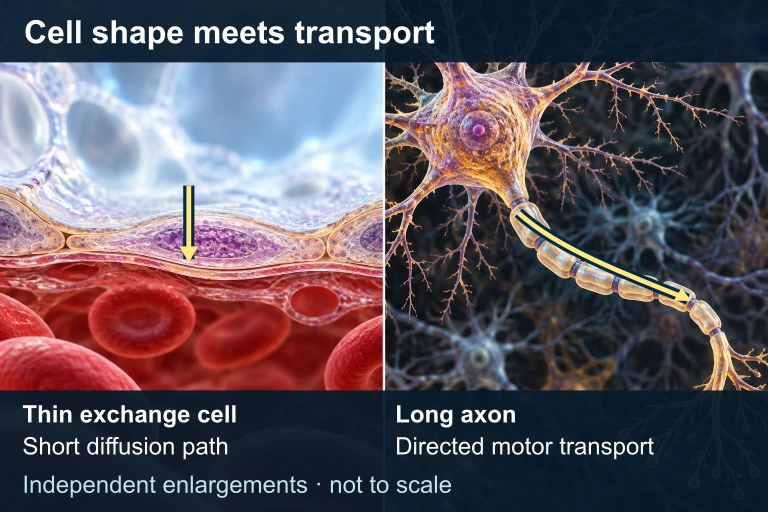
Shape adaptations solve different transport constraints
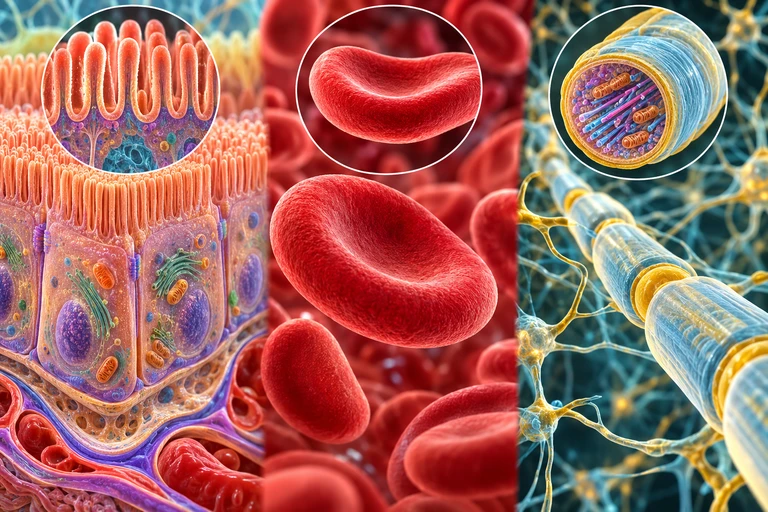 Microvilli increase exchange area, a biconcave shape shortens diffusion paths, and a thin axon limits radial diffusion distance while relying on active transport along its length.
Shape changes different constraints
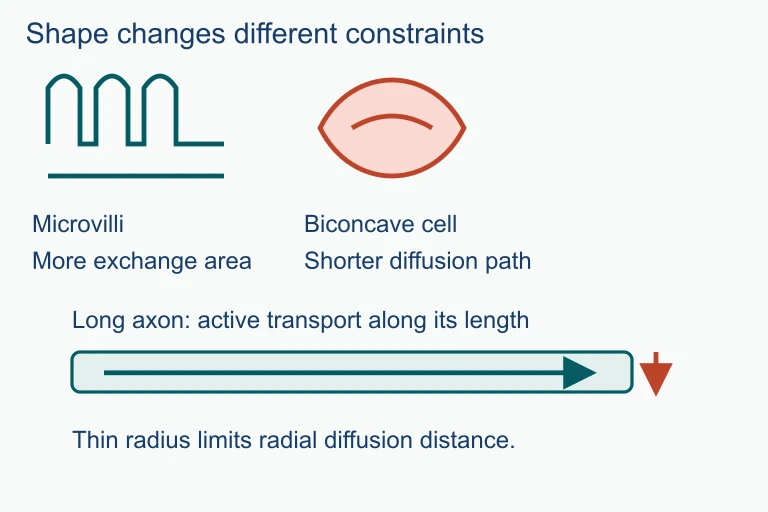 Microvilli increase exchange area, a biconcave shape shortens diffusion paths, and a thin axon limits radial diffusion distance while relying on active transport along its length.
How to Calculate SA:V
Example 1: Cube Cell
A cuboidal cell has a side length of \( s = 4 \; \mu\text{m} \). Find its SA:V ratio.
Example 2: Spherical Cell
A spherical cell has a radius of \( r = 5 \; \mu\text{m} \). Find its SA:V ratio.
Example 3: Dividing vs. Growing
Imagine one large cube with side \( s = 4 \) vs. eight smaller cubes each with side \( s = 2 \), totaling the same volume. Which arrangement has a higher total SA?
Cell Division Restores SA:V
When a cell reaches a critical size, its SA:V ratio drops below the threshold needed for efficient transport. Cell division (mitosis or binary fission) solves this problem by producing two smaller daughter cells, each with a higher SA:V ratio.
Common Mistakes
Summary Table
| Concept | Small Cell | Large Cell |
|---|---|---|
| SA:V Ratio | High | Low |
| Diffusion efficiency | Fast | Slow |
| Nutrient access | Adequate | Insufficient |
| Waste removal | Efficient | Toxic buildup |
| DNA:cytoplasm ratio | Balanced | Overloaded |
| Biological response | Continue growing | Divide (mitosis) |
Question 1 of 5
A cell shaped like a cube has a side length of \( 3 \; \mu\text{m} \). What is its SA:V ratio?
Question 2 of 5
As a spherical cell increases in radius, what happens to its surface-area-to-volume ratio?
Question 3 of 5
Which of the following is NOT a biological adaptation that increases a cell's effective surface-area-to-volume ratio?
Question 4 of 5
One large cube (side = 6) is divided into 27 smaller cubes (side = 2). Which statement is true?
Question 5 of 5
A biologist observes that a certain cell type is very flat and thin rather than spherical. The most likely explanation for this shape is: