01 / 21

The Cell Cycle

Explore how cells grow, replicate their DNA, and divide to produce genetically identical daughter cells: the foundation of all life.

AP Biology

What Is the Cell Cycle?

The cell cycle is the ordered series of events that a cell undergoes from its formation to the moment it divides into two daughter cells. It ensures that DNA is accurately copied and distributed so every new cell receives a complete genome.

Why the Cell Cycle Matters

Growth
Organisms develop from a single zygote to trillions of cells through repeated cell cycles.
Repair
Damaged or worn-out cells are replaced: skin cells, blood cells, and gut lining regenerate constantly.
Reproduction
Single-celled organisms reproduce entirely through cell division: binary fission or mitosis.

Phases of the Cell Cycle

CELL CYCLE G1 Growth S DNA Synthesis G2 Prep for Mitosis M Mitosis + Cytokinesis INTERPHASE = G1 + S + G2

Interphase: G1, S, and G2

1
G1 (Gap 1): The cell grows in size, produces proteins, and carries out its normal functions. Organelles are duplicated. This is the longest sub-phase of interphase.
2
S (Synthesis): DNA replication occurs. Each chromosome is duplicated to form two identical sister chromatids joined at the centromere.
3
G2 (Gap 2): The cell continues to grow and produces proteins needed for mitosis, such as tubulin (for the mitotic spindle). The cell checks for DNA replication errors.

The Mitotic Phase: Dividing the Cell

The M phase has two parts: mitosis (division of the nucleus) and cytokinesis (division of the cytoplasm). Mitosis itself proceeds through four stages.
Prophase
Chromatin condenses into visible chromosomes. The mitotic spindle begins to form.
Metaphase
Chromosomes align at the cell's equator (metaphase plate). Spindle fibers attach to centromeres.
Anaphase
Sister chromatids separate and move to opposite poles of the cell.
Telophase
Nuclear envelopes reform. Chromosomes decondense. Cytokinesis completes division.
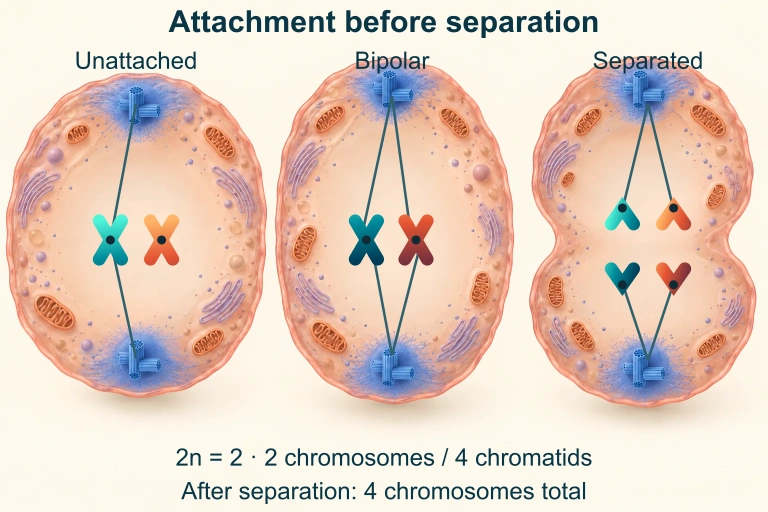
Three illustrative cell cutaways carry separately authored chromosome and spindle geometry. One of two chromosomes is unattached; next both have opposite-pole attachments; finally four separated chromosomes move toward opposite poles.
In this 2 n = 2 mitotic model, sister kinetochores attach to opposite poles before separation. Once sisters separate, each former chromatid counts as a chromosome.

Animal and plant cytokinesis

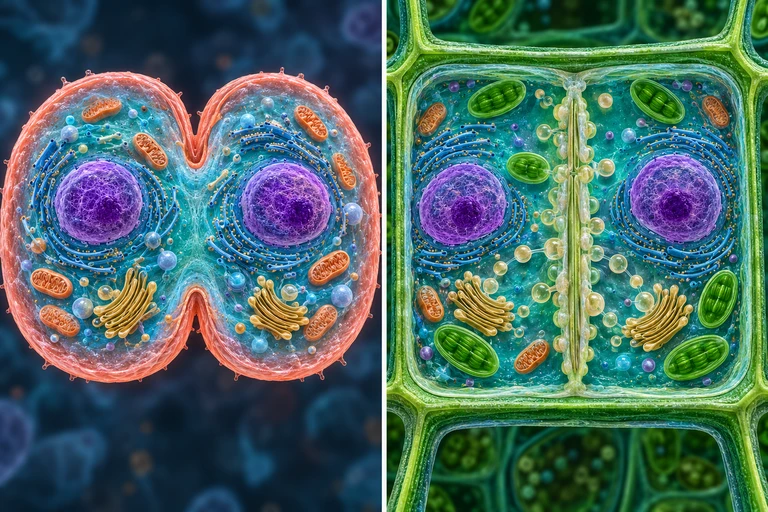
A constricted animal cell has one purple nucleus in each lobe; a walled plant cell has two nuclei and a central developing plate, with no animal-style asters.Animal cytokinesis constricts inward through an actomyosin ring. In plant cells, Golgi-derived vesicles build a central cell plate that expands outward and joins the parental boundary.

Two ways to divide the cytoplasm
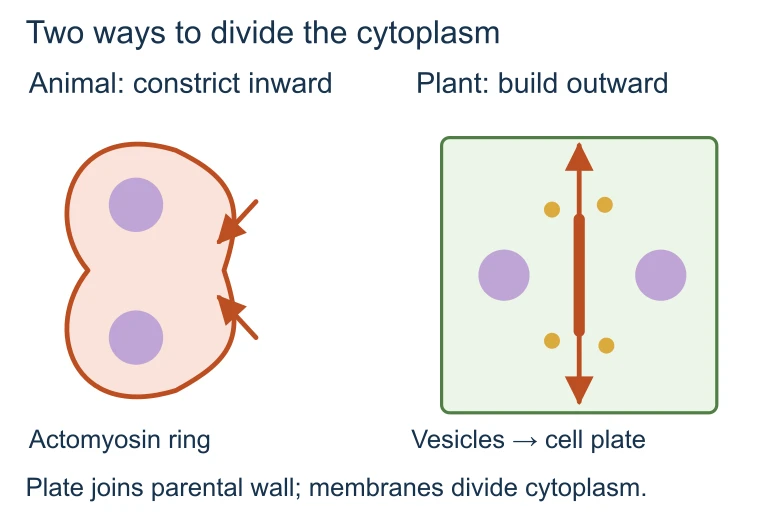
Two ways to divide the cytoplasm. Animal cytokinesis constricts inward through an actomyosin ring. In plant cells, Golgi-derived vesicles build a central cell plate that expands outward and joins the parental boundary.Animal cytokinesis constricts inward through an actomyosin ring. In plant cells, Golgi-derived vesicles build a central cell plate that expands outward and joins the parental boundary.

Stages of Mitosis: Visual Guide

Prophase Chromosomes condense Metaphase Aligned at equator Anaphase Chromatids separate Telophase Two nuclei form Mnemonic: PMAT (Prophase, Metaphase, Anaphase, Telophase)

Mitosis vs. Meiosis

Mitosis Meiosis
Purpose Growth and repair Gamete production
Divisions 1 2
Daughter cells 2 diploid (\(2n\)) 4 haploid (\(n\))
Genetic result Identical to parent Genetically unique
Crossing over? No Yes (prophase I)
Occurs in Somatic cells Germ cells only

Regulation of the Cell Cycle

The cell cycle is tightly controlled by an internal "braking system" that uses checkpoints, cyclins, and cyclin-dependent kinases (Cdks) to ensure each phase is completed accurately before the next begins.

G1 Checkpoint Cell size? DNA damage? G2 Checkpoint DNA replicated fully? M Checkpoint Spindles attached? End of G1 End of G2 During M Cyclin + Cdk complexes drive progression through each checkpoint If conditions not met: cell cycle HALTS or triggers apoptosis

Cyclins and Cdks

1
Cyclins are regulatory proteins whose concentrations rise and fall rhythmically during the cell cycle. They have no enzymatic activity on their own.
2
Cdks (cyclin-dependent kinases) are enzymes that phosphorylate target proteins, but they are only active when bound to the appropriate cyclin partner.
3
MPF (Maturation Promoting Factor) is the cyclin-Cdk complex that triggers the cell's entry from G2 into M phase. It is composed of cyclin B + Cdk1.

When Control Fails: Cancer

Cancer results from mutations in genes that regulate the cell cycle. Two major categories of genes are involved:

Proto-oncogenes
Normal genes that promote cell growth. When mutated into oncogenes, they become permanently "on," driving uncontrolled division.
Tumor Suppressors
Genes like p53 and Rb that halt the cell cycle or trigger apoptosis. When mutated, the "brakes" fail.

How to Identify Cell Cycle Phases

1
Check DNA content. If the cell has \(2n\) amount of DNA and has not yet replicated, it is in G1. If DNA content has doubled to \(4n\), it has completed S phase.
2
Look at chromosome appearance. Diffuse chromatin = interphase. Condensed, visible chromosomes = mitosis.
3
Note chromosome position. Aligned at center = metaphase. Moving apart = anaphase. At poles = telophase.
4
Check for a cleavage furrow (animal cells) or cell plate (plant cells): these indicate cytokinesis.

Example: DNA Content Over Time

0 \(2n\) \(4n\) G1 S G2 M G1 Time DNA Amount

Example: Mitotic Index

The mitotic index measures the fraction of cells in a population that are undergoing mitosis. It is calculated as:

Problem: A student examines a slide of onion root tip cells and counts 200 total cells. Of those, 36 cells are in some stage of mitosis. What is the mitotic index?

Example: Estimating Phase Duration

Problem: A cell has a total cycle time of 24 hours. If the mitotic index is 4%, approximately how long does the M phase last?

1
Set up the proportion. If 4% of cells are in M phase at any moment, then the M phase occupies approximately 4% of the total cycle time.
2
Calculate: \(0.04 \times 24 \text{ hours} = 0.96 \text{ hours} \approx 58 \text{ minutes}\)
3
Interpret: The M phase lasts about 1 hour, while interphase occupies the remaining ~23 hours.

Common Mistakes

✕ Confusing Mitosis with the Whole M Phase
Mitosis is only nuclear division. Cytokinesis (cytoplasm division) is a separate event that completes the M phase.
✕ Thinking S Phase Creates New Chromosomes
S phase creates sister chromatids (joined copies), not additional separate chromosomes. Chromosome number stays the same.
✕ Mixing Up Mitosis and Meiosis
Mitosis produces 2 identical diploid cells. Meiosis produces 4 unique haploid cells. They serve completely different purposes.

Question 1 of 5

During which phase of the cell cycle does DNA replication occur?

Question 2 of 5

A researcher observes a cell in which chromosomes are lined up along the metaphase plate with spindle fibers attached to the centromeres. This cell is in which stage?

Question 3 of 5

The protein p53 is best described as a:

Question 4 of 5

A student counts 300 cells on a microscope slide and finds that 45 are in mitosis. The total cell cycle time is 20 hours. Approximately how long is the M phase?

Question 5 of 5

Which statement correctly distinguishes mitosis from meiosis?