Cell
Compartmentalization
Discover how membrane-bound organelles create specialized environments that drive the complex chemistry of life.
What Is Compartmentalization?
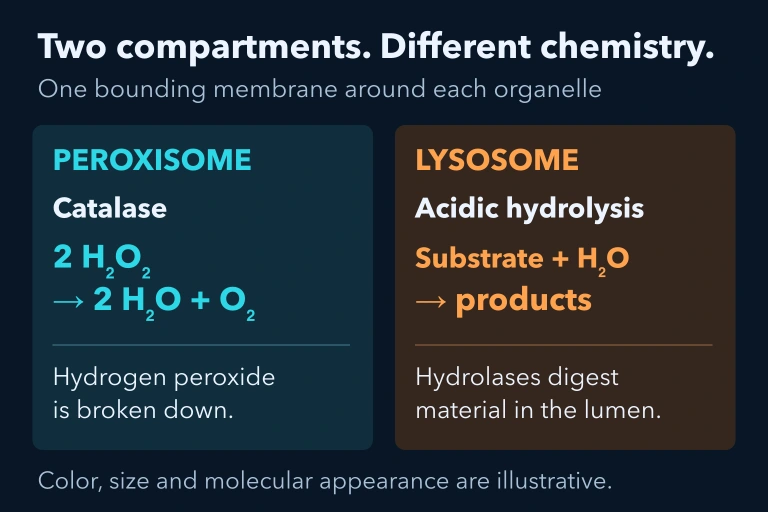
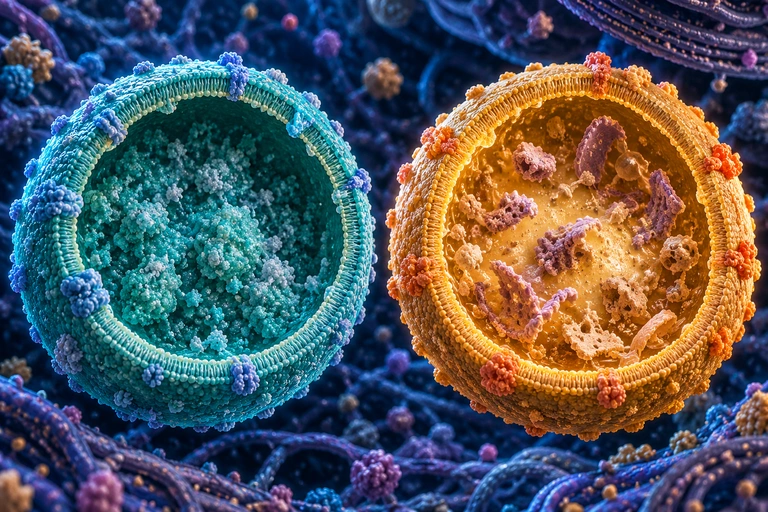
Eukaryotic cells divide their interior into membrane-bound compartments called organelles. Each compartment maintains a distinct internal environment—its own pH, ion concentrations, and enzyme sets—allowing incompatible chemical reactions to occur simultaneously within the same cell.
Why Does Compartmentalization Matter?
Prokaryotic vs Eukaryotic Organization
The Endomembrane System
Many organelles are physically or functionally connected through the endomembrane system—a network of membranes that coordinates protein synthesis, modification, packaging, and transport.
Core Principle: Membranes Create Microenvironments
Every membrane-bound compartment maintains a unique chemical environment. The phospholipid bilayer acts as a selective barrier, and embedded transport proteins control which molecules enter and exit.
Key Organelles and Their Specialized Roles
Cell compartments as distinct chemical environments
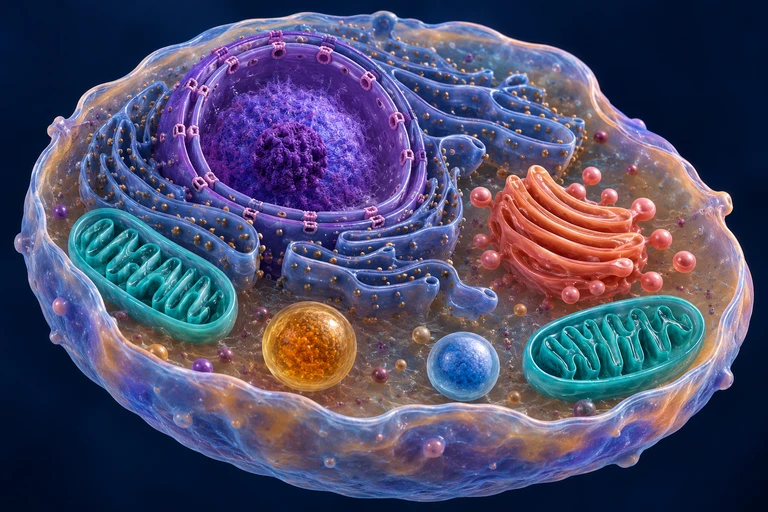
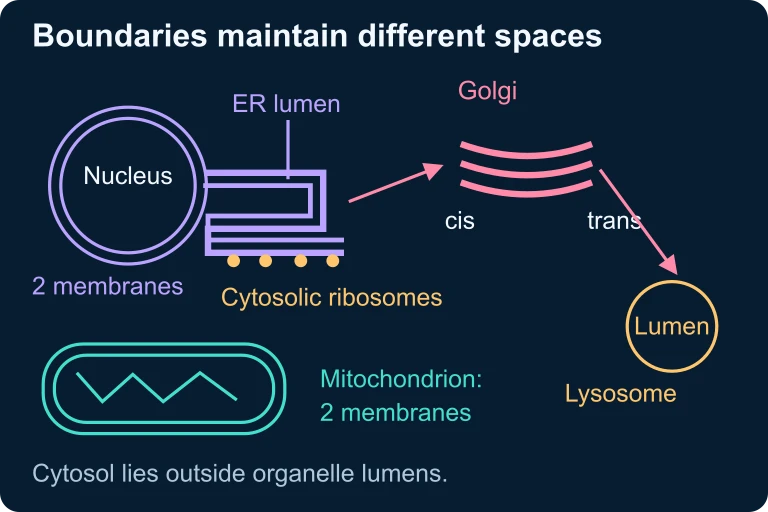
Membranes separate cytosol from organelle lumens and maintain distinct chemical environments. The nuclear outer membrane connects with the endoplasmic reticulum; mitochondrial and peroxisomal protein import follows routes distinct from ER–Golgi vesicle traffic.Boundaries maintain different spaces
Membranes separate cytosol from organelle lumens and maintain distinct chemical environments. The nuclear outer membrane connects with the endoplasmic reticulum; mitochondrial and peroxisomal protein import follows routes distinct from ER–Golgi vesicle traffic.Vesicles and direct import are different routes
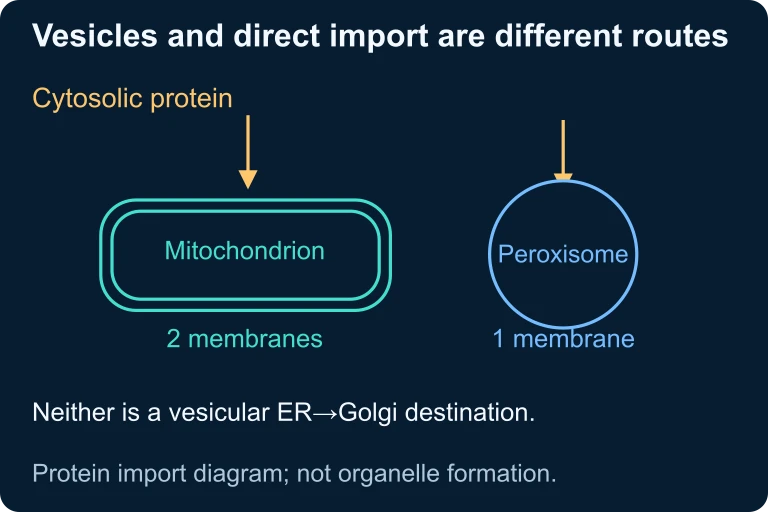
Mitochondrial and peroxisomal proteins can enter from the cytosol through direct-import routes distinct from ER–Golgi vesicle transport.A cell homogenate separates into enriched fractions
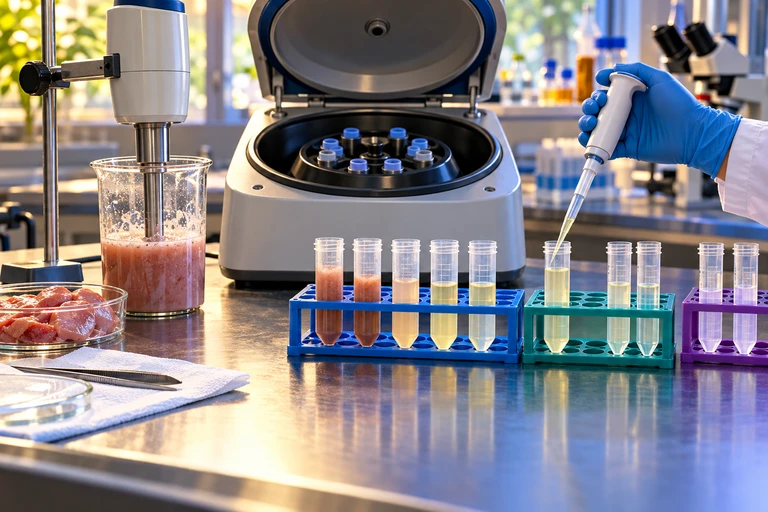
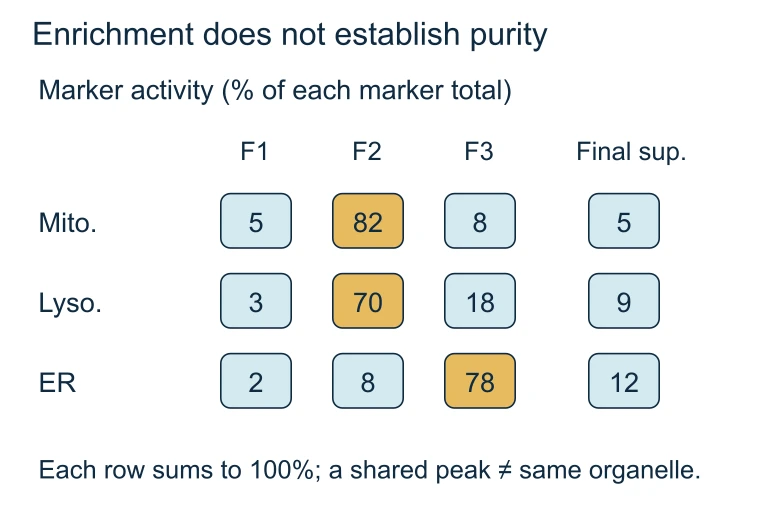
Each centrifugation step processes the previous supernatant while retaining its pellet. Marker activities identify enriched fractions rather than pure organelles; mitochondrial and lysosomal markers both peak in fraction 2.Sequential spins preserve sample lineage
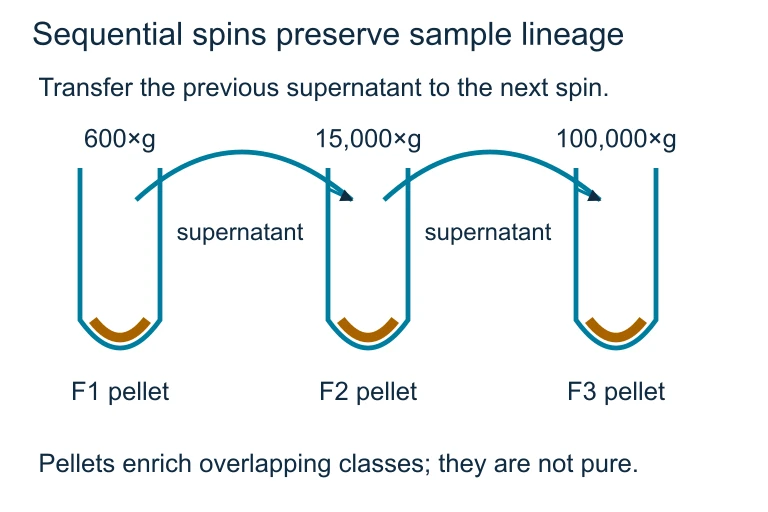
Each centrifugation step processes the previous supernatant while retaining its pellet. Marker activities identify enriched fractions rather than pure organelles; mitochondrial and lysosomal markers both peak in fraction 2.Enrichment does not establish purity
Each marker-activity row sums to 100%. Shared mitochondrial and lysosomal peaks in fraction 2 show that enrichment does not establish purity.Mitochondria: Compartments Within Compartments
Mitochondria vs Chloroplasts
| Mitochondria | Chloroplasts | |
|---|---|---|
| Function | Cellular respiration | Photosynthesis |
| Membranes | Double (+ cristae) | Double (+ thylakoids) |
| \( \text{H}^+ \) pumped to | Intermembrane space | Thylakoid lumen |
| ATP synthase location | Inner membrane | Thylakoid membrane |
| Energy input | Glucose / organic molecules | Light energy |
| Own DNA? | Yes | Yes |
Surface Area to Volume: Why Compartments Help
As cells grow larger, their volume increases faster than surface area. Internal membranes solve this by adding enormous surface area without changing the cell's outer dimensions.
How to Analyze Compartmentalization Questions
Example 1: Lysosomal Digestion
Question: Why must digestive enzymes be enclosed within lysosomes rather than free in the cytoplasm?


An acidic lumen has a boundary and an energy cost
A lysosomal lumen at pH 4.8 has about 251 times the hydrogen-ion concentration of cytosol at pH 7.2. A V-type H⁺-ATPase uses ATP to pump protons into the lumen and maintain this gradient.Acidic lumen: a maintained proton gradient
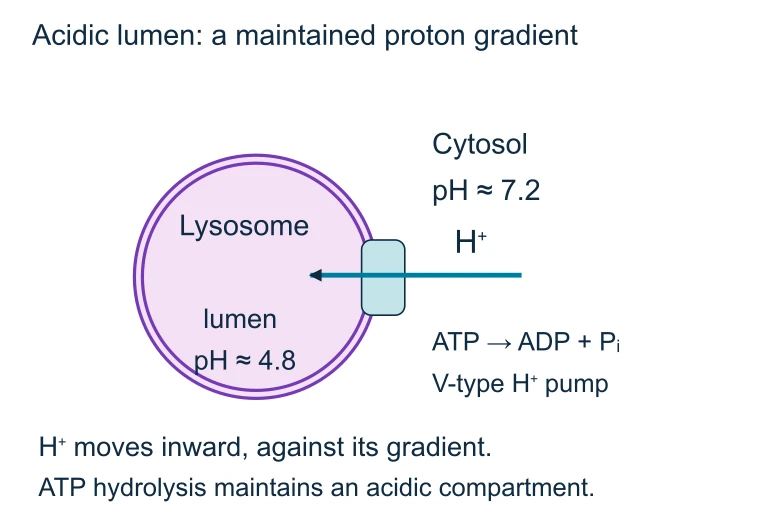
A lysosomal lumen at pH 4.8 has about 251 times the hydrogen-ion concentration of cytosol at pH 7.2. A V-type H⁺-ATPase uses ATP to pump protons into the lumen and maintain this gradient.pH differences become concentration ratios
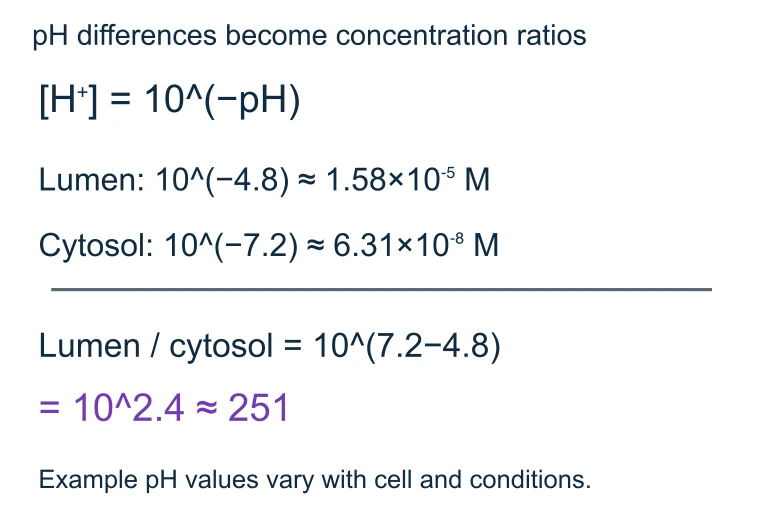
Hydrogen-ion concentration varies as 10 to the negative pH. The lumen-to-cytosol ratio is 10^(7.2−4.8), or about 251.Example 2: Oxidative Phosphorylation
Question: How does the structure of the mitochondrion enable efficient ATP production?
Example 3: Protein Trafficking
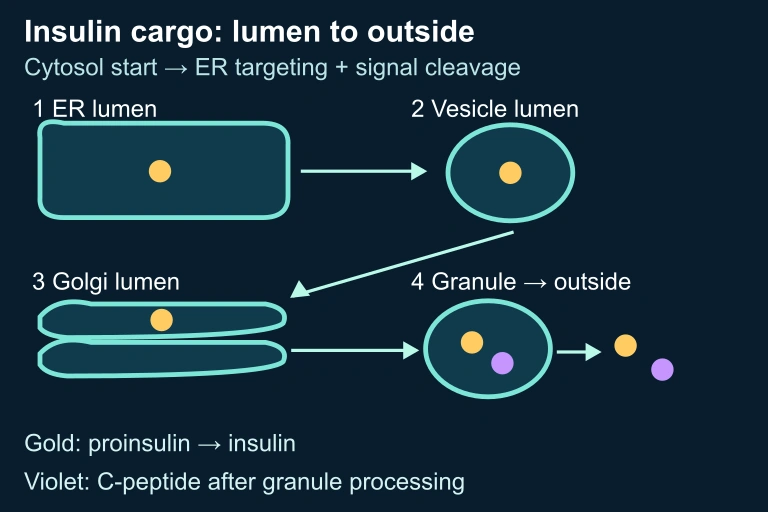
Scenario: A secretory protein is synthesized by a ribosome. Trace its path through the endomembrane system to the plasma membrane.


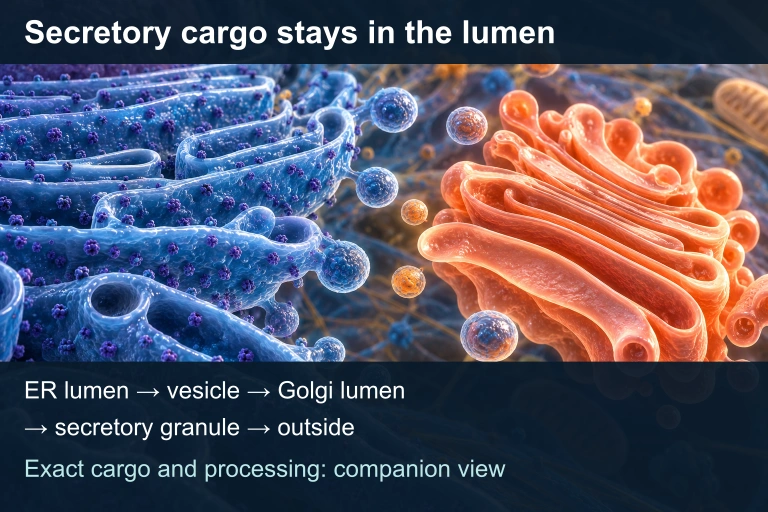
A secretory cargo stays inside the membrane-enclosed route
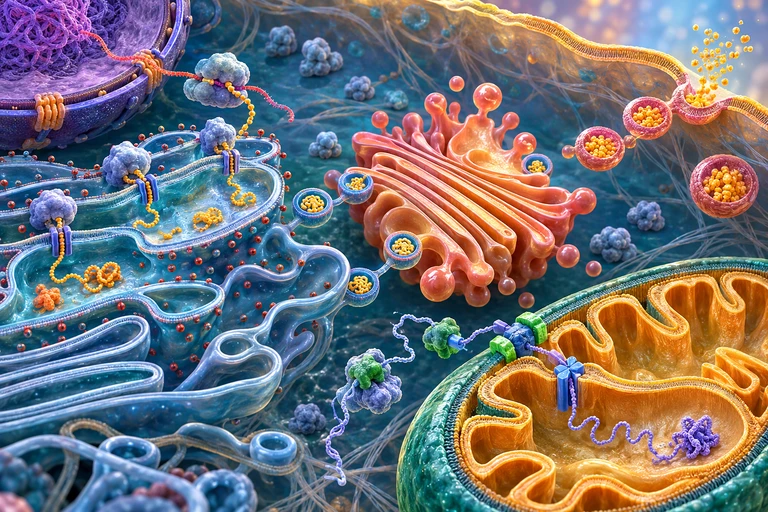
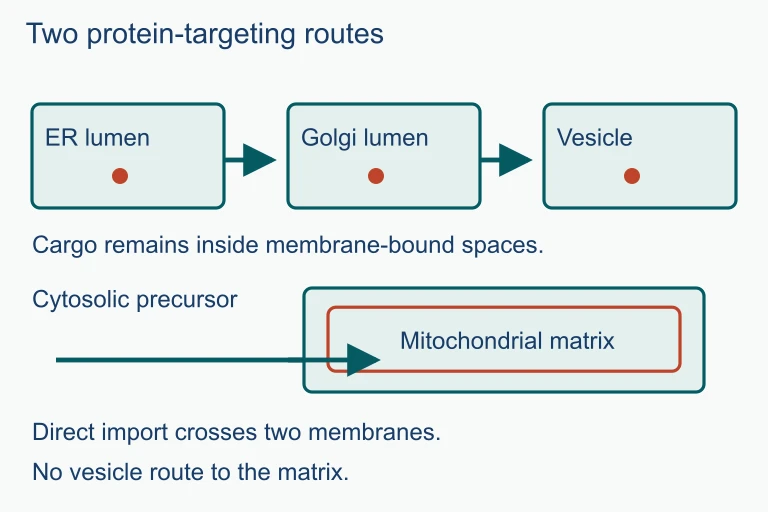
Secretory cargo stays inside membrane-enclosed spaces as vesicles bud and fuse. Proteins entering the mitochondrial matrix follow a separate direct-import route.Two protein-targeting routes
Secretory cargo stays inside membrane-enclosed spaces as vesicles bud and fuse. Proteins entering the mitochondrial matrix follow a separate direct-import route.Common Mistakes
Organelle Summary
| Organelle | Key Environment | Main Function |
|---|---|---|
| Nucleus | Protected DNA | Gene expression |
| Rough ER | Oxidizing lumen | Protein folding |
| Golgi | Graded pH (cis→trans) | Modification, sorting |
| Lysosome | Acidic (\( \text{pH} \approx 5 \)) | Intracellular digestion |
| Mitochondria | \( \text{H}^+ \) gradient | ATP production |
| Chloroplast | Light-harvesting thylakoids | Photosynthesis |
| Peroxisome | Oxidative | Detox, fatty acid breakdown |
Question 1 of 5
Which of the following best explains why lysosomes maintain an acidic internal \( \text{pH} \)?
Question 2 of 5
A researcher discovers that a drug makes the inner mitochondrial membrane permeable to \( \text{H}^+ \) ions. What is the most likely immediate effect?
Question 3 of 5
A secretory protein is translated on the rough ER. Which path correctly traces its route to the extracellular space?
Question 4 of 5
Which organelles are NOT considered part of the endomembrane system?
Question 5 of 5
Compartmentalization increases reaction efficiency primarily because it: