Carbohydrates
Structure & Function
Explore the molecular building blocks of life: from simple sugars to complex polysaccharides, and how their structure determines biological function.
What Are Carbohydrates?
Carbohydrates are organic molecules composed of carbon, hydrogen, and oxygen. They follow the general formula \( \text{C}_n(\text{H}_2\text{O})_n \), which literally means "hydrated carbons."
Monosaccharides: The Simplest Sugars
Monosaccharides are single sugar units that cannot be hydrolyzed into simpler carbohydrates. They are classified by the number of carbon atoms they contain.
Classifying Sugars by Carbon Number
Monosaccharides are named by their number of carbons. The most biologically important are pentoses (5C) and hexoses (6C).
| Type | Carbons | Formula | Examples |
|---|---|---|---|
| Triose | 3 | \( \text{C}_3\text{H}_6\text{O}_3 \) | Glyceraldehyde |
| Pentose | 5 | \( \text{C}_5\text{H}_{10}\text{O}_5 \) | Ribose, Deoxyribose |
| Hexose | 6 | \( \text{C}_6\text{H}_{12}\text{O}_6 \) | Glucose, Fructose, Galactose |
Dehydration Synthesis: Building Polymers
Monosaccharides link together through dehydration synthesis (also called condensation), forming a glycosidic bond and releasing a water molecule.
Common Disaccharides
Disaccharides are formed when two monosaccharides join via a glycosidic bond. Each disaccharide has its own specific combination of monomers.
Found in: table sugar, sugarcane, fruits
Found in: milk and dairy products
Found in: germinating grains, malt
Polysaccharides: Complex Carbohydrates
Polysaccharides are long chains of monosaccharides linked by glycosidic bonds. Their function depends on the type of monomer, the type of bond, and whether the chain is branched or unbranched.
Alpha vs Beta Glycosidic Bonds
The orientation of the glycosidic bond determines whether a polysaccharide is used for energy storage or structural support: this is one of the most important distinctions in carbohydrate biology.
Storage vs Structural Polysaccharides
| Feature | Storage | Structural |
|---|---|---|
| Function | Energy reserve | Physical support |
| Bond type | \( \alpha \)-glycosidic | \( \beta \)-glycosidic |
| Chain shape | Helical / branched | Straight / rigid |
| Examples | Starch, Glycogen | Cellulose, Chitin |
| Organisms | Plants (starch), Animals (glycogen) | Plants (cellulose), Arthropods (chitin) |
| Digestible by humans? | Yes | No (fiber) |
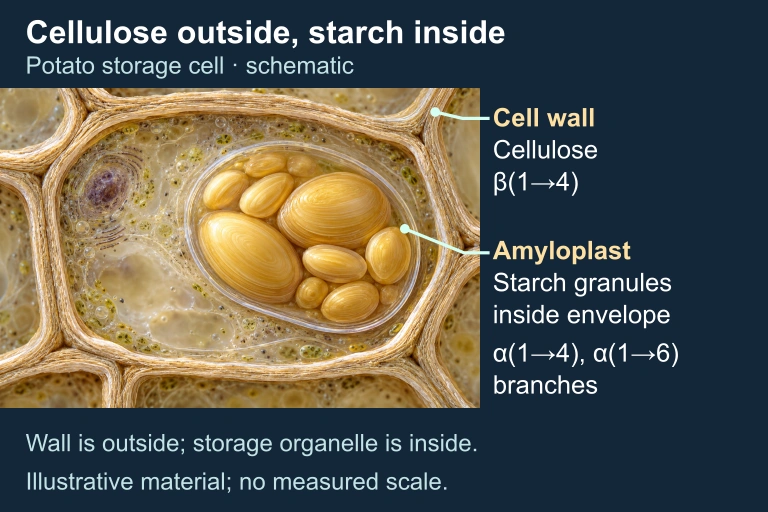
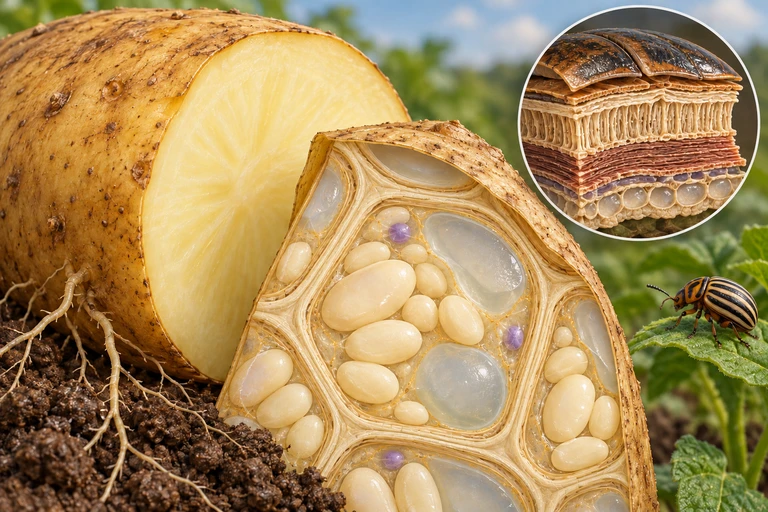
Polysaccharide geometry and biological function
 Amylose, amylopectin and glycogen use α-linked glucose chains; amylopectin and glycogen also have α-1,6 branches. Cellulose and chitin use unbranched β-1,4 backbones.
Linkage changes polymer function
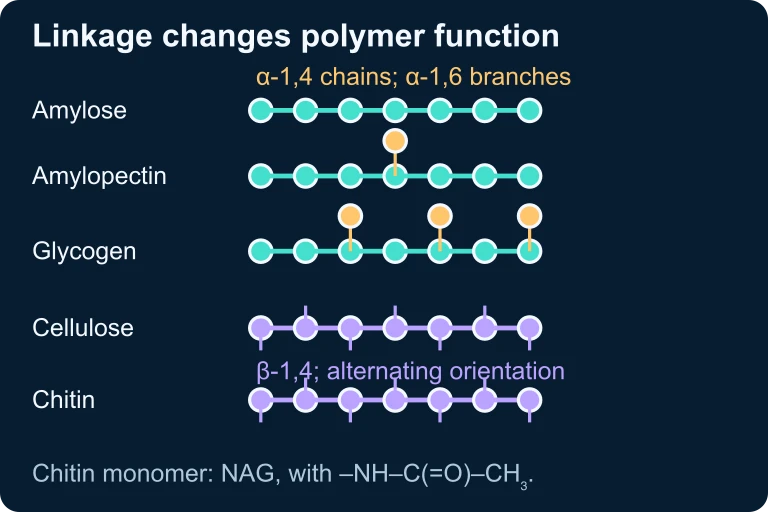 Amylose, amylopectin and glycogen use α-linked glucose chains; amylopectin and glycogen also have α-1,6 branches. Cellulose and chitin use unbranched β-1,4 backbones.
Different enzymes act at different sites
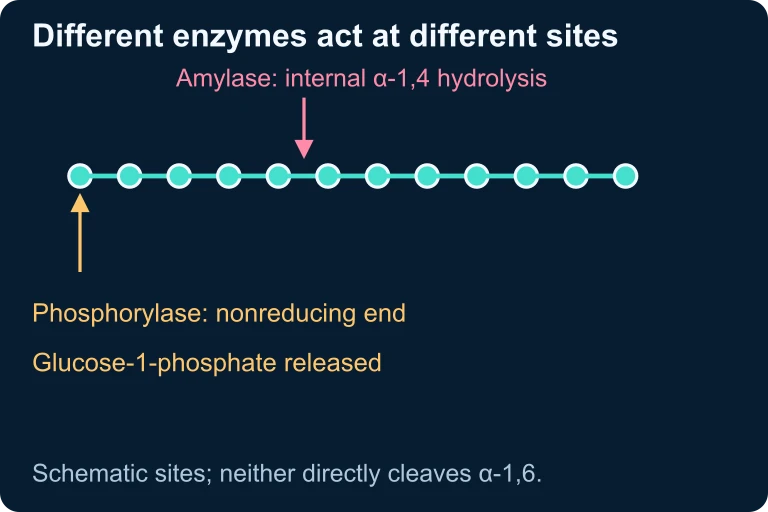 Amylase hydrolyzes internal α-1,4 bonds. Glycogen phosphorylase acts at nonreducing ends to release glucose-1-phosphate; neither enzyme directly cleaves α-1,6 branch bonds.
How to Identify Carbohydrates
Use this step-by-step checklist when encountering a carbohydrate question on the AP exam.
Example 1: Glucose Structure
Problem: Glucose has the molecular formula \( \text{C}_6\text{H}_{12}\text{O}_6 \). Verify that it fits the general carbohydrate formula \( \text{C}_n(\text{H}_2\text{O})_n \).
Example 2: Sucrose Hydrolysis
Problem: Write the hydrolysis reaction for sucrose (\( \text{C}_{12}\text{H}_{22}\text{O}_{11} \)). What products form?
Example 3: Why Can't We Digest Cellulose?
Problem: Both starch and cellulose are polymers of glucose. Why can humans digest starch but not cellulose?
Common Mistakes
Summary: Major Carbohydrates
| Molecule | Type | Monomer(s) | Function |
|---|---|---|---|
| Glucose | Monosaccharide | - | Cellular fuel |
| Sucrose | Disaccharide | Glu + Fru | Transport sugar (plants) |
| Starch | Polysaccharide | Glucose (\( \alpha \)) | Energy storage (plants) |
| Glycogen | Polysaccharide | Glucose (\( \alpha \)) | Energy storage (animals) |
| Cellulose | Polysaccharide | Glucose (\( \beta \)) | Structure (plant walls) |
| Chitin | Polysaccharide | NAG (\( \beta \)) | Structure (arthropods) |
Question 1 of 5
Which of the following correctly describes the process by which a disaccharide is formed from two monosaccharides?
Question 2 of 5
Glucose, fructose, and galactose all have the molecular formula \( \text{C}_6\text{H}_{12}\text{O}_6 \). These molecules are best described as:
Question 3 of 5
Starch and cellulose are both polymers of glucose, yet they have very different properties. The primary reason for this difference is:
Question 4 of 5
An animal cell needs to store glucose for rapid energy release. Which polysaccharide would it use, and why?
Question 5 of 5
A student observes that adding the enzyme sucrase to a sucrose solution produces glucose and fructose. This reaction is an example of: