Biotechnology
Tools and Techniques
Explore how scientists manipulate DNA, clone genes, and engineer organisms using restriction enzymes, PCR, and gel electrophoresis.
What Is Biotechnology?
Biotechnology is the use of biological systems and living organisms to develop or modify products and processes. At its core, modern biotechnology relies on our ability to read, copy, cut, and paste DNA.
Restriction Enzymes: Molecular Scissors
Creating Recombinant DNA
Polymerase Chain Reaction: PCR
PCR amplifies a specific DNA segment exponentially. After \(n\) cycles, you get approximately \( 2^n \) copies of the target sequence. Just 30 cycles produces over 1 billion copies.
Exponential Amplification in PCR
Gel Electrophoresis: Separating DNA
Sticky vs Blunt Ends
| Sticky Ends | Blunt Ends | |
|---|---|---|
| Cut Pattern | Staggered (offset cuts) | Straight across both strands |
| Overhangs | Single-stranded overhangs | No overhangs |
| Base Pairing | Can H-bond with complementary ends | No complementary base pairing |
| Ligation | More efficient, directional | Less efficient, non-directional |
| Example Enzyme | EcoRI | SmaI |
Gene Cloning via Bacterial Transformation
A cloning experiment seen from bench to DNA
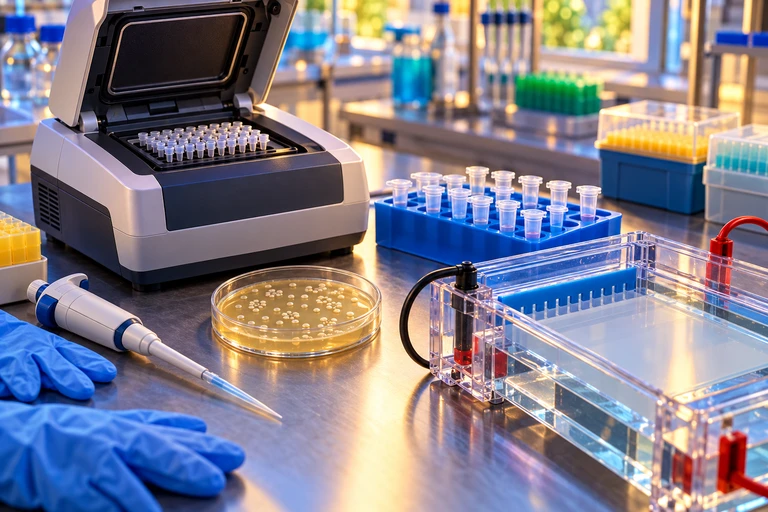
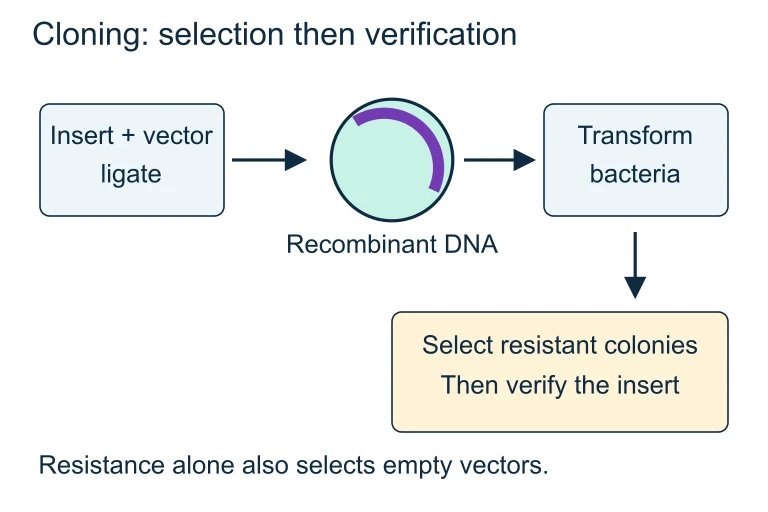
Cloning separates amplification, transformation, selection and insert verification. Vector resistance identifies transformed cells; checking the insert requires a further assay.Cloning: selection then verification
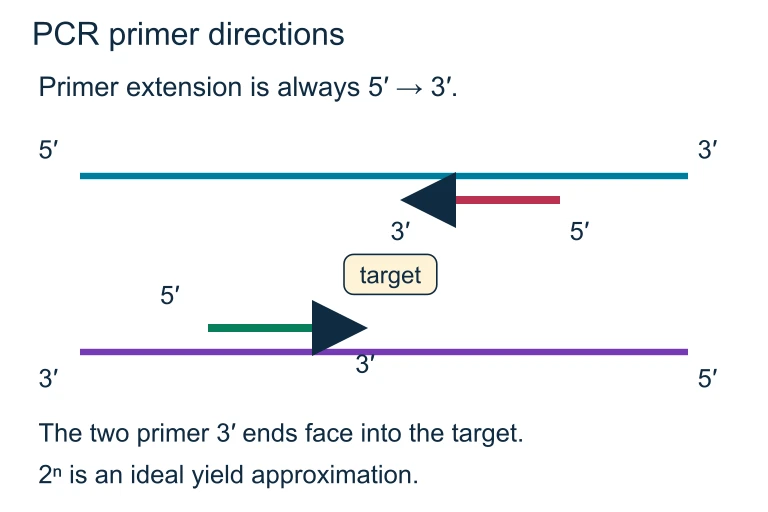
Cloning separates amplification, transformation, selection and insert verification. Vector resistance identifies transformed cells; checking the insert requires a further assay.PCR primer directions
Both PCR primers extend 5′ to 3′, with their 3′ ends directed into the target region.Restriction sites constrain fragments
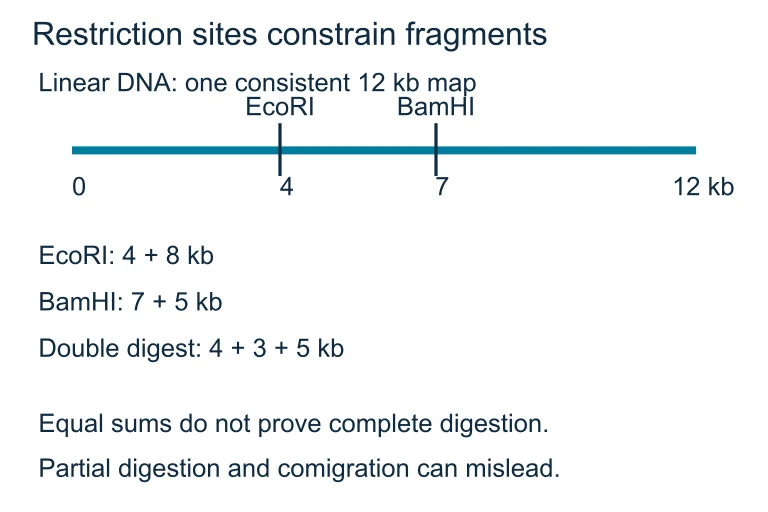
For the 12 kb linear DNA map, EcoRI cuts at 4 kb and BamHI at 7 kb. A complete double digest therefore produces 4, 3 and 5 kb fragments.Gel migration is not a linear ruler
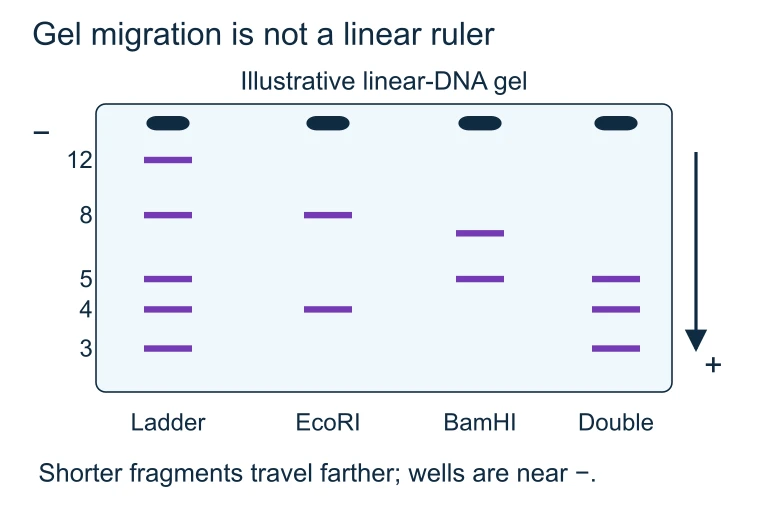
DNA moves from the negative end toward the positive electrode. Shorter fragments travel farther, and migration distance is not a linear ruler for fragment length.Real-World Applications
CRISPR-Cas9: Genome Editing
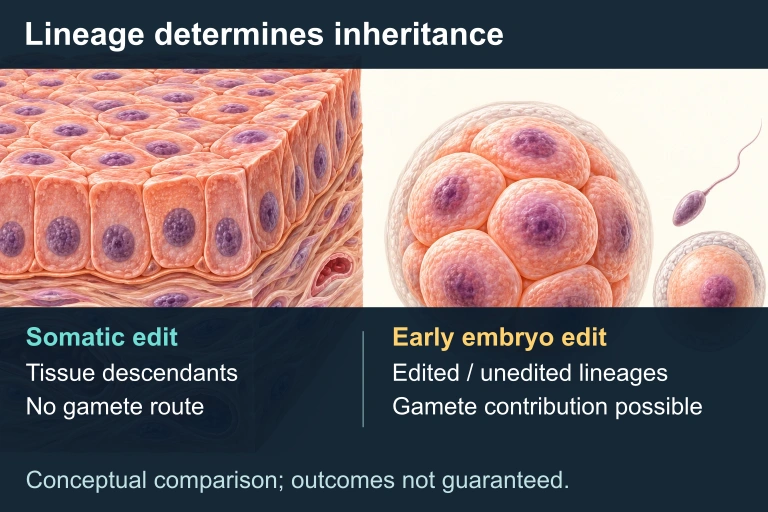
Distinguish editing a patient’s tissue from a potentially heritable change.
Somatic edits generally remain within tissue lineages. Germline or early-embryo edits can contribute to gametes, with inheritance and mosaicism depending on which cells carry the edit.
Example: Restriction Digest Analysis
A linear DNA molecule of \(10\,\text{kb}\) is digested with EcoRI. Gel electrophoresis reveals three fragments: \(2\,\text{kb}\), \(3\,\text{kb}\), and \(5\,\text{kb}\). How many EcoRI cut sites are present?
Example: PCR Amplification Math
A forensic scientist begins with 5 copies of a DNA sample and runs 25 cycles of PCR. How many copies of the target sequence will there be?
Example: Interpreting a Gel
Four suspects' DNA is compared to crime scene evidence using STR analysis. Whose DNA matches?
Common Mistakes
Biotechnology Techniques Summary
| Technique | Purpose | Key Enzyme/Tool |
|---|---|---|
| Restriction Digest | Cut DNA at specific sites | Restriction endonuclease |
| Ligation | Join DNA fragments | DNA ligase |
| PCR | Amplify specific DNA in vitro | Taq polymerase + primers |
| Gel Electrophoresis | Separate DNA by size | Agarose gel + electric field |
| Transformation | Introduce DNA into cells | Heat shock / electroporation |
| CRISPR-Cas9 | Edit specific genomic sequences | Cas9 nuclease + guide RNA |
Question 1 of 5
A restriction enzyme cuts a circular plasmid at 3 recognition sites. How many DNA fragments will be produced?
Question 2 of 5
During PCR, what is the role of the primers?
Question 3 of 5
In gel electrophoresis, which fragment will travel the farthest from the well?
Question 4 of 5
Why is Taq polymerase used in PCR instead of regular DNA polymerase?
Question 5 of 5
In CRISPR-Cas9 gene editing, what is the function of the guide RNA (gRNA)?