01 / 21

Artificial
Selection

Explore how humans shape the evolution of species by selectively breeding organisms with desirable traits across generations.

AP Biology

What Is Artificial Selection?

Artificial selection is the process by which humans intentionally breed organisms to promote specific desirable traits. Unlike natural selection, where the environment determines which traits are advantageous, in artificial selection humans act as the selective agent.

Why Artificial Selection Matters

Agriculture
Crop yields have increased dramatically through selective breeding for disease resistance, size, and nutritional content.
Medicine
Model organisms like lab mice are bred with specific genetic traits to study human diseases and test treatments.
Evolutionary Evidence
Darwin used artificial selection as evidence that traits can change over generations, supporting his theory of natural selection.

Essential Vocabulary

1
Phenotype: The observable physical or biochemical characteristics of an organism, determined by both genotype and environment.
2
Genotype: The genetic makeup of an organism: the specific set of alleles it carries.
3
Heritable Variation: Differences among individuals that are passed from parents to offspring through DNA.
4
Selective Pressure: In artificial selection, the human breeder determines which trait confers "fitness" for reproduction.
5
Allele Frequency: The relative proportion of a particular allele in a population, which shifts over generations during selection.

How Artificial Selection Works

Generation 1
\(aa\)
\(AA\)
\(Aa\)
\(AA\)
Human selects desired trait Selected Parents
\(AA\)
\(AA\)
\(\times\)
Breed together Generation 2
\(AA\)
\(AA\)
\(AA\)
\(AA\)
Allele Frequency Shift Gen 1
\(a\): 37.5%
\(A\): 62.5%
Gen 2
\(A\): 100%
Desired allele (\(A\))
increases in frequency
Undesired allele (\(a\))
decreases or eliminated

The Core Principle

If any one of these conditions is missing, artificial selection cannot occur. For example, if a trait is caused entirely by environmental factors (not heritable), selecting for it will not change the next generation's phenotype distribution.

Natural vs. Artificial Selection

Natural Selection Artificial Selection
Selective Agent Environment Humans
Goal Survival & reproduction Desired phenotype
Speed Slow (many generations) Rapid (few generations)
Genetic Diversity Maintained or increased Often reduced
Direction Unpredictable, varies Intentional, consistent
Example Peppered moth coloration Dog breed development

How to Apply Artificial Selection

1
Identify the target trait: Determine which phenotypic characteristic you want to enhance or diminish in the population.
2
Survey variation: Examine the population for individuals that express the desired trait more strongly than others.
3
Select parents: Choose only individuals with the most extreme expression of the desired trait to breed.
4
Breed and evaluate offspring: Cross selected parents, then evaluate the offspring for the desired trait.
5
Repeat across generations: Continue selecting and breeding the best performers. Each generation should show increased frequency of the desired trait.

Example: Teosinte to Maize

Teosinte (Wild Ancestor) Many branches Tiny hard seeds ~9,000 years Modern Maize (Domesticated) Single stalk Large, soft kernels

Example: Dog Breeds from Wolves

Gray Wolf Chihuahua Companionship Small size Border Collie Herding Intelligence Greyhound Speed Lean body Saint Bernard Rescue Large, strong All breeds: same species (Canis lupus familiaris)

Example: Brassica oleracea Diversification

Wild Cabbage Broccoli Flower clusters Kale Leaves Cauliflower Flower buds Cabbage Terminal bud Brussels Sprouts Lateral buds Same species, different selected traits Selection on different plant structures produced remarkably different vegetables

Selection on different Brassica organs
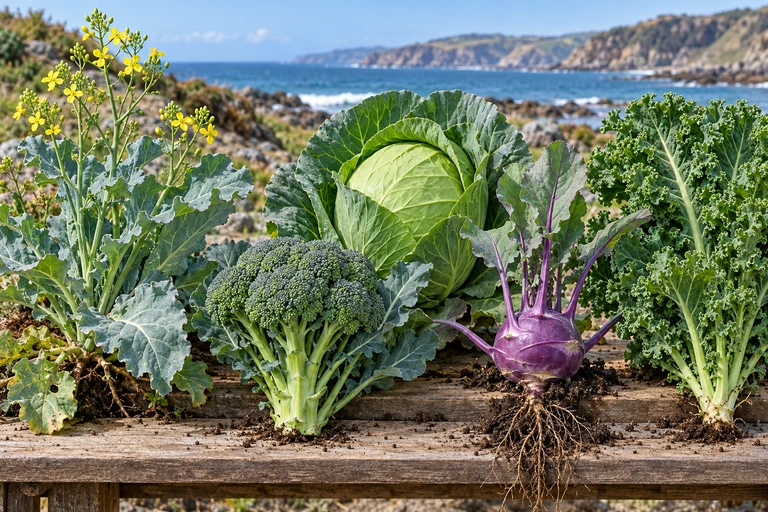
Wild coastal cabbage, broccoli, cabbage, purple kohlrabi above its roots and kale accompany an authored organ-selection branch diagram.Artificial selection has emphasized different organs of Brassica oleracea: flower clusters in broccoli, the terminal bud in cabbage, an enlarged stem in kohlrabi and leaves in kale.

Selection emphasizes different organs
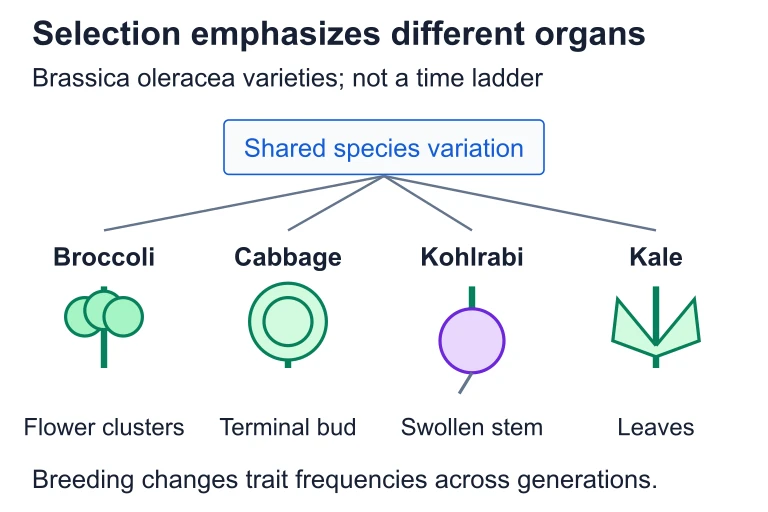
Selection emphasizes different organs. Artificial selection has emphasized different organs of Brassica oleracea: flower clusters in broccoli, the terminal bud in cabbage, an enlarged stem in kohlrabi and leaves in kale.Artificial selection has emphasized different organs of Brassica oleracea: flower clusters in broccoli, the terminal bud in cabbage, an enlarged stem in kohlrabi and leaves in kale.

Consequences: Reduced Genetic Diversity

Wild Population High diversity Selection Domesticated Population Low diversity Reduced genetic diversity leads to: Increased disease susceptibility Inbreeding depression and genetic disorders

Unintended Effects: Linkage & Inbreeding

Genetic Linkage
Selecting for one trait may inadvertently carry along linked genes on the same chromosome. Domesticated foxes bred for tameness also developed floppy ears and curly tails.
Inbreeding Depression
Mating closely related individuals increases homozygosity, which can expose harmful recessive alleles. Many purebred dogs suffer breed-specific genetic disorders.

Modern Applications

Crop Improvement
Wheat varieties have been selectively bred over centuries for higher yields, shorter stalks, and disease resistance, as seen in the Green Revolution.
Livestock Breeding
Dairy cows have been selectively bred to produce over 10 times more milk than their wild ancestors.
Lab Organisms
Drosophila (fruit flies) and E. coli strains are bred for specific traits to study gene function and disease.

Common Mistakes

✕ Confusing with GMOs
Artificial selection uses existing genetic variation through breeding. Genetic engineering directly modifies DNA in a lab. They are related but distinct processes.
✕ Ignoring Heritability
Only heritable traits respond to selection. A plant grown larger due to fertilizer won't pass that size to offspring if the trait is not genetic.
✕ Assuming Traits Are Isolated
Due to genetic linkage and pleiotropy, selecting for one trait can change other unrelated traits simultaneously.

Summary of Key Concepts

Concept Key Detail Example
Definition Humans select traits for breeding Breeding larger tomatoes
Requirements Variation, heritability, selective agent Coat color in dogs
Mechanism Shifts allele frequencies Increasing "A" allele in crops
Speed Faster than natural selection Dog breeds in ~15,000 years
Risk Reduced genetic diversity Irish Potato Famine
Linkage Unintended trait co-selection Belyaev's tame foxes

Question 1 of 5

Which of the following is the primary difference between artificial selection and natural selection?

Question 2 of 5

A farmer selects the cows that produce the most milk and breeds them together. After several generations, the average milk production increases. Which condition was essential for this outcome?

Question 3 of 5

In Belyaev's silver fox experiment, foxes were selected solely for tameness. Over generations, the foxes also developed floppy ears and piebald coats. What best explains these unselected traits appearing?

Question 4 of 5

Broccoli, kale, cauliflower, and cabbage all belong to the species Brassica oleracea. How did artificial selection produce such different-looking vegetables from one species?

Question 5 of 5

A major risk of intensive artificial selection in crop species is reduced genetic diversity. Why does this make populations more vulnerable?