
SECTION 1
Historical Context & Motivation
For most of scientific history, water was considered a fundamental element rather than a compound—Aristotle classified it as one of four elemental substances alongside earth, fire, and air. It was not until the late eighteenth century that chemists began to appreciate that water is a molecule with a definite composition, and the full understanding of hydrogen bonding would take another century and a half. The journey from recognizing water's composition to explaining its anomalous physical properties—high boiling point, surface tension, density maximum at 4 °C—required revolutions in both chemistry and quantum mechanics. Today, understanding the structure of water and its hydrogen bonds is foundational to AP Biology, because virtually every macromolecular interaction, enzymatic reaction, and cellular transport phenomenon depends on the unique behavior of H₂O.
1781 • Cavendish Synthesizes Water
1805 • Dalton's Atomic Theory
1920 • Latimer & Rodebush Describe Hydrogen Bonds
1933 • Bernal & Fowler Model Liquid Water
1957 • Linus Pauling's 'The Nature of the Chemical Bond'
The central question this lesson addresses is deceptively simple: how does a three-atom molecule composed of the two lightest reactive elements produce properties so radically different from those predicted by molecular weight alone? The answer lies in polarity and hydrogen bonding—intermolecular forces that arise directly from water's bent molecular geometry and the electronegativity difference between oxygen and hydrogen.
SECTION 2
Core Principles & Definitions
Water's remarkable properties emerge from a small set of interrelated principles rooted in molecular geometry and electron distribution. Each water molecule consists of one oxygen atom covalently bonded to two hydrogen atoms, but the geometry is not linear—it is bent at approximately 104.5°. This angle, combined with oxygen's high electronegativity (3.44 on the Pauling scale compared to hydrogen's 2.20), produces a permanent dipole moment across the molecule. This polarity is the foundation upon which all of water's biologically important behaviors are built.
Polar Covalent Bonding
Bent Molecular Geometry
Hydrogen Bonding
Cohesion & Adhesion
High Specific Heat & Heat of Vaporization
KEY TAKEAWAY
SECTION 3
Visual Explanation — Water's Molecular Geometry
The visual above illustrates why water is a polar molecule rather than a nonpolar one. Oxygen's electron configuration gives it six valence electrons; two of these form covalent bonds with hydrogen atoms, while four remain as lone pairs. VSEPR theory (Valence Shell Electron Pair Repulsion) predicts that the four electron-pair domains around oxygen adopt a roughly tetrahedral arrangement, but because two domains are lone pairs rather than bonding pairs, the resulting molecular shape is bent. Had the molecule been linear (180°), the two O–H bond dipoles would have pointed in opposite directions and canceled, yielding a nonpolar molecule. The 104.5° angle ensures the dipoles add constructively, producing a strong net dipole of 1.85 debye. This permanent polarity is the origin of water's capacity to form hydrogen bonds with itself and with other polar or charged species.
SECTION 4
How Hydrogen Bonding Works
A hydrogen bond is an electrostatic attraction between a hydrogen atom covalently bonded to a highly electronegative atom (the hydrogen-bond donor) and a lone pair on another electronegative atom (the hydrogen-bond acceptor). In water, each molecule can act as both donor and acceptor: the two O–H bonds provide two potential donor sites, and the two lone pairs on oxygen provide two acceptor sites. This yields a maximum of four hydrogen bonds per molecule—a tetrahedral arrangement that is fully realized in ice and partially maintained in liquid water, where the average molecule participates in roughly 3.4 hydrogen bonds at any instant.
HYDROGEN BOND ENERGY
Compare this to a typical O–H covalent bond energy of ~463 kJ mol⁻¹. Hydrogen bonds are roughly 5–10% as strong as covalent bonds, placing them in the category of intermolecular forces rather than chemical bonds.
COULOMB'S LAW (QUALITATIVE APPLICATION)
Where F is the electrostatic force, q₁ and q₂ are the partial charges (δ+ and δ−), and r is the distance between them. Because hydrogen bonding is fundamentally electrostatic, its strength increases with larger partial charges (higher electronegativity difference) and decreases rapidly with distance.
The directional character of hydrogen bonds distinguishes them from other intermolecular forces. Unlike van der Waals interactions, which are nondirectional, hydrogen bonds are strongest when the donor atom, the hydrogen, and the acceptor atom are nearly collinear (an O–H···O angle close to 180°). This directionality is critical in biology: it dictates the specific geometry of base pairing in DNA (adenine forms two hydrogen bonds with thymine; guanine forms three with cytosine), the alpha-helix and beta-sheet secondary structures in proteins, and the three-dimensional folding of RNA molecules. In every case, the spatial precision of hydrogen bonding enables molecular recognition events that underpin the central dogma of biology.
AP EXAM TIP
SECTION 5
Emergent Properties of Water
The collective behavior of water's hydrogen-bond network produces several emergent properties—macroscopic phenomena that cannot be predicted from a single water molecule alone. Each of these properties has direct biological significance, and the AP Biology exam expects you to connect the molecular explanation to its organismal or ecological consequence.
| Emergent Property | Molecular Explanation | Biological Significance |
|---|---|---|
| Cohesion / Surface Tension | Extensive hydrogen bonding between water molecules resists disruption at the liquid surface. | Water transport in xylem via transpiration-cohesion-tension mechanism; insects walk on water. |
| Adhesion | Water molecules form hydrogen bonds with polar surfaces (e.g., cellulose in plant cell walls). | Capillary action in plant vascular tissue; meniscus in narrow tubes. |
| High Specific Heat | Energy absorbed must first break hydrogen bonds before increasing kinetic energy (temperature). | Thermal buffering of cells and organisms; ocean moderates coastal climates. |
| High Heat of Vaporization | Many hydrogen bonds must be broken for a molecule to escape the liquid phase. | Evaporative cooling (sweating, transpiration) dissipates large amounts of heat per gram of water lost. |
| Ice Floats (Density Anomaly) | In ice, every molecule forms 4 hydrogen bonds in a rigid, open hexagonal lattice less dense than liquid water. | Frozen surface insulates aquatic ecosystems; prevents lakes from freezing solid in winter. |
| Universal Solvent | Polar water molecules surround and stabilize ions (hydration shells) and interact with polar solutes. | Medium for biochemical reactions; transport of nutrients and waste in blood and cytoplasm. |
Emergent Properties of Water and Their Biological Significance
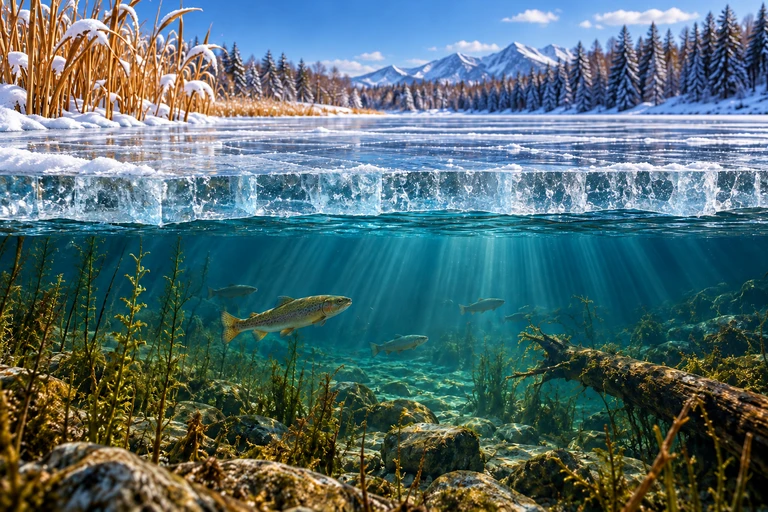
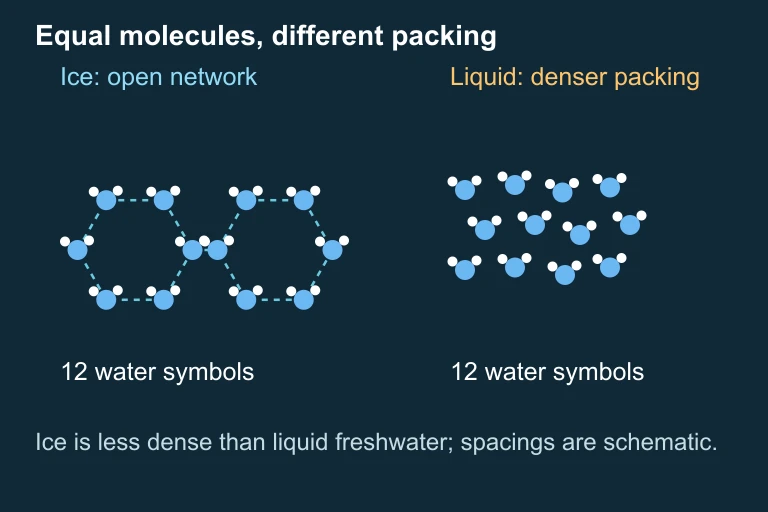 Ordinary freshwater ice is less dense than liquid water and can float above an insulated liquid habitat. Equal-count molecular symbols compare an explicitly projected open network with less ordered liquid packing; they do not provide calibrated volumes or a universal pond temperature profile.
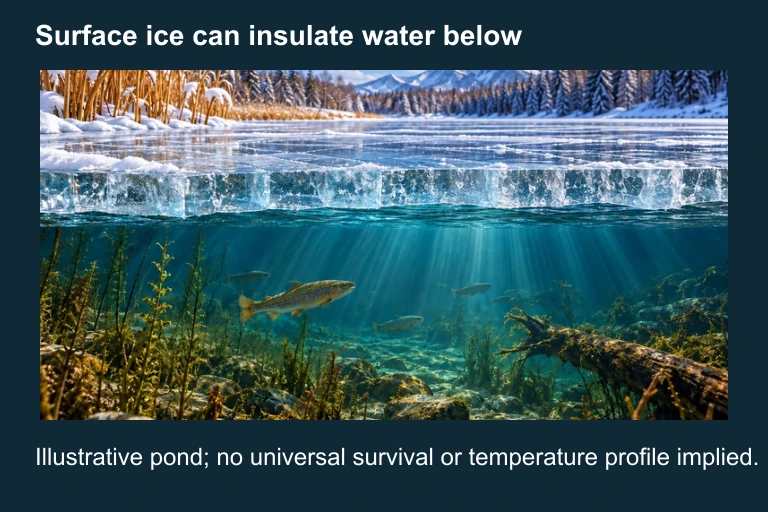 Illustrative pond context.
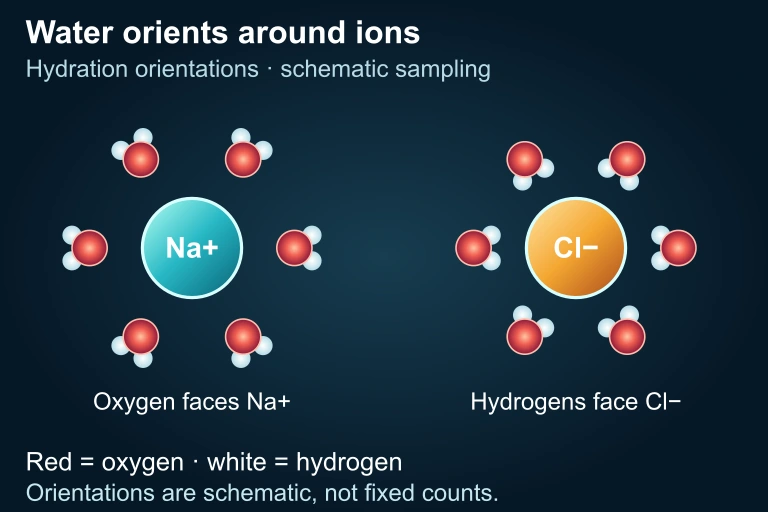 Water orientation around ions is schematic, not a fixed hydration-number claim. The nonpolar companion shows four separated schematic objects and the same four objects clustered, reducing exposed nonpolar surface. This illustrates the hydrophobic effect, not a special repulsive bond.
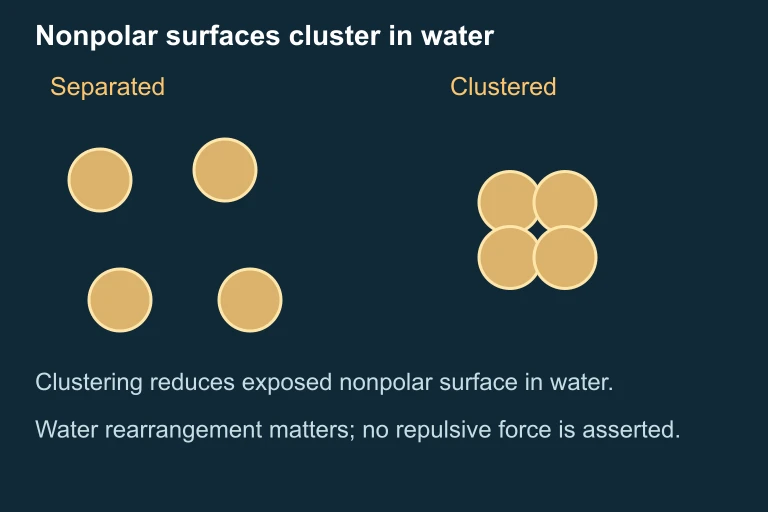 Water orientation around ions is schematic, not a fixed hydration-number claim. The nonpolar companion shows four separated schematic objects and the same four objects clustered, reducing exposed nonpolar surface. This illustrates the hydrophobic effect, not a special repulsive bond.
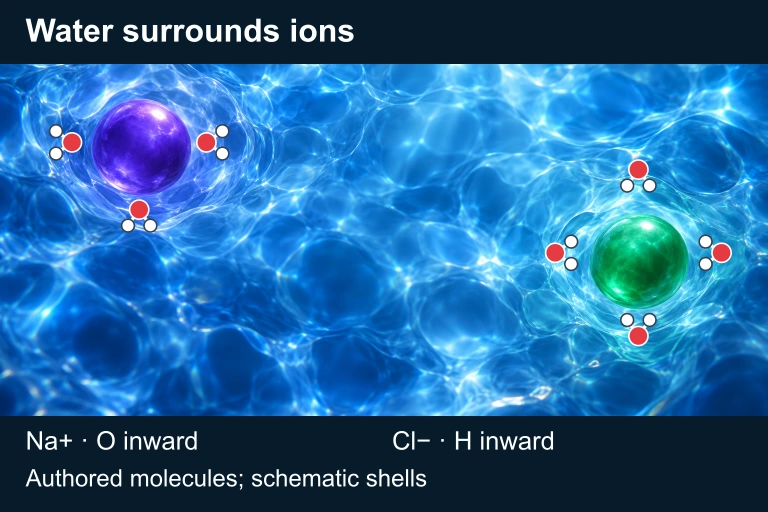 Water orientation around ions is schematic, not a fixed hydration-number claim. The nonpolar companion shows four separated schematic objects and the same four objects clustered, reducing exposed nonpolar surface. This illustrates the hydrophobic effect, not a special repulsive bond.
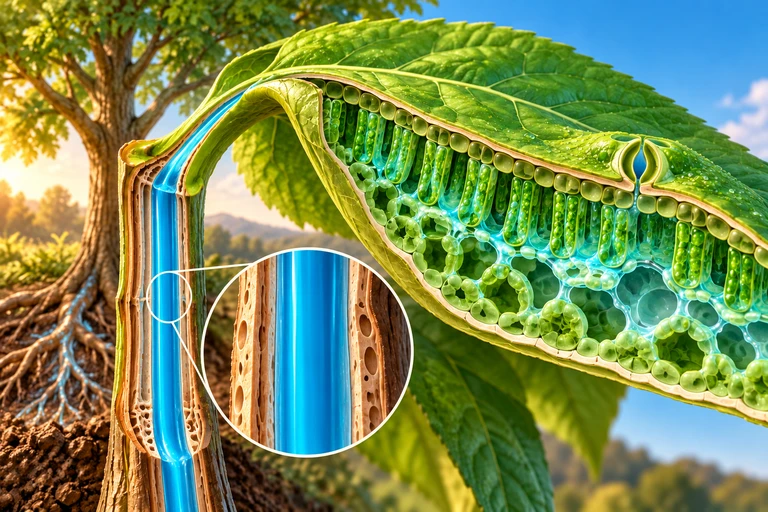 Evaporation from moist mesophyll walls creates tension transmitted through cohesive liquid water in xylem. Water vapor then exits through stomata; adhesion helps maintain contact with xylem walls.
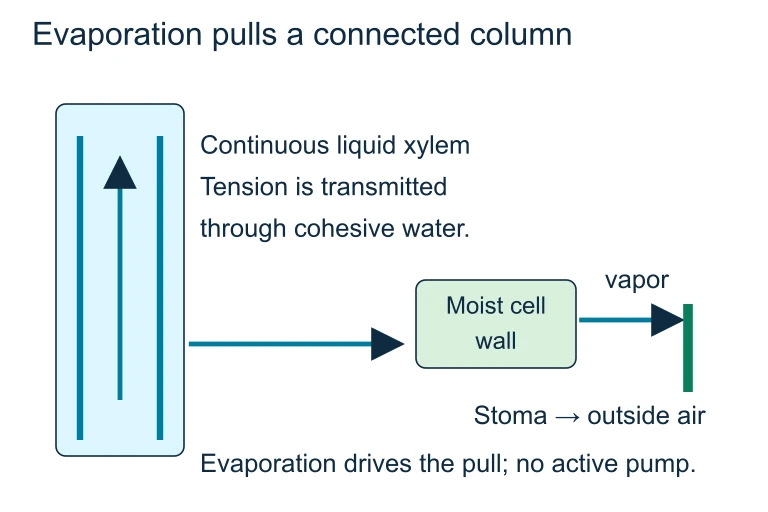 Evaporation from moist mesophyll walls creates tension transmitted through cohesive liquid water in xylem. Water vapor then exits through stomata; adhesion helps maintain contact with xylem walls.
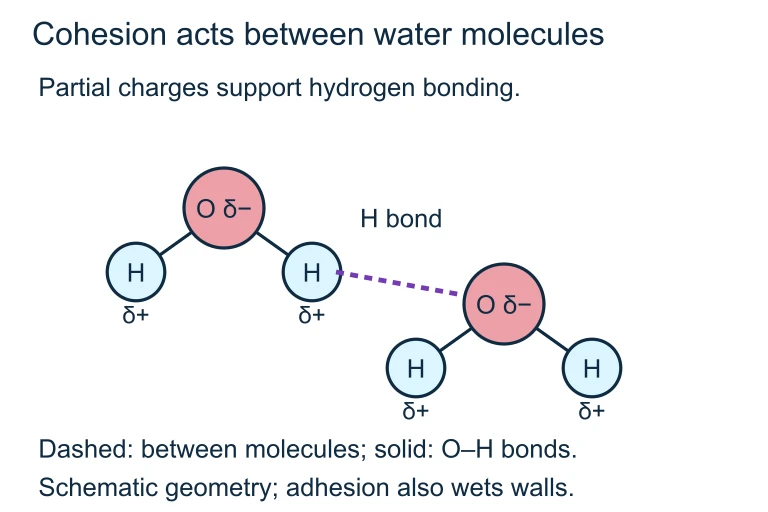 Hydrogen bonds connect the partially positive hydrogen of one water molecule with the partially negative oxygen of another; covalent O–H bonds remain within each molecule.
 Near 0 °C and 1 atm, 18 g of ordinary ice Ih occupies about 19.63 mL, compared with 18.00 mL for liquid water. The more open ice structure produces about 9% greater volume at equal mass.
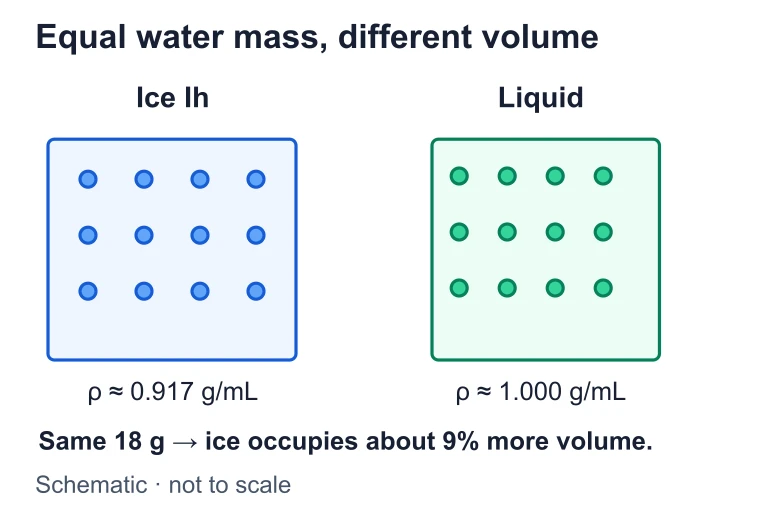 Near 0 °C and 1 atm, 18 g of ordinary ice Ih occupies about 19.63 mL, compared with 18.00 mL for liquid water. The more open ice structure produces about 9% greater volume at equal mass.
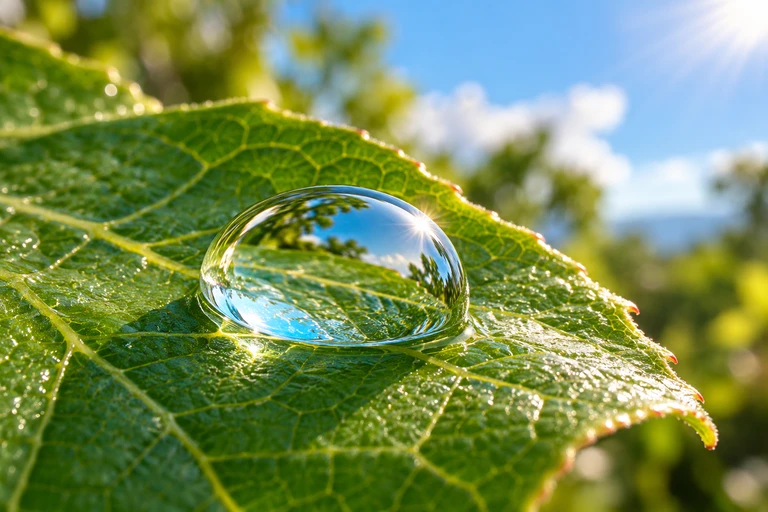 Water can evaporate below its boiling point. Escaping molecules carry energy away and can cool the remaining liquid; sensible heating instead follows Q = mcΔT.
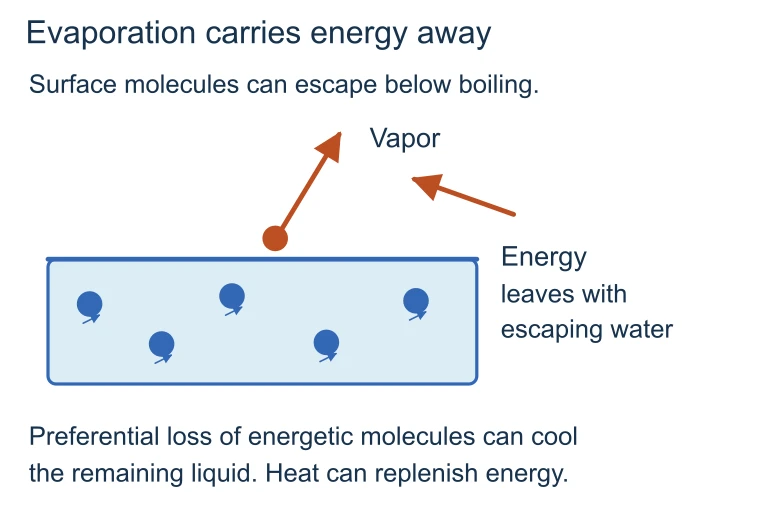 Water can evaporate below its boiling point. Escaping molecules carry energy away and can cool the remaining liquid; sensible heating instead follows Q = mcΔT.
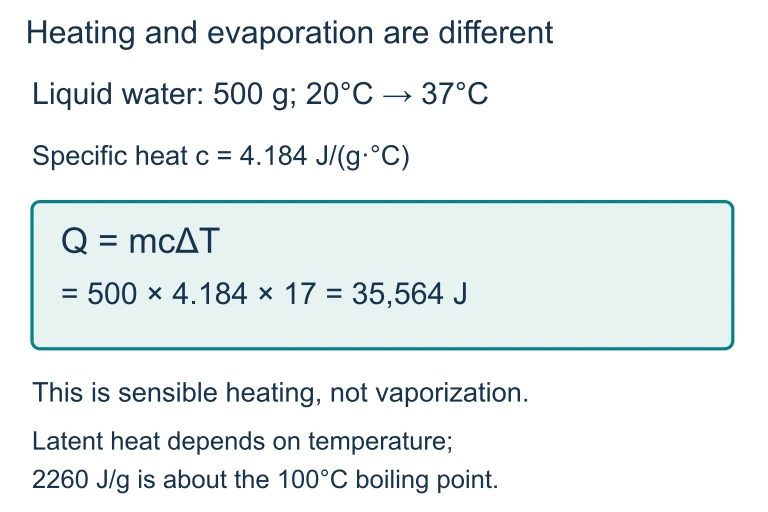 Heating 500 g of liquid water from 20 °C to 37 °C requires 35,564 J using c = 4.184 J/(g·°C). Vaporization uses a temperature-dependent latent heat instead.
SECTION 6
Worked Example — Connecting Molecular Structure to Biological Function
AP Biology free-response questions frequently require you to trace the chain of reasoning from molecular properties of water to observable biological phenomena. The worked example below models the type of multi-part explanation expected on the exam.
Explain how water's molecular structure enables transpiration in tall trees.
- 1
Step 1 — Identify the Molecular Feature
Water is a polar molecule due to its bent geometry (~104.5°) and the electronegativity difference between oxygen (3.44) and hydrogen (2.20). This creates a molecular dipole with δ− on oxygen and δ+ on each hydrogen. - 2
Step 2 — Connect Polarity to Hydrogen Bonding
The partial charges allow water molecules to form hydrogen bonds: δ+ hydrogen of one molecule attracts δ− oxygen of a neighboring molecule. Each molecule can participate in up to four hydrogen bonds simultaneously. - 3
Step 3 — Derive Cohesion and Adhesion
Hydrogen bonds between water molecules produce cohesion (water sticking to water), while hydrogen bonds between water and the hydrophilic cellulose walls of xylem vessels produce adhesion (water sticking to the vessel wall). - 4
Step 4 — Apply to Transpiration
When water evaporates from leaf mesophyll cells through stomata, the loss creates a negative pressure (tension) at the top of the xylem. Cohesion transmits this tension downward as a continuous column of water molecules linked by hydrogen bonds. Adhesion counteracts gravity by helping water cling to xylem walls, preventing the column from collapsing.Conclusion: Water's polarity → hydrogen bonding → cohesion + adhesion → continuous water column → transpiration pull that can lift water over 100 meters in the tallest trees.
SECTION 7
Hydrogen Bonds Compared to Other Intermolecular Forces
Hydrogen bonds are one category within the broader family of intermolecular forces that govern how molecules interact without forming new covalent bonds. To fully appreciate their biological importance, it helps to compare them with other types of interactions in terms of strength, directionality, and biological roles.
| Force Type | Strength (kJ mol⁻¹) | Requirements | Biological Example |
|---|---|---|---|
| Covalent Bond | 150–950 | Shared electron pairs between atoms | C–C backbone of organic molecules |
| Ionic Interaction | 20–40 (in water) | Full positive and negative charges | Salt bridges in protein tertiary structure |
| Hydrogen Bond | 12–30 | H bonded to F, O, or N; lone pair acceptor | DNA base pairing; protein α-helices |
| Dipole–Dipole | 5–25 | Permanent dipoles in polar molecules | Interactions among polar amino acid side chains |
| Van der Waals (London Dispersion) | 0.05–40 | Temporary induced dipoles; all molecules | Hydrophobic packing in membrane lipid tails |
Comparison of Major Intermolecular and Intramolecular Forces
KEY TAKEAWAY
SECTION 8
Connections to Advanced Biological Concepts
The principles of water chemistry and hydrogen bonding introduced here thread through nearly every major topic in AP Biology. Understanding these connections will help you integrate seemingly disparate content areas into a coherent conceptual framework. The table below maps each water property to the more advanced concepts it supports, several of which appear later in the course.
| Water Property | Advanced Biological Connection |
|---|---|
| Polarity / solvent properties | Hydrophobic effect drives membrane assembly (Unit 2) and protein folding (Unit 1). Nonpolar molecules are excluded from aqueous solution, causing lipid bilayers to self-organize. |
| Cohesion / adhesion | Transpiration-cohesion-tension theory (Unit 8). The unbroken water column in xylem depends on cohesive hydrogen bonds resisting the tension generated by evaporation. |
| High specific heat | Thermoregulation in endotherms and ectotherms (Unit 8). Homeostatic feedback loops depend on water's capacity to absorb metabolic heat without drastic temperature changes. |
| Hydrogen bonding specificity | Complementary base pairing in DNA and RNA (Unit 6). A–T pairs form 2 hydrogen bonds, G–C pairs form 3—explaining differential stability and Chargaff's rules. |
| Water as reactant / product | Dehydration synthesis and hydrolysis reactions (Unit 1). Water participates directly in building and breaking macromolecular polymers. Photolysis of water provides electrons in Photosystem II (Unit 3). |
How Water Properties Connect to Advanced AP Biology Topics
As you progress through the course, revisit this foundation frequently. When you encounter enzyme denaturation or osmosis across a selectively permeable membrane, trace the explanation back to water's polarity and hydrogen bonding. The College Board rewards students who can articulate these causal chains explicitly, moving from molecular structure to macroscopic outcome in a logical sequence.
SECTION 9
Practice Problems
Question 1: CONCEPTUAL
- A. Water would have a higher boiling point because the linear molecule would be larger.
- B. Water would be nonpolar because the two bond dipoles would cancel each other.
- C. Water would still form hydrogen bonds because oxygen is still electronegative.
- D. Water molecules would form more hydrogen bonds due to reduced steric hindrance.
Show answer (B)
Question 2: BASIC CALCULATION
- A. 2,092 J
- B. 17,560 J
- C. 35,564 J
- D. 71,128 J
Show answer (C)
Question 3: INTERMEDIATE
- A. Ice contains fewer hydrogen bonds per molecule than liquid water, making it less dense.
- B. In ice, each water molecule forms a maximum of four hydrogen bonds in a rigid, open hexagonal lattice that spaces molecules farther apart than in liquid water.
- C. The covalent bonds in ice are longer than those in liquid water, increasing the volume of each molecule.
- D. Ice has lower kinetic energy than liquid water, causing molecules to shrink and trap air pockets that reduce overall density.
Show answer (B)
Question 4: APPLIED
4 ptsShow answer
Question 5: CRITICAL THINKING
4 ptsShow answer
SUMMARY
Lesson Summary
Summary
Water's biological importance stems from its polar covalent bonds and bent molecular geometry (104.5° bond angle). The electronegativity difference between oxygen and hydrogen creates partial charges (δ− and δ+) that allow water molecules to form hydrogen bonds—individually weak (~20 kJ mol⁻¹) but collectively powerful intermolecular attractions. Each water molecule can form up to four hydrogen bonds simultaneously, creating a dynamic three-dimensional network.
This hydrogen-bond network produces water's emergent properties: cohesion and adhesion (enabling xylem transport), high specific heat and high heat of vaporization (enabling thermal regulation and evaporative cooling), the density anomaly of ice (insulating aquatic ecosystems), and its role as the universal solvent (medium for all biochemical reactions). On the AP exam, always trace the causal chain: molecular structure → polarity → hydrogen bonding → emergent property → biological function.