
SECTION 1
Historical Context & Motivation
The question of how new species arise has driven biological inquiry for centuries. Before the nineteenth century, most Western scholars subscribed to a view of species as fixed, unchanging entities created independently. The publication of Charles Darwin's On the Origin of Species in 1859 shattered that assumption by proposing that populations diverge through natural selection, ultimately giving rise to distinct lineages. Yet Darwin himself acknowledged that his theory left the precise mechanisms of species formation incompletely explained—a gap that would take another century to fill.
1859 • Darwin's Origin of Species
1942 • Mayr's Biological Species Concept
1963 • Allopatric Speciation Model Codified
1981 • Sympatric Speciation Gains Evidence
2000s • Genomic Era of Speciation
The central question that speciation research addresses is deceptively simple: how does one continuously varying population become two reproductively isolated species? Answering this requires integrating genetics, ecology, behavior, and geography—an interdisciplinary challenge that continues to shape modern evolutionary biology. Understanding speciation is essential for AP Biology because it connects natural selection to macroevolutionary patterns such as adaptive radiation, convergent evolution, and biodiversity.
SECTION 2
Core Principles & Definitions
Before examining the mechanisms of speciation, it is essential to establish a working definition of a species. The biological species concept (BSC) defines a species as a group of populations whose members can interbreed and produce viable, fertile offspring but are reproductively isolated from other such groups. While the BSC is the most commonly applied framework on the AP exam, alternative concepts—such as the morphological, ecological, and phylogenetic species concepts—exist because the BSC cannot be applied to asexual organisms or fossils. With this definition in hand, speciation can be understood as the evolution of reproductive isolation between populations.
Gene Flow Disruption
Reproductive Isolation
Genetic Divergence
Modes of Speciation
KEY TAKEAWAY
SECTION 3
Visual Explanation — Modes of Speciation
The diagram above illustrates that all three modes share a common logical structure: an ancestral population experiences some reduction in gene flow, selection or drift drives genetic divergence, and reproductive isolation accumulates over time. The critical variable is the spatial context in which gene flow is disrupted. Allopatric speciation is the best-documented and most widely accepted mode; it is also the most intuitive because a physical barrier provides a clear mechanism for eliminating gene flow. Sympatric speciation is more controversial because populations must diverge reproductively despite having the opportunity to interbreed—a scenario that requires strong disruptive selection or sudden chromosomal changes such as polyploidy. Parapatric speciation occupies a middle ground, where a steep environmental gradient can reduce gene flow enough for divergence to occur without a complete physical barrier.
 Geographic barriers, shared habitat and adjacent ranges create different opportunities for gene flow. Reproductive isolation must be tested separately from geographic separation.
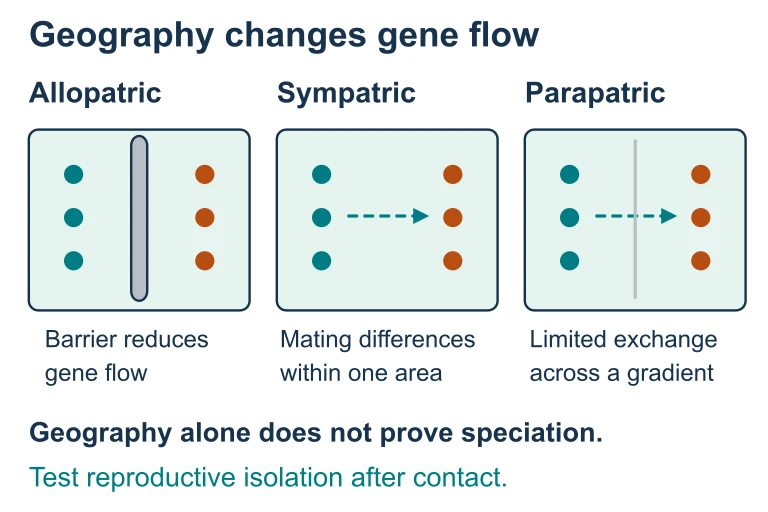 Geographic barriers, shared habitat and adjacent ranges create different opportunities for gene flow. Reproductive isolation must be tested separately from geographic separation.
SECTION 4
Mechanisms of Reproductive Isolation
Because the biological species concept hinges on reproductive isolation, a thorough understanding of the barriers that prevent gene flow is essential for AP Biology. Reproductive barriers are classified into two broad categories based on when they act relative to fertilization: prezygotic barriers prevent the formation of a hybrid zygote, while postzygotic barriers reduce the viability or fertility of hybrid offspring. Together, these barriers ensure that populations remain genetically distinct even when they occupy overlapping ranges.
Prezygotic Barriers
| Barrier Type | Mechanism | Example |
|---|---|---|
| Habitat (ecological) | Species occupy different habitats in the same geographic area, so they rarely encounter each other. | Two species of garter snakes: one lives mainly in water, the other on land. |
| Temporal | Species breed at different times of day, seasons, or years. | Eastern and western spotted skunks breed in fall and spring, respectively. |
| Behavioral | Unique courtship signals (songs, dances, pheromones) are not recognized across species. | Blue-footed boobies perform a stereotyped foot-lifting display not matched by other booby species. |
| Mechanical | Morphological differences prevent copulation or pollination. | Different flower structures limit certain pollinators and prevent cross-pollination between plant species. |
| Gametic | Sperm and egg are biochemically incompatible; sperm cannot penetrate egg coats. | Sea urchin sperm-binding proteins are species-specific, preventing cross-species fertilization. |
Summary of Prezygotic Reproductive Barriers
Postzygotic Barriers
- Reduced hybrid viability: Genetic incompatibility causes hybrids to fail to develop or to die before reproduction. For example, certain sheep–goat hybrid embryos fail to develop past early stages.
- Reduced hybrid fertility: Hybrids are viable but cannot produce functional gametes, often because homologous chromosomes from the two parent species cannot pair properly during meiosis. The mule (horse × donkey) is the classic example.
- Hybrid breakdown: First-generation hybrids are viable and fertile, but subsequent generations include individuals that are weak, infertile, or both. This occurs in some strains of cultivated rice.
Reinforcement
SECTION 5
Polyploidy, Adaptive Radiation & Rates of Speciation
While most speciation is a gradual process driven by the accumulation of many small genetic changes, certain mechanisms can produce reproductive isolation in a single generation. Polyploidy—the condition of having more than two complete sets of chromosomes—is the most important example and is especially common in plants. An autopolyploid arises when a cell-division error doubles the chromosome number within one species (e.g., a diploid 2n organism produces a tetraploid 4n offspring). An allopolyploid forms when two different species hybridize and the resulting hybrid undergoes chromosome doubling, restoring pairing ability during meiosis. Because a tetraploid individual cannot produce fertile offspring with diploid members of the parent species, reproductive isolation is instantaneous—making polyploidy a dramatic example of sympatric speciation.
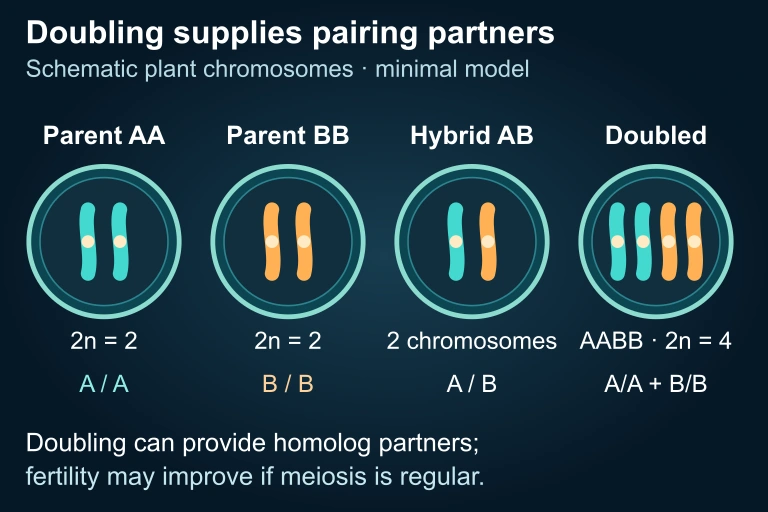 Exact chromosome pairing model
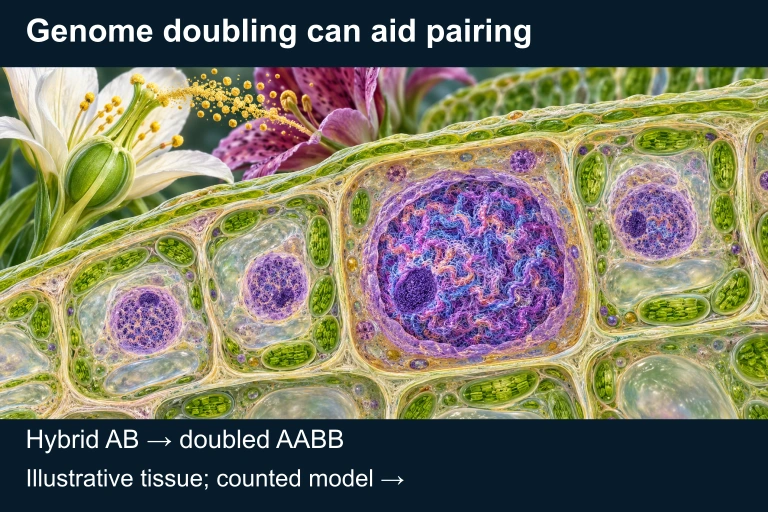 Illustrative plant tissue introduces a chromosome-doubling model; counted chromosome pairing is shown in the authored companion.
Adaptive Radiation
When a lineage encounters a wealth of unexploited ecological niches—often after colonizing a new environment or following a mass extinction—it can undergo rapid diversification into many species, each adapted to a different niche. This phenomenon is called adaptive radiation. The Darwin's finches of the Galápagos Islands illustrate adaptive radiation beautifully: a single ancestral finch species colonized the archipelago and diversified into at least 14 species with beaks adapted to different food sources. Hawaiian honeycreepers, East African cichlid fishes, and Anolis lizards of the Caribbean are other well-studied examples. Adaptive radiation demonstrates how speciation, natural selection, and ecological opportunity interact to generate biodiversity on relatively short evolutionary timescales.
Gradualism vs. Punctuated Equilibrium
Evolutionary biologists have debated the pace at which speciation occurs. Gradualism holds that species diverge slowly and steadily over millions of years. In contrast, the punctuated equilibrium model, proposed by Niles Eldredge and Stephen Jay Gould in 1972, argues that species remain largely unchanged (stasis) for long periods, with speciation events occurring in relatively rapid bursts. The AP Biology curriculum recognizes that both patterns exist in the fossil record; they are not mutually exclusive but rather represent endpoints on a continuum of evolutionary tempos.
SECTION 6
Worked Example — Identifying Speciation Modes & Barriers
Analyzing the Speciation of Kaibab and Abert Squirrels
- 1
Step 1 — Describe the Scenario
The Kaibab squirrel lives on the north rim of the Grand Canyon, while the Abert squirrel occupies the south rim. Both are closely related and likely descended from a common ancestral population that was split when the Colorado River carved the canyon deeper over the past ≈ 5 million years. The two squirrels differ in tail color and belly fur, and they do not interbreed in the wild. - 2
Step 2 — Identify the Mode of Speciation
The ancestral population was physically divided by a geographic barrier (the Grand Canyon). Gene flow was eliminated not by behavioral or ecological differences within the same area, but by an impassable physical feature. This matches the definition of allopatric speciation.Mode: Allopatric speciation - 3
Step 3 — Identify the Reproductive Barriers
The Grand Canyon functions as a prezygotic habitat/geographic barrier because the squirrels simply cannot encounter each other to mate. Even if they could be brought together, divergent morphology and potential behavioral differences (courtship displays, vocalizations) may act as additional prezygotic barriers. At the genetic level, accumulated mutations over millions of years of separation may also contribute postzygotic barriers (e.g., reduced hybrid viability), though this has not been directly tested.Primary barrier: Prezygotic — habitat isolation (geographic) - 4
Step 4 — Predict What Would Happen at Secondary Contact
If the canyon were bridged or the squirrels artificially relocated, three outcomes are possible: (1) they interbreed freely and merge back into one species (speciation is incomplete), (2) hybrids form but have reduced fitness, leading to reinforcement of prezygotic barriers and completion of speciation, or (3) they are fully reproductively isolated and remain distinct species. The degree of genetic divergence accumulated during their separation would determine which outcome occurs.If hybrids are less fit → reinforcement → completed speciation - 5
Step 5 — Connect to AP Exam Language
On the AP Biology exam, you would be expected to identify the geographic barrier as the initiating factor, classify the speciation as allopatric, name specific prezygotic or postzygotic barriers, and explain how natural selection (reinforcement) could strengthen isolation upon secondary contact. Practice framing your answer in terms of gene flow, allele frequencies, and reproductive success.Key terms for FRQ: allopatric, geographic barrier, gene flow, reproductive isolation, reinforcement
SECTION 7
Comparing Speciation Modes — Strengths & Limitations
| Feature | Allopatric | Sympatric | Parapatric |
|---|---|---|---|
| Gene flow disruption | Complete — physical barrier eliminates gene flow | Partial to none — must be overcome by strong disruptive selection | Reduced — limited by distance and environmental gradient |
| Required selection strength | Moderate — drift alone can drive divergence in small isolated populations | Strong — must counteract homogenizing gene flow | Moderate to strong — depends on steepness of environmental gradient |
| Prevalence | Most common; well-documented in vertebrates, invertebrates, and plants | Less common in animals; very common in plants via polyploidy | Intermediate; documented in grasses, snails, and some insects |
| Speed | Typically gradual (thousands to millions of years) | Can be instantaneous (polyploidy) or gradual | Typically gradual |
| Classic example | Darwin's finches; Kaibab/Abert squirrels | Apple maggot fly (Rhagoletis); polyploid plants | Anthoxanthum (sweet vernal grass) near mine boundaries |
Comparison of Major Speciation Modes
KEY TAKEAWAY
SECTION 8
Connection to Broader Evolutionary Theory
Speciation does not occur in isolation from other evolutionary processes—it is deeply intertwined with concepts you have already studied and those you will encounter in more advanced coursework. Understanding how speciation connects to macroevolution, phylogenetics, and population genetics will strengthen your ability to answer integrative free-response questions on the AP exam.
| AP Biology Concept | Connection to Speciation |
|---|---|
| Hardy-Weinberg Equilibrium | Speciation violates H-W assumptions (no gene flow, no selection, no drift, random mating). The conditions that drive speciation—isolation, selection, drift—are exactly those that cause allele frequency change. |
| Genetic Drift (Founder Effect) | A small founding population colonizing an island may diverge rapidly due to the founder effect, accelerating allopatric speciation. Reduced genetic variation in the new population means drift has a proportionally larger effect. |
| Phylogenetic Trees | Each node (branching point) on a phylogenetic tree represents a speciation event. The tree's topology records the history of reproductive isolation among lineages. |
| Biogeography | The geographic distribution of species often reflects historical speciation events. Island archipelagos, continental drift, and mountain ranges create the barriers that initiate allopatric speciation. |
| Molecular Clocks | Neutral mutation accumulation allows estimation of when two species diverged. The molecular clock concept assumes a roughly constant rate of sequence change and calibrates divergence times against the fossil record. |
Integrating Speciation with Other AP Biology Topics
Looking ahead, college-level evolutionary biology courses explore speciation genomics—the identification of specific loci that contribute to reproductive isolation. Researchers use genome-wide scans to find 'genomic islands of divergence,' regions of the genome where allele frequencies differ sharply between incipient species even when the rest of the genome shows little differentiation. This work is revealing that speciation often proceeds with ongoing gene flow, blurring the line between population divergence and species formation and challenging the traditional view that complete geographic isolation is required.
SECTION 9
Practice Problems
Question 1: CONCEPTUAL
- A. Gametic isolation — the sperm and eggs are biochemically incompatible.
- B. Behavioral isolation — females do not recognize the mating call of males from the other population.
- C. Temporal isolation — the two populations breed at different times of year.
- D. Hybrid breakdown — offspring of hybrid crosses are infertile in the F₂ generation.
Show answer (B)
Question 2: BASIC CALCULATION
- A. 14
- B. 21
- C. 28
- D. 56
Show answer (C)
Question 3: INTERMEDIATE
- A. Genetic drift eliminating hybrid genotypes from the population
- B. Reinforcement strengthening prezygotic isolation via natural selection
- C. Adaptive radiation into multiple ecological niches
- D. Stabilizing selection reducing phenotypic variation within each species
Show answer (B)
Question 4: APPLIED
4 ptsShow answer
Question 5: CRITICAL THINKING
4 ptsShow answer
SUMMARY
Speciation — Key Concepts Review
Summary
Speciation is the process by which one ancestral population becomes two or more reproductively isolated species. The biological species concept defines species based on the ability to interbreed and produce viable, fertile offspring. Prezygotic barriers (habitat, temporal, behavioral, mechanical, gametic) prevent the formation of hybrid zygotes, while postzygotic barriers (hybrid inviability, infertility, breakdown) reduce hybrid fitness. Allopatric speciation occurs when a geographic barrier divides a population, sympatric speciation occurs within a single range (often via polyploidy in plants), and parapatric speciation involves adjacent populations diverging across an environmental gradient.
When partially diverged populations come back into contact and hybrids have reduced fitness, reinforcement can strengthen prezygotic barriers and complete speciation. Adaptive radiation occurs when a lineage diversifies rapidly into many species to fill open ecological niches. The pace of speciation may follow gradualism (slow, steady divergence) or punctuated equilibrium (long stasis interrupted by rapid change). For the AP exam, be prepared to identify speciation modes, classify reproductive barriers, and connect speciation to gene flow, natural selection, genetic drift, and phylogenetic tree interpretation.