
SECTION 1
Historical Context & Motivation
Every nucleated cell in a multicellular organism carries essentially the same genome, yet a neuron looks and functions nothing like a hepatocyte. This paradox—identical DNA giving rise to wildly different cell types—drove biologists to ask not just what genes encode, but when and how genes are turned on or off. The study of transcriptional regulation emerged from mid-twentieth-century microbiology and rapidly expanded into one of the central pillars of molecular biology, connecting genetics, development, and disease in a unified framework.
1961 • The Operon Model
1969 • Isolation of Lac Repressor
1981 • Eukaryotic Enhancers Discovered
1996 • Histone Acetyltransferases Linked to Activation
2003 • ENCODE Project Begins
These discoveries established a central question that still drives modern biology: how do specific DNA sequences, regulatory proteins, and chromatin architecture interact to ensure that the right genes are transcribed in the right cells at the right time? Understanding transcriptional regulation is essential for explaining everything from embryonic development to cancer, and it forms a cornerstone of the AP Biology curriculum's treatment of gene expression.
SECTION 2
Core Principles of Transcriptional Regulation
Transcriptional regulation operates through a layered system of controls that determines whether RNA polymerase can access a gene's promoter and initiate mRNA synthesis. Both prokaryotes and eukaryotes share the fundamental logic of using cis-regulatory elements (DNA sequences near or within genes) and trans-acting factors (proteins that bind those sequences), but eukaryotes layer on additional complexity through chromatin remodeling, enhancers, and epigenetic modifications.
Promoter Recognition
Positive vs. Negative Control
Signal Integration
Chromatin Accessibility
Operons vs. Individual Gene Regulation
KEY TAKEAWAY
SECTION 3
Prokaryotic Gene Regulation — The Lac Operon
The lac operon of Escherichia coli remains the most thoroughly studied example of transcriptional regulation and a staple of the AP Biology exam. It encodes three enzymes needed to metabolize lactose—β-galactosidase (lacZ), permease (lacY), and transacetylase (lacA)—and is controlled by both a negative mechanism (the lac repressor) and a positive mechanism (the CAP-cAMP complex). This dual regulation ensures that the operon is expressed only when lactose is present and glucose is absent, an elegant example of metabolic efficiency.
The lac operon exemplifies a dual-control system in which both negative regulation (the repressor blocking the operator) and positive regulation (the CAP-cAMP activator complex) act on the same promoter region. The biological rationale is energetic economy: E. coli should only invest in lactose-digesting enzymes when lactose is the best available carbon source, meaning glucose must be depleted (low glucose → high cAMP → CAP activation) and lactose must be present (allolactose inactivates repressor). For the AP exam, be ready to predict operon expression status given any combination of glucose and lactose levels.
SECTION 4
Eukaryotic Transcriptional Regulation — Mechanisms in Depth
Eukaryotic gene regulation is far more complex than prokaryotic regulation because of the compartmentalized cell, the enormous genome wrapped in chromatin, and the need to coordinate gene expression across diverse cell types. Transcriptional control in eukaryotes operates at multiple levels, each of which must be understood for a thorough grasp of the AP Biology curriculum.
Chromatin Remodeling and Epigenetics
Before any transcription factor can access a eukaryotic gene, the local chromatin structure must permit it. DNA in eukaryotic cells is wound around octamers of histone proteins (two each of H2A, H2B, H3, and H4) to form nucleosomes, and these nucleosomes can be compacted further into heterochromatin, a transcriptionally silent state. Conversely, loosely packed euchromatin is accessible to the transcription machinery. Two major chemical modifications govern this transition. Histone acetylation, catalyzed by histone acetyltransferases (HATs), neutralizes the positive charge on lysine residues of histone tails, loosening the electrostatic grip on negatively charged DNA and opening chromatin for transcription. DNA methylation, typically at CpG dinucleotides, generally recruits proteins that condense chromatin and silence gene expression. These modifications are heritable through cell division, forming the basis of epigenetics—changes in gene expression that do not alter the underlying DNA sequence.
Transcription Factors and Enhancers
Eukaryotic transcription initiation requires the assembly of a pre-initiation complex (PIC) at the promoter, composed of RNA polymerase II and general transcription factors (TFIIA, TFIIB, TFIID, TFIIE, TFIIF, TFIIH). However, general factors alone produce only a basal (low) level of transcription. High-level, regulated transcription depends on specific transcription factors that bind to enhancer or silencer sequences, which can be located thousands of base pairs upstream or downstream of the gene they regulate. Enhancer-bound activators communicate with the PIC through a large protein complex called Mediator, and this long-range communication is made possible by DNA looping, which brings the enhancer into physical proximity with the promoter.
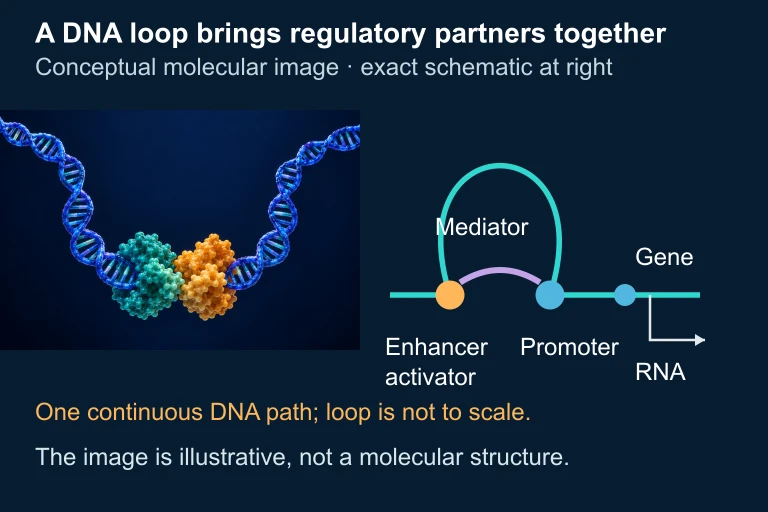 DNA looping can bring an enhancer-bound activator near the promoter machinery without removing intervening DNA. Illustration is schematic where scale or molecular structure is simplified.
Signal Transduction and Transcription
Many transcription factors are activated or deactivated by signal transduction pathways. For example, the binding of a steroid hormone to its intracellular receptor creates a hormone-receptor complex that directly enters the nucleus and acts as a transcription factor. In receptor tyrosine kinase (RTK) pathways, a phosphorylation cascade ultimately activates transcription factors such as Myc or CREB. The AP exam frequently tests students' ability to trace a signal from the extracellular ligand through the pathway to a specific transcriptional outcome.
AP EXAM TIP
SECTION 5
Epigenetic Modifications and Chromatin Architecture
Epigenetic mechanisms represent a critical layer of transcriptional control that does not involve changes to the nucleotide sequence itself. Instead, chemical tags on DNA and histones act as a molecular memory system, recording cell identity and environmental history. Understanding the interplay between histone modification and DNA methylation is essential for AP Biology, as these concepts appear in questions about cell differentiation, development, and cancer.
A particularly important concept for the AP exam is the distinction between histone methylation—whose effect depends on which residue is methylated (e.g., H3K4me3 activates, H3K27me3 represses)—and DNA methylation, which almost always correlates with silencing. These marks are maintained through cell division: DNA methyltransferases recognize hemi-methylated DNA after replication and methylate the new strand, ensuring daughter cells inherit the same expression pattern. This mechanism underlies phenomena such as X-inactivation in female mammals and genomic imprinting, in which only the maternal or paternal copy of a gene is expressed.
SECTION 6
Worked Example — Predicting Gene Expression
Let's apply our understanding of transcriptional regulation to a scenario typical of AP Biology free-response questions. This example integrates prokaryotic operon logic with signal interpretation.
Predicting trp Operon Expression Under Various Conditions
- 1
Step 1 — Identify the Regulatory System
The trp operon in E. coli encodes five enzymes for tryptophan biosynthesis. It is a repressible operon controlled by negative regulation. The trp repressor protein is normally inactive and cannot bind the operator on its own. - 2
Step 2 — Determine the Role of the Corepressor
When intracellular tryptophan levels are high, tryptophan itself acts as a corepressor. It binds the trp repressor protein and induces a conformational change that allows the repressor-corepressor complex to bind the operator sequence. - 3
Step 3 — Predict Expression When Tryptophan is Abundant
High tryptophan → trp binds repressor → repressor-trp complex binds operator → RNA polymerase is blocked → structural genes are NOT transcribed.Operon OFF — no tryptophan biosynthesis enzymes are produced - 4
Step 4 — Predict Expression When Tryptophan is Scarce
Low tryptophan → no corepressor available → repressor remains in its inactive conformation → operator is unoccupied → RNA polymerase freely transcribes the five structural genes.Operon ON — tryptophan biosynthesis enzymes are produced - 5
Step 5 — Compare with the Lac Operon Logic
The trp operon is the logical inverse of the lac operon's negative regulation. In the lac system, the inducer (allolactose) removes the repressor to turn the operon ON. In the trp system, the corepressor (tryptophan) activates the repressor to turn the operon OFF. Both are examples of feedback regulation — the end product of a pathway controls expression of the genes encoding that pathway.Key insight: inducible operons are turned ON by substrate presence; repressible operons are turned OFF by product accumulation.
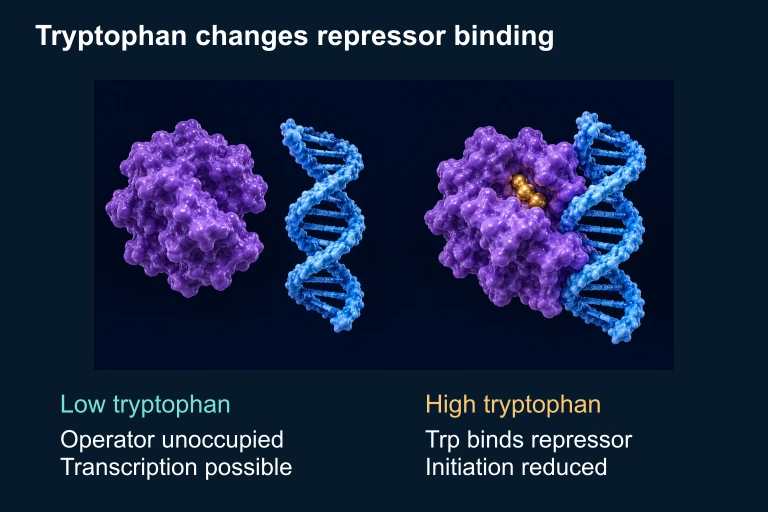 Tryptophan acts as a corepressor, promoting repressor binding to the operator and reducing transcription. Illustration is schematic where scale or molecular structure is simplified.
SECTION 7
Prokaryotic vs. Eukaryotic Regulation Compared
While both prokaryotes and eukaryotes regulate transcription using DNA-binding proteins, the mechanisms differ substantially in complexity, spatial organization, and the layers of control involved. The AP exam frequently asks students to compare and contrast these systems, so a clear understanding of their similarities and differences is essential.
| Feature | Prokaryotic Regulation | Eukaryotic Regulation |
|---|---|---|
| Gene organization | Operons: multiple genes under one promoter | Individual genes with their own promoters |
| Chromatin | No histones (some histone-like proteins); DNA is largely accessible | DNA packaged into nucleosomes; chromatin remodeling required for activation |
| Regulatory sequences | Operator, promoter (adjacent to gene) | Promoter, enhancers, silencers (can be thousands of bp away) |
| RNA polymerase | Single type; sigma factor determines promoter specificity | Three types (Pol I, II, III); Pol II transcribes mRNA with general TFs |
| Epigenetic control | Limited (some DNA methylation for defense) | Extensive: histone modification, DNA methylation, chromatin remodeling complexes |
| Coupling of transcription/translation | Coupled — ribosomes translate mRNA while it is being transcribed | Separated — mRNA processed in nucleus, exported for cytoplasmic translation |
| Response speed | Rapid (minutes); essential for adapting to fast environmental shifts | Slower; multiple processing steps but allows more nuanced control |
Comparison of transcriptional regulation in prokaryotes and eukaryotes
KEY TAKEAWAY
SECTION 8
Connections to Development, Disease, and Biotechnology
Transcriptional regulation is not merely an academic abstraction—it sits at the heart of developmental biology, cancer research, and modern biotechnology. For the AP exam, connecting regulation to broader biological phenomena demonstrates deep conceptual understanding and strengthens free-response answers.
| Application | How Transcriptional Regulation Is Involved |
|---|---|
| Cell Differentiation | Master regulatory transcription factors (e.g., MyoD for muscle cells) activate tissue-specific gene sets. All cells share the same genome, but differential transcription factor expression creates over 200 distinct cell types in the human body. |
| Cancer | Mutations in proto-oncogenes can create constitutively active transcription factors that drive uncontrolled cell division. Epigenetic silencing of tumor suppressor genes via promoter hypermethylation is equally common. HDAC inhibitors and DNMT inhibitors are now used as cancer therapies. |
| Induced Pluripotent Stem Cells (iPSCs) | Yamanaka (2006) showed that introducing four transcription factors (Oct4, Sox2, Klf4, c-Myc) into differentiated adult cells can reprogram their transcriptional state back to pluripotency—a powerful demonstration that cell identity is governed by transcription factor combinations. |
| Homeotic (Hox) Genes | Hox transcription factors control body plan organization in animals. Their sequential expression along the anterior-posterior axis is regulated by enhancers and chromatin accessibility, and mutations cause dramatic homeotic transformations (e.g., legs in place of antennae in Drosophila). |
| CRISPR-Based Gene Regulation | CRISPRi (interference) and CRISPRa (activation) use a catalytically dead Cas9 fused to repressor or activator domains to precisely regulate target gene transcription without cutting DNA, opening new frontiers in gene therapy and synthetic biology. |
Connections between transcriptional regulation and broader biology
As you progress beyond AP Biology into molecular biology and genetics courses, you will encounter additional layers of complexity: long non-coding RNAs that scaffold chromatin-modifying complexes, three-dimensional genome organization through topologically associating domains (TADs), and phase-separated transcriptional condensates at super-enhancers. These frontiers build directly on the foundational concepts covered in this lesson.
SECTION 9
Practice Problems
Question 1: CONCEPTUAL
- A. The operon will be constitutively expressed (always ON) regardless of lactose concentration.
- B. The operon will never be expressed because the repressor cannot function.
- C. The operon will be expressed only in the presence of glucose.
- D. The operon will only be expressed if both lactose and glucose are present.
Show answer (A)
Question 2: BASIC CALCULATION
- A. Condition 1, because glucose is the preferred carbon source and activates all metabolic genes.
- B. Condition 2, because lactose induces the operon by inactivating the repressor, and the absence of glucose allows high cAMP, activating CAP.
- C. Condition 3, because the presence of both sugars ensures maximum enzyme production.
- D. Condition 4, because without any sugar the cell upregulates all catabolic operons, including the lac operon, as a survival strategy to prepare for any available carbon source.
Show answer (B)
Question 3: INTERMEDIATE
- A. Transcription of the gene will be fully restored to maximum levels because removing DNA methylation is sufficient to open chromatin.
- B. Transcription will remain completely silenced because histone modifications alone are sufficient to maintain repression.
- C. Transcription may partially increase because DNA demethylation removes one layer of repression, but the repressive histone marks still limit full activation.
- D. The gene will be deleted from the genome because 5-azacytidine is a mutagen that disrupts DNA integrity.
Show answer (C)
Question 4: APPLIED
4 ptsShow answer
Question 5: CRITICAL THINKING
4 ptsShow answer
SUMMARY
Lesson Summary
Summary
Regulation of gene transcription is the primary mechanism by which cells control which genes are expressed, when, and to what extent. In prokaryotes, operons such as the lac operon and trp operon illustrate negative regulation (repressors blocking the operator) and positive regulation (activators like CAP-cAMP enhancing polymerase binding). The key to predicting operon expression is identifying whether inducer molecules or corepressors are present and how they change repressor/activator conformation.
In eukaryotes, transcriptional regulation is far more complex and occurs at multiple levels: chromatin remodeling through histone acetylation/deacetylation and DNA methylation (epigenetics), transcription factor binding at enhancers and silencers, and signal transduction pathways that connect extracellular cues to nuclear responses. These mechanisms enable cell differentiation, underlie diseases like cancer when dysregulated, and are harnessed in biotechnologies such as iPSC reprogramming and CRISPRi/CRISPRa. Mastering the interplay between DNA sequence elements, protein regulators, and epigenetic marks is essential for AP Biology success and for understanding modern molecular biology.