

SECTION 1
Historical Context & Motivation
The idea that plants derive nourishment from the soil alone persisted for centuries, rooted in Aristotle's notion that plants simply absorb food through their roots. It was not until a series of elegant experiments spanning the seventeenth through twentieth centuries that scientists uncovered the remarkable truth: plants harness sunlight to synthesize organic molecules from inorganic precursors. The discovery of photosynthesis fundamentally reshaped our understanding of energy flow through ecosystems and the biogeochemical cycling of carbon and oxygen. This section traces the key milestones that built our modern understanding of how autotrophs convert light into life.
1648 • Van Helmont's Willow Experiment
1771 • Priestley's Restoration of Air
1845 • Mayer Proposes Energy Conservation
1932 • Van Niel's Comparative Biochemistry
1961 • Calvin Elucidates the Carbon Cycle
These discoveries collectively answered a central question in biology: how do organisms capture the energy of sunlight and store it in forms usable by virtually every living cell? The answer lies in two interconnected stages—the light-dependent reactions and the Calvin cycle—that together transform light energy, water, and carbon dioxide into glucose and oxygen.
SECTION 2
Core Principles & Definitions
Photosynthesis is the process by which photoautotrophs—including plants, algae, and cyanobacteria—use light energy to drive the synthesis of organic compounds from carbon dioxide and water. The overall process can be divided into two major stages that are spatially separated within the chloroplast: the light-dependent reactions occurring at the thylakoid membranes and the light-independent reactions (Calvin cycle) occurring in the stroma. Understanding these foundational concepts is essential before examining the molecular details.
Chloroplast Structure
Pigments & Light Absorption
Light-Dependent Reactions
Calvin Cycle (C₃ Pathway)
Redox Chemistry & Energy Coupling
KEY TAKEAWAY
SECTION 3
Visual Explanation — The Light Reactions
The light-dependent reactions occur across the thylakoid membrane and involve two multiprotein complexes—Photosystem II (PSII) and Photosystem I (PSI)—linked by an electron transport chain. The following Z-scheme diagram illustrates how electrons are energized by light, passed through carriers, and ultimately used to reduce NADP⁺ to NADPH. Pay close attention to the energy levels of the electron carriers and the sites of photon absorption.
As the diagram illustrates, noncyclic electron flow involves two sequential photoexcitation events. Photosystem II absorbs photons at 680 nm, exciting electrons that travel downhill through plastoquinone (PQ), the cytochrome b₆f complex, and plastocyanin (PC), generating a proton gradient en route. Photosystem I absorbs at 700 nm, re-energizing the electrons so they can reduce ferredoxin and ultimately NADP⁺. The electrons lost by PSII are replenished by the photolysis of water, which releases O₂ as a byproduct—the oxygen we breathe. Meanwhile, cyclic electron flow around PSI can produce additional ATP without generating NADPH, helping to balance the ATP:NADPH ratio needed by the Calvin cycle.
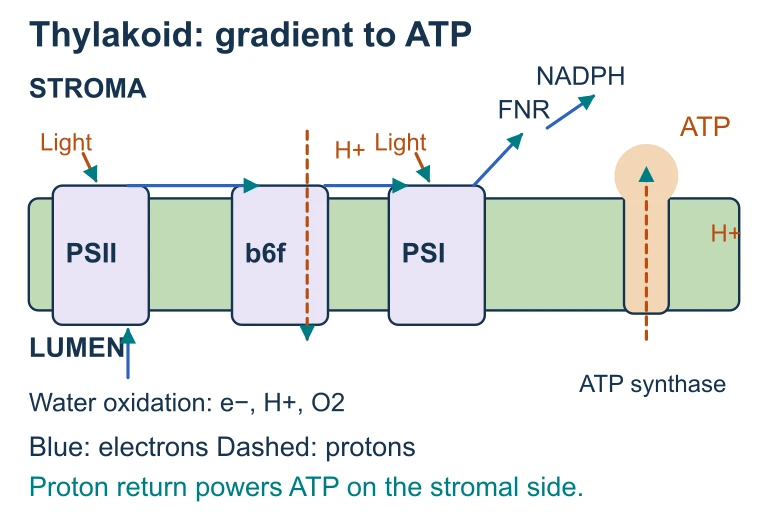
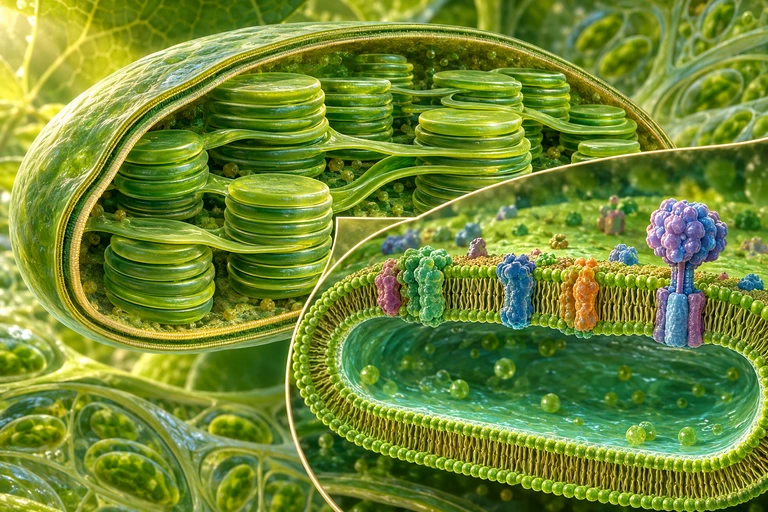 Water supplies electrons to the light reactions. Electron transport builds a proton gradient, and proton return from the thylakoid lumen to the stroma through ATP synthase powers ATP production.
 Water supplies electrons to the light reactions. Electron transport builds a proton gradient, and proton return from the thylakoid lumen to the stroma through ATP synthase powers ATP production.
SECTION 4
Mechanism — Chemiosmosis & the Calvin Cycle
Chemiosmotic ATP Synthesis
The proton gradient across the thylakoid membrane is established by three processes: (1) the oxidation of water in the thylakoid lumen, (2) the active pumping of H⁺ by the cytochrome b₆f complex, and (3) the consumption of H⁺ from the stroma during NADP⁺ reduction. The resulting proton-motive force drives protons back through ATP synthase (CF₁-CF₀ complex), catalyzing the phosphorylation of ADP to ATP. This mechanism is directly analogous to oxidative phosphorylation in mitochondria, reflecting a deeply conserved chemiosmotic principle first articulated by Peter Mitchell in 1961.
OVERALL PHOTOSYNTHESIS EQUATION
This summary equation masks the true complexity: it requires 12 H₂O consumed (6 are regenerated), 18 ATP, and 12 NADPH per glucose molecule. Light energy (approximately 48 photons per glucose) provides the thermodynamic driving force for this endergonic reaction (ΔG° ≈ +2870 kJ/mol).
The Calvin Cycle: Three Phases
The Calvin cycle operates in the stroma and consists of three distinct phases. In Phase 1: Carbon Fixation, the enzyme ribulose-1,5-bisphosphate carboxylase/oxygenase (RuBisCO) catalyzes the attachment of CO₂ to the five-carbon sugar ribulose-1,5-bisphosphate (RuBP), producing two molecules of 3-phosphoglycerate (3-PGA). In Phase 2: Reduction, ATP phosphorylates 3-PGA and NADPH reduces the resulting 1,3-bisphosphoglycerate to glyceraldehyde-3-phosphate (G3P). For every three CO₂ fixed, six G3P molecules are formed, but only one represents net carbon gain—the remaining five enter Phase 3: Regeneration of RuBP, which consumes an additional three ATP to rearrange the five-carbon skeletons.
CALVIN CYCLE NET INPUT (PER 3 CO₂ FIXED)
One net G3P (3-carbon) is exported per three turns of the cycle. Two G3P molecules combine to form one molecule of glucose via gluconeogenesis. The 9 ATP and 6 NADPH required per three CO₂ establishes the 3:2 ATP:NADPH stoichiometric demand that cyclic electron flow helps satisfy.
SECTION 5
Detailed Breakdown — C₃, C₄, and CAM Pathways
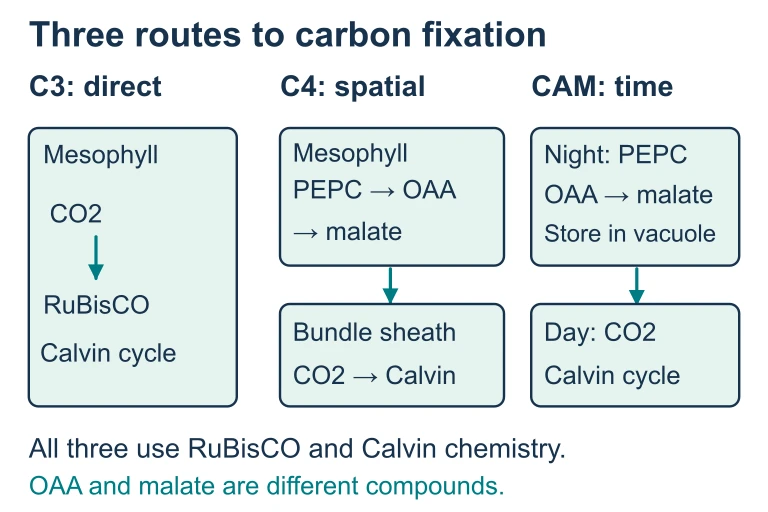
While the Calvin cycle is universal among photosynthetic organisms, the initial steps of carbon fixation vary among plants as adaptations to different environmental conditions. RuBisCO's dual affinity for both CO₂ and O₂ creates a problem called photorespiration, in which O₂ is fixed instead of CO₂, producing a two-carbon compound (phosphoglycolate) that must be recycled at an energetic cost. On hot, dry days, C₃ plants close their stomata to conserve water, but this traps O₂ and depletes CO₂ inside the leaf, exacerbating photorespiration. C₄ plants and CAM plants have evolved alternative strategies that spatially or temporally separate initial carbon fixation from the Calvin cycle.
| Feature | C₃ Plants | C₄ Plants | CAM Plants |
|---|---|---|---|
| Initial CO₂ acceptor | RuBP (5C) | PEP (3C) | PEP (3C) |
| First stable product | 3-PGA (3C) | OAA (4C) | OAA (4C) |
| Fixation enzyme | RuBisCO only | PEP carboxylase + RuBisCO | PEP carboxylase + RuBisCO |
| Leaf anatomy | No distinct bundle sheath | Kranz anatomy (prominent bundle-sheath cells) | Large vacuoles for malate storage |
| Photorespiration | High (up to 25% carbon loss) | Very low | Very low |
| Water efficiency | Low | Moderate | Very high |
Comparison of C₃, C₄, and CAM Photosynthetic Strategies
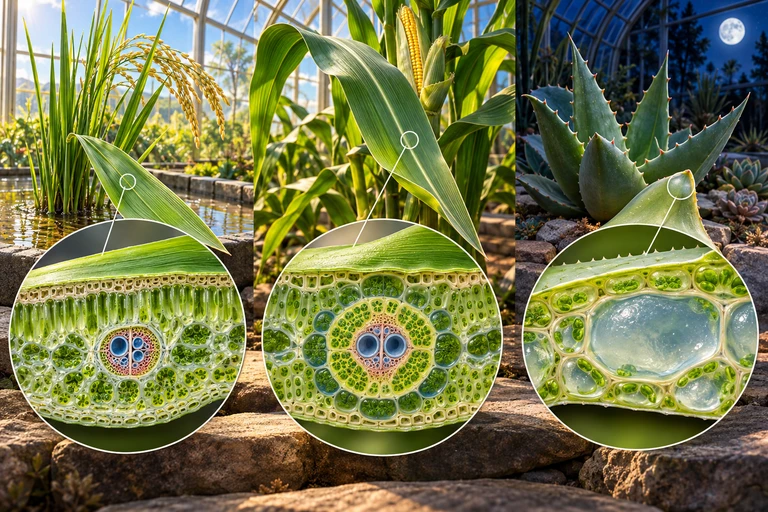 C₄ plants separate initial carbon fixation and the Calvin cycle between cell types. CAM plants separate them between night and day. Both concentrate carbon dioxide while retaining Calvin-cycle chemistry.
 C₄ plants separate initial carbon fixation and the Calvin cycle between cell types. CAM plants separate them between night and day. Both concentrate carbon dioxide while retaining Calvin-cycle chemistry.
SECTION 6
Worked Example — Tracking Carbon Through the Calvin Cycle
A common AP Biology question involves tracking the inputs and outputs of the Calvin cycle. Let's work through a stoichiometric analysis of the molecules consumed and produced when enough CO₂ is fixed to yield one net molecule of G3P.
How many turns of the Calvin cycle, and how much ATP and NADPH, are needed to produce one net G3P?
- 1
Step 1 — Identify the goal
The Calvin cycle produces G3P (a 3-carbon sugar phosphate). For every three CO₂ molecules fixed, six G3P are produced, but five of those are recycled to regenerate three RuBP. Therefore, the net gain per three turns is one G3P molecule. We need three turns of the cycle.3 turns → 1 net G3P - 2
Step 2 — Calculate ATP consumption
Each turn of the cycle consumes ATP at two points: (a) the phosphorylation of 3-PGA during reduction (2 ATP per CO₂ fixed, since each CO₂ produces 2 molecules of 3-PGA → wait, actually each CO₂ + RuBP yields 2 molecules of 3-PGA, each requiring 1 ATP for phosphorylation = 2 ATP) and (b) 1 ATP for the regeneration of RuBP. Per turn: 2 + 1 = 3 ATP. For three turns:3 turns × 3 ATP = 9 ATP consumed - 3
Step 3 — Calculate NADPH consumption
NADPH is used only during the reduction phase. Each 3-PGA (after phosphorylation) is reduced by one NADPH. Each CO₂ fixed generates 2 molecules of 3-PGA, so each turn uses 2 NADPH. For three turns:3 turns × 2 NADPH = 6 NADPH consumed - 4
Step 4 — Extend to one glucose
Glucose (C₆H₁₂O₆) requires two G3P molecules. Since three turns of the Calvin cycle produce one net G3P, we need six turns total to produce one glucose. This means 6 × 3 = 18 ATP and 6 × 2 = 12 NADPH per glucose, along with 6 CO₂.1 Glucose = 6 CO₂ + 18 ATP + 12 NADPH
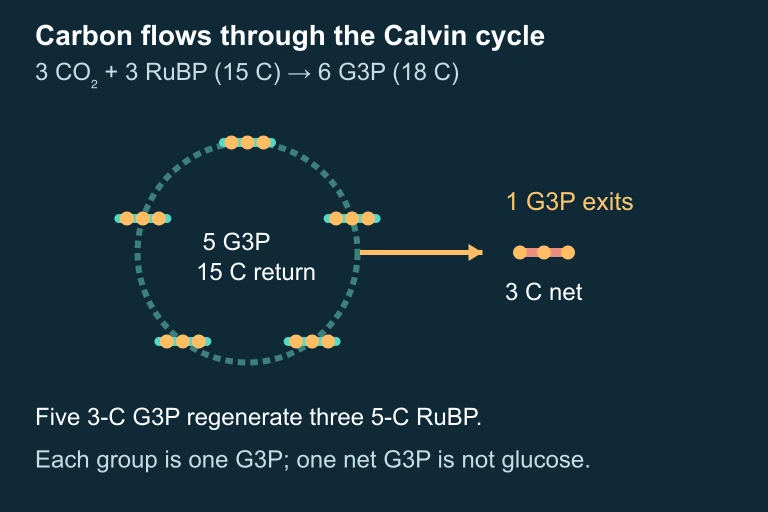 Three CO2 fixed yield one net three-carbon G3P while five G3P equivalents regenerate three RuBP. The companion accounts for six ATP and six NADPH in reduction plus three ATP in regeneration: nine ATP and six NADPH per net G3P.
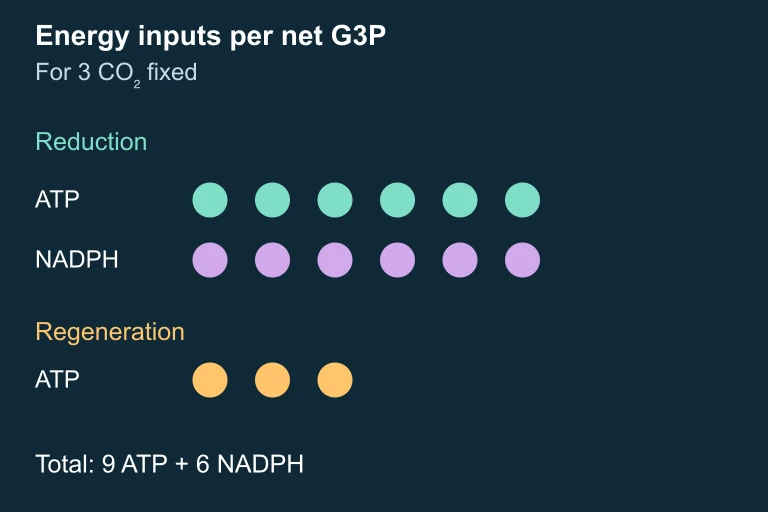 ATP and NADPH requirements.
SECTION 7
Factors Affecting Photosynthetic Rate
The rate of photosynthesis is governed by the principle of limiting factors, originally articulated by F.F. Blackman. At any given moment, the factor in shortest supply relative to demand constrains the overall rate, regardless of how abundant other factors may be. The three primary environmental factors are light intensity, CO₂ concentration, and temperature. Understanding how each factor affects the rate—and at what point another factor becomes limiting—is essential for interpreting experimental data on the AP exam.
| Factor | Effect on Photosynthetic Rate | Limitations / Notes |
|---|---|---|
| Light Intensity | Rate increases linearly at low intensities as more photons excite reaction center chlorophylls; rate plateaus at saturation point when all reaction centers are occupied. | Excess light can cause photoinhibition and photooxidative damage to PSII. The light compensation point is where photosynthesis = cellular respiration. |
| CO₂ Concentration | Rate increases as more CO₂ saturates RuBisCO active sites; plateaus when all RuBisCO molecules are operating at V_max or when light reactions cannot supply sufficient ATP/NADPH. | Current atmospheric CO₂ (~420 ppm) is suboptimal for C₃ plants. Increasing CO₂ in greenhouses can boost yields until another factor becomes limiting. |
| Temperature | Rate increases with temperature (Q₁₀ ≈ 2) due to faster enzyme kinetics, reaching an optimum around 25–35 °C for most C₃ plants; declines sharply above optimum due to enzyme denaturation. | High temperatures also increase RuBisCO's oxygenase activity relative to carboxylase activity, increasing photorespiration in C₃ plants. C₄ plants have a higher temperature optimum. |
| Water Availability | Water stress triggers stomatal closure, reducing CO₂ entry and indirectly limiting carbon fixation. | Also limits the electron donor for PSII, though water for photolysis is rarely limiting; the stomatal effect dominates. |
Primary Environmental Factors Affecting Photosynthetic Rate
KEY TAKEAWAY
SECTION 8
Connections to Cellular Respiration & Advanced Topics
Photosynthesis and cellular respiration are fundamentally complementary redox processes that together form the core of biological energy cycling. The products of photosynthesis (glucose and O₂) serve as the substrates for aerobic respiration, which in turn produces the CO₂ and H₂O that photosynthesis requires. Both processes share the chemiosmotic mechanism for ATP production, though the direction of proton flow and the electron donors/acceptors differ. Understanding these connections is critical for the AP Biology exam, where free-response questions frequently ask students to compare and contrast the two pathways.
| Feature | Photosynthesis | Cellular Respiration |
|---|---|---|
| Overall reaction | 6CO₂ + 6H₂O → C₆H₁₂O₆ + 6O₂ | C₆H₁₂O₆ + 6O₂ → 6CO₂ + 6H₂O |
| Energy transformation | Light → Chemical (endergonic) | Chemical → ATP + Heat (exergonic) |
| Organelle | Chloroplast | Mitochondrion |
| Electron donor | H₂O | NADH and FADH₂ (from glucose) |
| Final electron acceptor | NADP⁺ → NADPH | O₂ → H₂O |
| ATP synthase location | Thylakoid membrane (H⁺ flows from lumen to stroma) | Inner mitochondrial membrane (H⁺ flows from IMS to matrix) |
| Key coenzyme | NADPH (reducing power for biosynthesis) | NADH (reducing power for ETC) |
Photosynthesis vs. Cellular Respiration
Looking ahead, advanced coursework explores several extensions of photosynthetic biology. The endosymbiotic theory explains the evolutionary origin of chloroplasts from ancestral cyanobacteria, supported by double membranes, circular DNA, and 70S ribosomes. Research into artificial photosynthesis and engineering more efficient forms of RuBisCO are active frontiers in addressing global food security and renewable energy. Understanding the molecular mechanisms of photosynthesis thus has implications far beyond the classroom—from climate modeling to agricultural biotechnology.
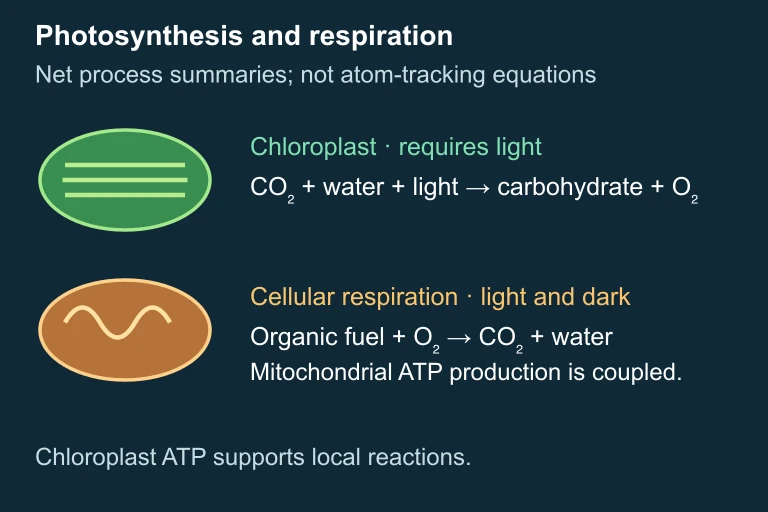 Photosynthesis and respiration.
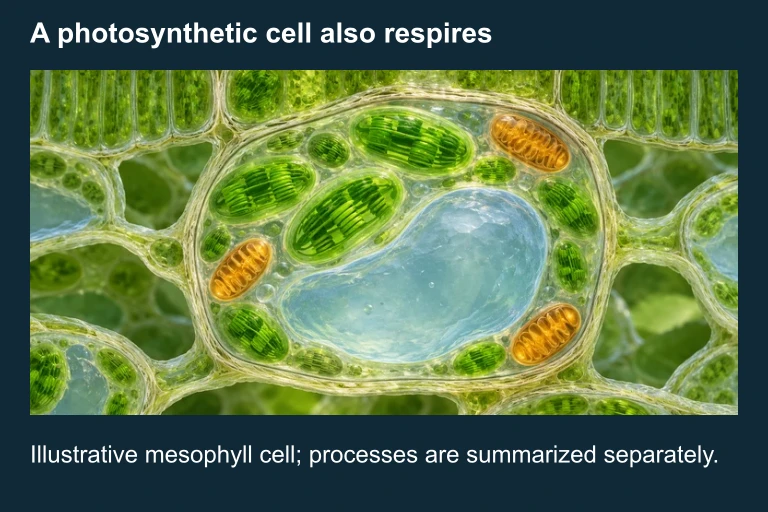 Leaf cells both photosynthesize and respire. The two organelle panels summarize distinct net processes rather than a closed atom shuttle; photosynthetic oxygen originates from water, and respiration occurs in light and dark.
SECTION 9
Practice Problems
Question 1: CONCEPTUAL
- A. O₂ production by PSII would stop immediately because electrons cannot leave PSII.
- B. The proton gradient across the thylakoid membrane would fail to form, reducing ATP synthesis by chemiosmosis.
- C. NADPH production would increase because electrons would be redirected from PSI to NADP⁺ reductase more rapidly.
- D. RuBisCO activity in the Calvin cycle would increase because more CO₂ would accumulate in the stroma.
Show answer (B)
Question 2: BASIC CALCULATION
- A. 3
- B. 6
- C. 18
- D. 36
Show answer (B)
Question 3: INTERMEDIATE
- A. The C₃ plant will have a higher net photosynthetic rate because it uses less ATP per CO₂ fixed.
- B. The C₄ plant will have a higher net photosynthetic rate because PEP carboxylase concentrates CO₂ at the site of RuBisCO, minimizing photorespiration.
- C. Both plants will have equal photosynthetic rates because the Calvin cycle operates identically in both.
- D. The C₃ plant will have a higher rate because RuBisCO functions more efficiently at high temperatures.
Show answer (B)
Question 4: APPLIED
4 ptsShow answer
Question 5: CRITICAL THINKING
4 ptsShow answer
SUMMARY
Photosynthesis — Summary Review
Summary
Photosynthesis converts light energy into chemical energy through two interconnected stages. The light-dependent reactions occur at the thylakoid membranes, where Photosystem II and Photosystem I drive noncyclic electron flow from water to NADP⁺, generating ATP (via chemiosmosis) and NADPH while releasing O₂ from the photolysis of water. The Calvin cycle operates in the stroma, using RuBisCO to fix CO₂ into G3P through three phases: carbon fixation, reduction, and RuBP regeneration. Three turns of the cycle fix 3 CO₂, consume 9 ATP and 6 NADPH, and yield one net G3P.
Plants have evolved distinct strategies to manage photorespiration, which arises from RuBisCO's dual affinity for CO₂ and O₂. C₄ plants achieve spatial separation by concentrating CO₂ in bundle-sheath cells, while CAM plants achieve temporal separation by fixing CO₂ at night and running the Calvin cycle by day. Photosynthetic rate is governed by limiting factors—light intensity, CO₂ concentration, and temperature—and is complementary to cellular respiration, sharing the chemiosmotic mechanism for ATP production but running the overall redox reaction in the opposite direction.