

SECTION 1
Historical Context & Motivation
The question of how life began on Earth is one of the most profound in all of science, sitting at the intersection of chemistry, geology, and biology. For centuries, the dominant explanation was spontaneous generation—the notion that living organisms routinely arose from nonliving matter, such as maggots from rotting meat or mice from grain. Louis Pasteur's famous swan-neck flask experiments in 1859 demolished this idea for contemporary organisms, yet paradoxically sharpened the central puzzle: if life does not spontaneously appear today, how did it first arise on a sterile, prebiotic Earth roughly 3.8 to 4.0 billion years ago? The scientific pursuit of this question has produced a rich, multidisciplinary narrative that directly connects to the AP Biology framework's emphasis on evolution by natural selection as the mechanism that subsequently shaped all biodiversity.
1924 • Oparin-Haldane Hypothesis
1953 • Miller-Urey Experiment
1977 • Hydrothermal Vent Discovery
1982 • Discovery of Ribozymes
2010s • Protocell Research
The central question that unifies this timeline is deceptively simple: how did self-replicating, metabolically active systems emerge from abiotic chemical reactions on early Earth? Answering this question requires understanding how small organic monomers formed abiotically, how they polymerized into functional macromolecules, how self-replication and catalysis coevolved, and how primitive membranes enclosed these systems to create the first cells. Each of these steps connects to core AP Biology concepts—from the chemistry of life and macromolecules to the principles of natural selection that drove biological complexity once self-replication was established.
SECTION 2
Core Principles of Abiogenesis
The scientific framework for understanding the origin of life rests on several foundational principles, each supported by experimental evidence and geological data. These principles describe sequential—but likely overlapping—stages in the transition from prebiotic chemistry to the first living systems. It is important to recognize that abiogenesis (the natural emergence of life from non-living matter) is distinct from evolution by natural selection; abiogenesis describes how the first replicators arose, whereas Darwinian evolution describes what happened once replication with heritable variation was in place.
Abiotic Synthesis of Monomers
Polymerization on Surfaces
RNA World & Self-Replication
Protocell Formation
Chemical to Darwinian Evolution
SECTION 3
From Prebiotic Chemistry to Protocells
The diagram above illustrates how each stage builds upon the products of the previous one, creating an increasingly complex chemical system. Notice that the transition from Stage 4 to Stage 5 represents one of the most consequential thresholds in Earth's history: the point at which chemical evolution gives way to biological evolution. Once protocells with heritable, mutable genetic information exist, they satisfy the three requirements for natural selection identified by Darwin—variation, inheritance, and differential reproductive success. From this point forward, evolutionary processes drive all subsequent increases in biological complexity, from the simplest prokaryotes to the eukaryotic organisms that would eventually form multicellular life.
SECTION 4
Mechanisms of Prebiotic Chemistry
The Miller-Urey Apparatus and Abiotic Synthesis
The Miller-Urey experiment remains one of the most iconic experiments in biology, demonstrating that organic molecules essential for life can form under conditions simulating early Earth. The apparatus consisted of a closed system containing water (simulating the ocean), a gas mixture of methane (CH₄), ammonia (NH₃), and hydrogen (H₂) representing the hypothesized reducing atmosphere, and electrodes that generated spark discharges to simulate lightning. After one week of continuous cycling, analysis of the condensed liquid revealed over 20 different amino acids, including glycine, alanine, and aspartic acid, as well as hydroxy acids and urea. Although modern geochemists debate whether Earth's early atmosphere was as strongly reducing as Miller and Urey assumed, subsequent experiments using more neutral gas mixtures (CO₂, N₂, H₂O) have still produced organic compounds, particularly when the reactions occur near hydrothermal vents where mineral catalysts and steep thermal gradients provide additional chemical activation energy.
Polymerization and the Concentration Problem
Even if monomers form readily, the formation of polymers such as polypeptides and polynucleotides presents a thermodynamic challenge. Dehydration synthesis (condensation reactions) releases water, meaning that in an aqueous environment, the equilibrium strongly favors hydrolysis over polymerization. Several mechanisms have been proposed to overcome this barrier. Wetting-drying cycles on volcanic shorelines could concentrate monomers and drive condensation during dry phases. Clay minerals such as montmorillonite have been shown experimentally to catalyze the formation of RNA oligomers up to 50 nucleotides long by adsorbing monomers onto their charged surfaces, aligning them in orientations favorable for phosphodiester bond formation. Iron-sulfur mineral surfaces near hydrothermal vents may have played an analogous role, providing both catalytic surfaces and redox chemistry to power early metabolic reactions.
The RNA World Hypothesis
Modern cells use DNA for information storage, RNA for information transfer, and proteins for catalysis—a division of labor that poses a chicken-and-egg problem for the origin of life. The RNA world hypothesis resolves this paradox by proposing that RNA served as both the genetic material and the primary catalyst in early life. Several lines of evidence support this model. First, ribozymes—RNA molecules with catalytic activity—exist in modern organisms; the ribosome itself is fundamentally a ribozyme, with rRNA catalyzing peptide bond formation. Second, the building blocks of RNA (nucleotides) can be synthesized under plausible prebiotic conditions. Third, RNA molecules have been evolved in vitro to catalyze a wide range of reactions, including self-replication. Over time, the more chemically stable DNA likely took over the information-storage role, while proteins—with their greater catalytic versatility arising from 20 different amino acid side chains—assumed most catalytic functions, relegating RNA to its modern intermediary roles.
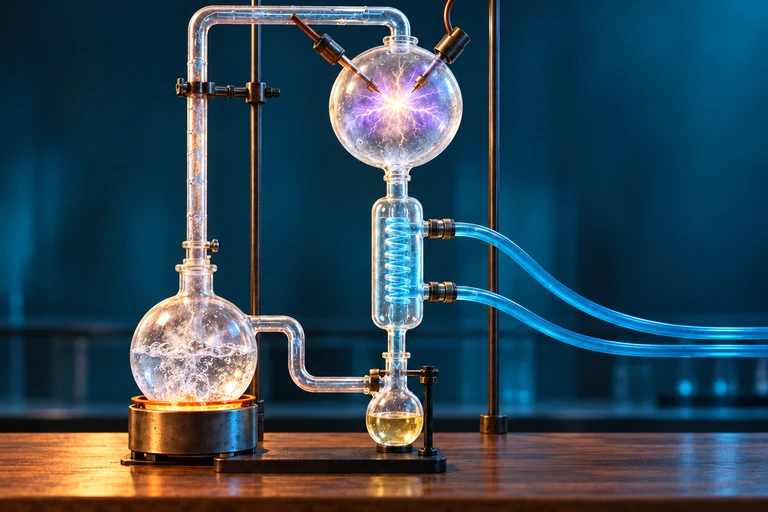 The Miller–Urey apparatus tests organic synthesis under a specified gas mixture and energy input. Heated water, a spark chamber, a condenser and a collection trap form the experimental loop.
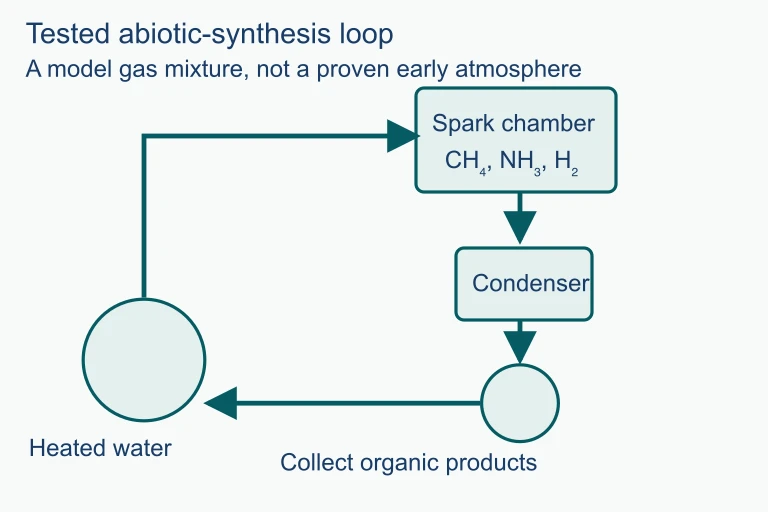 The Miller–Urey apparatus tests organic synthesis under a specified gas mixture and energy input. Heated water, a spark chamber, a condenser and a collection trap form the experimental loop.
SECTION 5
Lines of Evidence for the Origin of Life
Multiple independent lines of evidence converge to support the scientific account of life's origin on Earth. Understanding these evidence types is critical for the AP exam, where you are frequently asked to evaluate claims based on the quality and type of supporting data. The evidence spans laboratory experiments, geological records, molecular biology, and comparative genomics, each contributing a different piece to the puzzle.
| Evidence Type | Key Examples | What It Demonstrates |
|---|---|---|
| Experimental | Miller-Urey; Szostak protocell experiments | Abiotic synthesis of monomers and self-assembly of vesicles are chemically feasible under early Earth conditions |
| Geological | Stromatolites; ¹²C/¹³C isotope ratios in ancient rocks | Life existed by ~3.5 Ga; biological carbon fixation preferentially uses ¹²C, leaving isotopic signatures in sedimentary rocks |
| Molecular | Universal genetic code; ribozymes; shared use of ATP | All life shares a common biochemical ancestry consistent with a single origin (LUCA) |
| Extraterrestrial | Murchison meteorite amino acids; interstellar organic spectra | Organic molecule formation is not unique to Earth; prebiotic chemistry may be a universal process |
Summary of the four major categories of evidence supporting the origin of life on Earth
SECTION 6
Worked Example: Evaluating Evidence for Abiogenesis
A common AP Biology task involves evaluating a claim about the origin of life by connecting experimental evidence to a specific hypothesis. Let us work through a representative example that mirrors the reasoning expected on free-response questions.
Worked example
- 1
Step 1 — Identify the Claim
A scientist claims that RNA, rather than DNA or protein, was the first molecule capable of both storing genetic information and catalyzing chemical reactions in early life. This is the RNA world hypothesis. - 2
Step 2 — List Supporting Evidence
Three major lines of evidence support this claim. (1) Ribozymes exist in living organisms today—for instance, the peptidyl transferase activity of the ribosome resides in its rRNA component, not its protein subunits. (2) RNA nucleotides can be synthesized under simulated prebiotic conditions (e.g., Sutherland's 2009 synthesis of activated pyrimidine ribonucleotides). (3) In vitro evolution experiments have generated RNA molecules capable of template-directed self-replication, demonstrating that RNA can fulfill both informational and catalytic roles simultaneously.Three independent evidence types: biochemical, prebiotic chemistry, and in vitro evolution - 3
Step 3 — Address Limitations
No single experiment has yet demonstrated the spontaneous origin of a self-replicating RNA molecule from scratch under realistic prebiotic conditions. The "prebiotic plausibility" of some nucleotide synthesis pathways remains debated, and RNA is chemically less stable than DNA, raising questions about how RNA-based life could persist long enough for natural selection to operate. Additionally, some researchers propose a pre-RNA world based on simpler informational polymers such as PNA (peptide nucleic acid) or TNA (threose nucleic acid).Limitation: No demonstrated full abiotic pathway from simple precursors to self-replicating RNA - 4
Step 4 — Formulate a Conclusion
The RNA world hypothesis is well-supported by converging evidence from modern biochemistry, prebiotic chemistry experiments, and in vitro evolution studies, making it the most widely accepted model for early molecular evolution. However, the hypothesis is not proven in the absolute sense; it remains an active area of research where new evidence—particularly regarding the transition from simpler polymers to RNA—could refine or revise the model. This is consistent with the nature of science: models are the best current explanations supported by available evidence, not final truths.Conclusion: Well-supported but still being refined—a hallmark of robust scientific inquiry
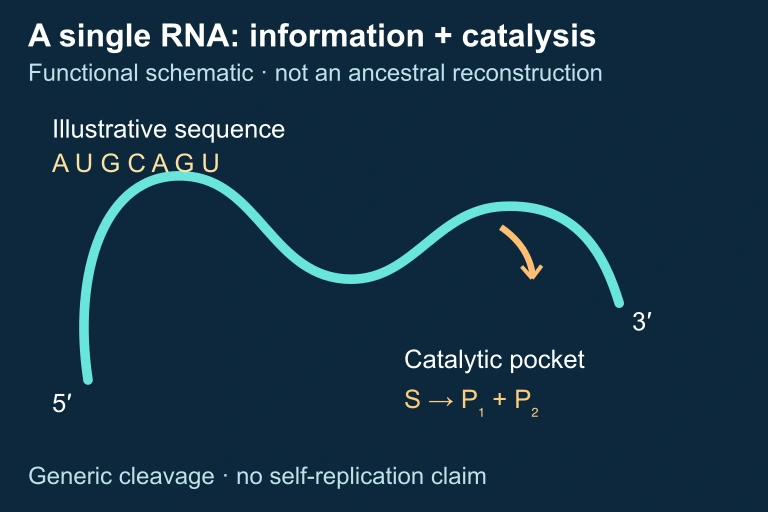 One strand: sequence and abstract catalysis
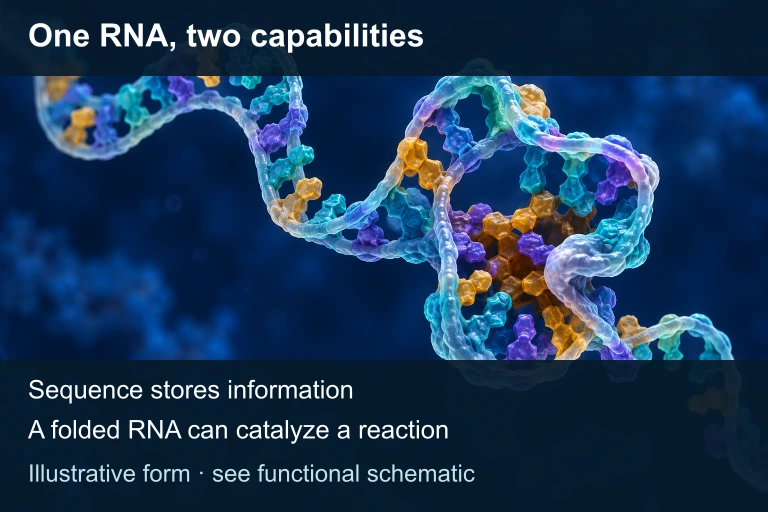 RNA can carry sequence information and catalyze a reaction. This invented functional example illustrates an abstract cleavage, not a specific ancestral molecule, atomic mechanism or self-replication demonstration. Molecular form is illustrative.
SECTION 7
Comparing Origin-of-Life Hypotheses
Multiple hypotheses have been proposed for where and how life originated, each emphasizing different environments and chemical processes. These hypotheses are not necessarily mutually exclusive; elements of each may have contributed to the overall process. Understanding their strengths and limitations is important for the AP exam, where you may need to compare competing scientific models and evaluate them based on evidence.
| Hypothesis | Proposed Environment | Key Strengths | Key Limitations |
|---|---|---|---|
| Primordial Soup (Oparin-Haldane) | Surface oceans, warm ponds, tidal pools | Experimentally validated (Miller-Urey); simple and intuitive; wetting-drying cycles can drive polymerization | Relies on a strongly reducing atmosphere (debated); dilution problem in open ocean; UV damage to organic molecules |
| Hydrothermal Vent (Iron-Sulfur World) | Deep-sea alkaline hydrothermal vents (e.g., Lost City) | Independent of solar energy; mineral catalysts available; natural proton gradients mimic chemiosmosis; protected from UV | Difficult to experimentally reproduce full pathway; high temperatures may destabilize some organic molecules; less experimental evidence for polymer formation |
| RNA World | Any environment where RNA can form and persist | Solves chicken-and-egg problem; ribozymes documented; in vitro evolution supports RNA catalysis and replication | Prebiotic synthesis of nucleotides is complex; RNA is chemically fragile; may require a simpler "pre-RNA" precursor |
| Panspermia | Extraterrestrial (interstellar space, comets, meteorites) | Murchison meteorite contains amino acids; organic molecules detected in interstellar clouds; extremophiles survive space-like conditions | Does not explain origin—only transport; extreme conditions during atmospheric entry may destroy organics; currently untestable for complete organisms |
Comparison of major origin-of-life hypotheses
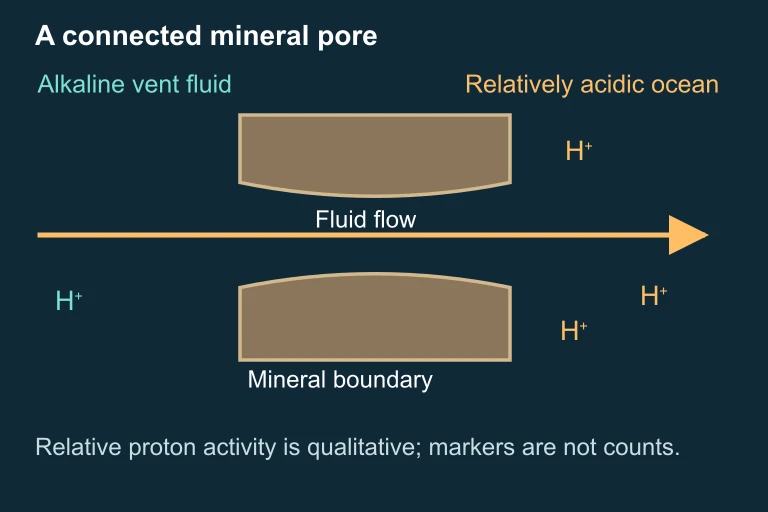 Qualitative connected pore.
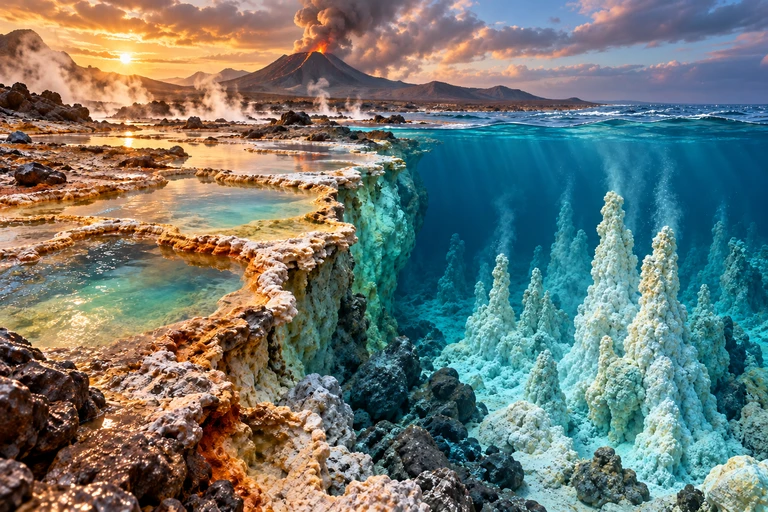
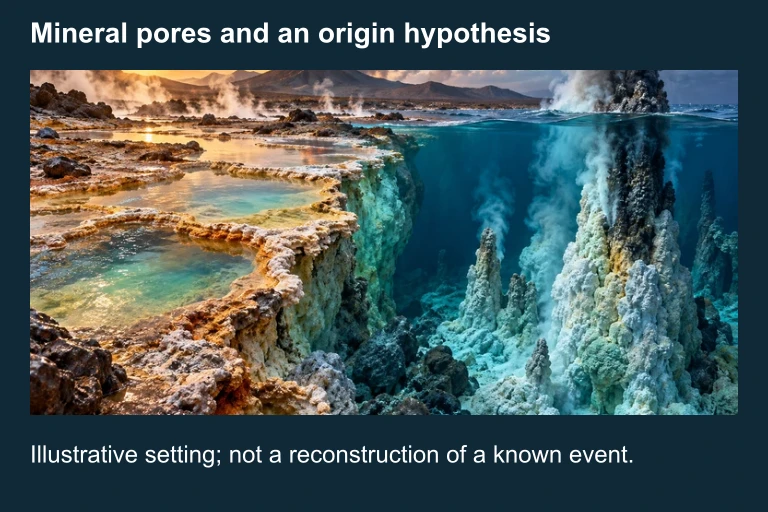 A conceptual landscape combines shoreline pools and submerged chimneys as broad environmental context, not one reconstructed alkaline vent. The exact pore panel selects only a qualitative proton-activity difference between fluid regions; symbol counts are not measured concentrations. Redox pathways and the origin-of-life setting remain outside this selected view.
 Origin-of-life models connect monomer supply, energy coupling, polymer formation, compartments and replication. These processes may interact rather than follow one established historical sequence.
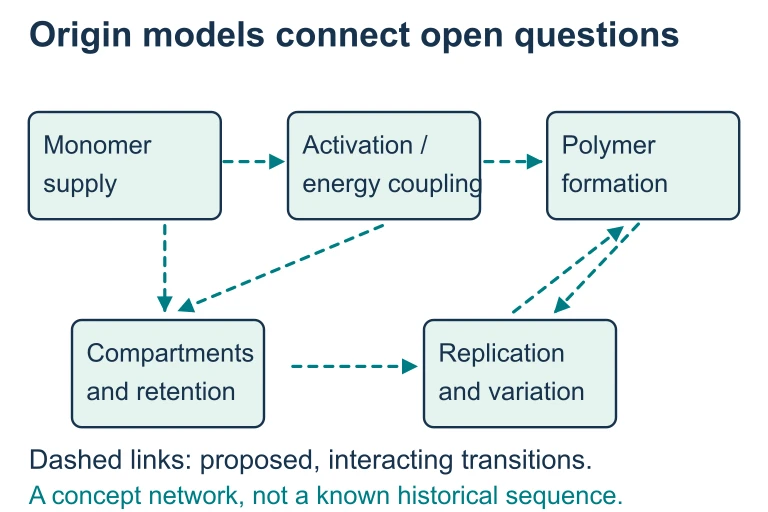 Origin-of-life models connect monomer supply, energy coupling, polymer formation, compartments and replication. These processes may interact rather than follow one established historical sequence.
SECTION 8
Connections to Evolution & Modern Biology
The origin of life is not an isolated topic—it connects directly to several major themes in AP Biology, including evolution, information transfer, energetics, and the unity and diversity of life. Understanding how prebiotic chemistry transitions into Darwinian evolution provides crucial context for concepts you will encounter throughout the course. The table below maps key origin-of-life concepts to their downstream connections in modern biology.
| Origin-of-Life Concept | Connection to Modern Biology | AP Biology Big Idea |
|---|---|---|
| Abiotic monomer synthesis | All organisms use the same 20 amino acids and 5 nucleotide bases, suggesting a shared chemical origin | Big Idea 1: Evolution |
| RNA world / ribozymes | The ribosome's catalytic core is rRNA; mRNA splicing involves catalytic RNA (snRNAs); telomerase contains an RNA template | Big Idea 3: Information |
| Protocell membranes | Modern phospholipid bilayers maintain cellular compartmentalization; endosymbiotic theory extends membrane-bound compartments | Big Idea 2: Energetics |
| Chemical → Darwinian evolution | Once heritable variation + differential reproduction exist, natural selection drives adaptation; applies to antibiotic resistance, speciation, etc. | Big Idea 1: Evolution |
| LUCA (Last Universal Common Ancestor) | Phylogenetics, universal genetic code, homologous structures—all point to shared ancestry from a single origin | Big Idea 1: Evolution |
Mapping origin-of-life concepts to AP Biology Big Ideas
Looking forward, research on the origin of life increasingly intersects with astrobiology—the search for life beyond Earth. NASA's missions to Mars and the icy moons of Jupiter and Saturn (Europa and Enceladus) are guided by principles derived directly from origin-of-life research: look for liquid water, organic molecules, and energy gradients. The Last Universal Common Ancestor (LUCA) is inferred from comparative genomics to have been an anaerobic, thermophilic prokaryote that used a chemiosmotic mechanism for ATP synthesis—remarkably similar to organisms found today near hydrothermal vents. Synthetic biology is also approaching the origin-of-life problem from the opposite direction, attempting to build minimal cells from scratch and thereby defining the boundary between chemistry and life. These frontiers demonstrate that origin-of-life research remains vibrant and directly relevant to 21st-century science.
SECTION 9
Practice Problems
Question 1: CONCEPTUAL
- A. RNA is single-stranded, making it less stable than double-stranded DNA.
- B. The catalytic core of the ribosome consists of rRNA, not protein, demonstrating that RNA can catalyze peptide bond formation.
- C. Amino acids can be synthesized abiotically under early Earth conditions, as shown by the Miller-Urey experiment.
- D. All living organisms use DNA as their primary genetic material, suggesting DNA is more ancient than RNA.
Show answer (B)
Question 2: BASIC CALCULATION
- A. 0.3 billion years
- B. 0.8 billion years
- C. 1.1 billion years
- D. 3.8 billion years
Show answer (B)
Question 3: INTERMEDIATE
- A. It demonstrates that RNA can catalyze lipid synthesis, explaining how the first cell membranes were produced.
- B. It shows that protocells with encapsulated genetic material had a selective advantage over empty vesicles, providing a mechanism for natural selection before modern cells existed.
- C. It proves that DNA was not necessary for the first cells because RNA alone is sufficient for all cellular functions.
- D. It refutes the hydrothermal vent hypothesis because lipid vesicles cannot form near high-temperature environments.
Show answer (B)
Question 4: APPLIED
4 ptsShow answer
Question 5: CRITICAL THINKING
4 pts