AP Biology • Chemistry of Life

Nucleic Acids

The information-carrying polymers that encode, transmit, and express the genetic blueprint of all living organisms.

AP Biology illustration with DNA, a microscope, and a leaf
Inside this lesson 9 sections 5 questions 8 figures

SECTION 1

Historical Context & Motivation

The quest to identify the molecular basis of heredity spanned nearly a century, beginning with the isolation of a mysterious phosphorus-rich substance from white blood cell nuclei in the 1860s. Early biochemists recognized that this material differed from proteins and lipids, yet its function remained obscure for decades. The story of nucleic acids illustrates how converging lines of evidence — biochemical, genetic, and crystallographic — ultimately revealed that DNA and RNA carry the instructions for life. Understanding this history clarifies why nucleic acid structure and function occupy a central place in modern biology.

1869 • Miescher Isolates 'Nuclein'

Friedrich Miescher extracted a phosphorus-rich substance from leukocyte nuclei, naming it nuclein — the first crude preparation of DNA.

1928–1944 • Transforming Principle

Griffith's transformation experiments and Avery, MacLeod, and McCarty's biochemical work demonstrated that DNA, not protein, is the hereditary material in bacteria.

1950 • Chargaff's Rules

Erwin Chargaff showed that in DNA the amount of adenine equals thymine and guanine equals cytosine, implying specific base-pairing relationships.

1952 • Hershey-Chase Experiment

Using radiolabeled bacteriophages, Alfred Hershey and Martha Chase confirmed that DNA — not protein — enters the host cell and directs viral reproduction.

1953 • Watson & Crick Double Helix

James Watson and Francis Crick, aided by Rosalind Franklin's X-ray diffraction data, proposed the double-helix model of DNA, immediately suggesting a mechanism for replication.

These milestones collectively answered a fundamental question: What molecule stores and transmits genetic information? The answer — nucleic acids — opened the door to molecular biology, genomics, and biotechnology. The sections that follow examine the chemical architecture that makes this informational role possible.

SECTION 2

Core Principles & Definitions

Nucleic acids are informational polymers assembled from monomer subunits called nucleotides. Each nucleotide contains three components: a five-carbon (pentose) sugar, a phosphate group, and a nitrogenous base. The two principal types — deoxyribonucleic acid (DNA) and ribonucleic acid (RNA) — differ in sugar identity, one nitrogenous base, and typical strand number, yet both employ the same fundamental polymerization chemistry.

1

Nucleotide Monomer

A nucleotide consists of a pentose sugar (ribose or deoxyribose), a phosphate group bonded to the 5ʹ carbon, and a nitrogenous base bonded to the 1ʹ carbon. Nucleotides are the building blocks of all nucleic acids.
2

Phosphodiester Bonds

Nucleotides polymerize via dehydration synthesis, forming a covalent phosphodiester bond between the 3ʹ hydroxyl of one sugar and the 5ʹ phosphate of the next. This creates a directional sugar-phosphate backbone with 5ʹ→3ʹ polarity.
3

Complementary Base Pairing

In DNA, adenine (A) pairs with thymine (T) via two hydrogen bonds, while guanine (G) pairs with cytosine (C) via three hydrogen bonds. In RNA, uracil (U) replaces thymine. This specificity underlies replication and transcription fidelity.
4

Antiparallel Orientation

The two strands of a DNA double helix run in opposite directions — one 5ʹ→3ʹ, the other 3ʹ→5ʹ. This antiparallel arrangement is essential for base-pair geometry and for the function of DNA polymerases during replication.
5

Central Dogma Flow

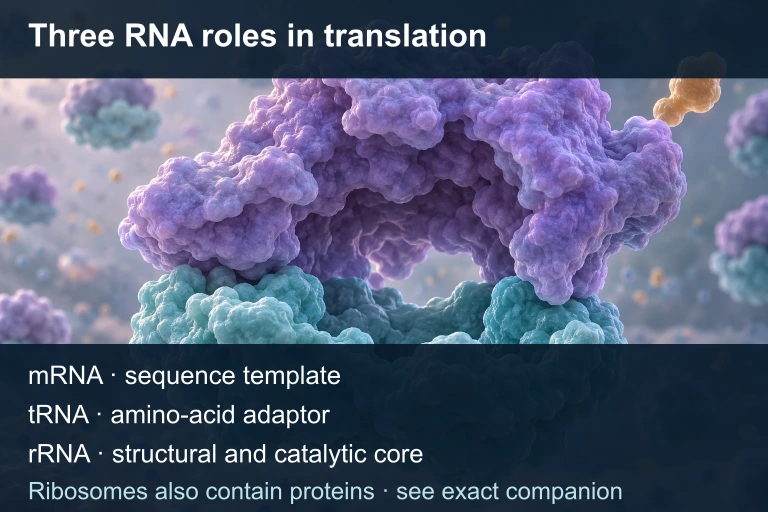
Genetic information flows from DNA → RNA → protein. DNA stores the master copy; messenger RNA carries transcribed instructions to ribosomes, where transfer RNA and ribosomal RNA collaborate to synthesize polypeptides.

SECTION 3

Nucleotide Structure & Polymerization

Nucleotide Structure & Phosphodiester Bond FormationSingle NucleotidePentoseSugar(Cʹ1–Cʹ5)Nitrogenous Basebonded at 1ʹCPO₄at 5ʹC3ʹ OH ↓Phosphodiester LinkageSugar 1PO₄Base 13ʹ→5ʹphosphodiesterbond−O−PO₄−O−Sugar 2Base 25ʹ end (free phosphate) ↑3ʹ end (free hydroxyl) ↓Each bond releases H₂O(dehydration synthesis)
Left: a single nucleotide showing its three components — phosphate group (pink) at 5ʹ, pentose sugar (violet ring), and nitrogenous base (cyan) at 1ʹ. Right: two nucleotides linked by a phosphodiester bond (gold), formed via dehydration synthesis between the 3ʹ-OH of the upper sugar and the 5ʹ-phosphate of the lower sugar.

As the diagram illustrates, the covalent backbone of a nucleic acid strand consists of alternating sugar and phosphate groups linked by phosphodiester bonds. The nitrogenous bases project laterally from the sugar and are free to form hydrogen bonds with complementary bases on an opposing strand. Because each strand possesses a free 5ʹ-phosphate at one end and a free 3ʹ-hydroxyl at the other, nucleic acid strands are inherently directional — a property that has profound functional consequences for replication, transcription, and translation.

ℹ
AP Exam Tip

SECTION 4

Base Pairing & the Double Helix

The functional sophistication of DNA arises from the interplay between its covalent backbone and the non-covalent forces stabilizing its three-dimensional shape. Two categories of nitrogenous bases exist: the purines (adenine and guanine), which feature a fused double-ring structure, and the pyrimidines (cytosine, thymine in DNA, uracil in RNA), which carry a single-ring structure. Complementary base pairing always links a purine to a pyrimidine, maintaining a uniform helix diameter of approximately 2 nm.

Hydrogen Bonding Rules

BASE PAIRING — DNA

A=T(2H−bonds)G≡C(3H−bonds)A = T (2 H-bonds) G ≡ C (3 H-bonds)

A = adenine, T = thymine, G = guanine, C = cytosine. The triple H-bond of G–C makes GC-rich regions more thermally stable than AT-rich regions.

BASE PAIRING — RNA

A=U(2H−bonds)G≡C(3H−bonds)A = U (2 H-bonds) G ≡ C (3 H-bonds)

In RNA, uracil (U) replaces thymine. Uracil lacks the methyl group present on thymine's C-5 position. RNA is typically single-stranded but can form intramolecular base pairs creating secondary structures such as hairpins.

CHARGAFF'S RULES

%A = %T %G = %C ∴ %A + %G = %T + %C = 50%

These relationships hold for double-stranded DNA. If %A = 30%, then %T = 30%, and %G = %C = 20%. This quantitative constraint is a direct consequence of complementary base pairing.

Beyond hydrogen bonding, hydrophobic stacking interactions between the flat, planar bases contribute significantly to helix stability. The bases stack atop one another like coins in a roll, excluding water from the helix interior. The combination of H-bonds, base stacking, and the antiparallel orientation of the two strands produces the iconic right-handed B-form double helix with approximately 10 base pairs per full turn and a pitch of 3.4 nm.

SECTION 5

DNA versus RNA — Structure & Function

DNA vs. RNA — Structural ComparisonDNAA ══ TG ≡≡ CC ≡≡ GT ══ AG ≡≡ C5ʹ3ʹ3ʹ5ʹDouble-strandedDeoxyribose sugarBases: A, T, G, CAntiparallel strandsRNAAGUCAhairpin5ʹ3ʹSingle-stranded*Ribose sugar (2ʹ-OH)Bases: A, U, G, C*can form intramolecular pairs
Side-by-side comparison of DNA (left, violet) and RNA (right, emerald). DNA is double-stranded and antiparallel; RNA is typically single-stranded but can fold into secondary structures via intramolecular base pairing (gold hairpin loop). Note that RNA uses uracil (U) instead of thymine (T).
FeatureDNARNA
SugarDeoxyribose (−H at 2ʹ)Ribose (−OH at 2ʹ)
BasesA, T, G, CA, U, G, C
StrandsDouble-stranded (helix)Usually single-stranded
StabilityMore stable (no 2ʹ-OH; double helix)Less stable; more easily hydrolyzed
Primary rolesLong-term genetic storageProtein synthesis (mRNA, tRNA, rRNA); regulation; catalysis (ribozymes)

Key structural and functional differences between DNA and RNA.

The seemingly small chemical difference at the 2ʹ carbon — a hydrogen in deoxyribose versus a hydroxyl in ribose — has major functional implications. The 2ʹ-OH group in RNA makes the backbone susceptible to alkaline hydrolysis, limiting its longevity, whereas DNA's lack of this group confers the chemical stability required for long-term information storage. This chemical logic explains why organisms evolved DNA as the archival genome molecule while retaining RNA for transient informational and catalytic roles.

SECTION 6

Worked Example — Applying Chargaff's Rules

Worked example

  1. 1

    Step 1 — State the Problem

    A double-stranded DNA molecule is analyzed and found to contain 22% adenine. Determine the percentages of thymine, guanine, and cytosine.
  2. 2

    Step 2 — Apply Chargaff's First Rule (A = T)

    Because adenine pairs exclusively with thymine in double-stranded DNA, %T must also equal 22%.
    %T = 22%
  3. 3

    Step 3 — Calculate Remaining Percentage

    The four bases must sum to 100%. Therefore, %G + %C = 100% − 22% − 22% = 56%.
    %G + %C = 56%
  4. 4

    Step 4 — Apply Chargaff's Second Rule (G = C)

    Since guanine pairs with cytosine, %G = %C = 56% ÷ 2 = 28%.
    %G = 28%, %C = 28%
  5. 5

    Step 5 — Verify

    Check: 22% + 22% + 28% + 28% = 100%. Also verify A + G (purines) = T + C (pyrimidines) = 50%. The answer is consistent with Chargaff's rules.
    A = 22%, T = 22%, G = 28%, C = 28% ✓
ℹ
Common Pitfall

SECTION 7

Major RNA Types & Their Roles

While DNA serves as the long-term repository of genetic information, the cell deploys multiple forms of RNA to execute gene expression. Each RNA type has a distinct structure tailored to its function, illustrating the relationship between macromolecular shape and biological role.

RNA TypeAbbreviationFunction
Messenger RNAmRNACarries the coding sequence from DNA to the ribosome; read in triplet codons during translation.
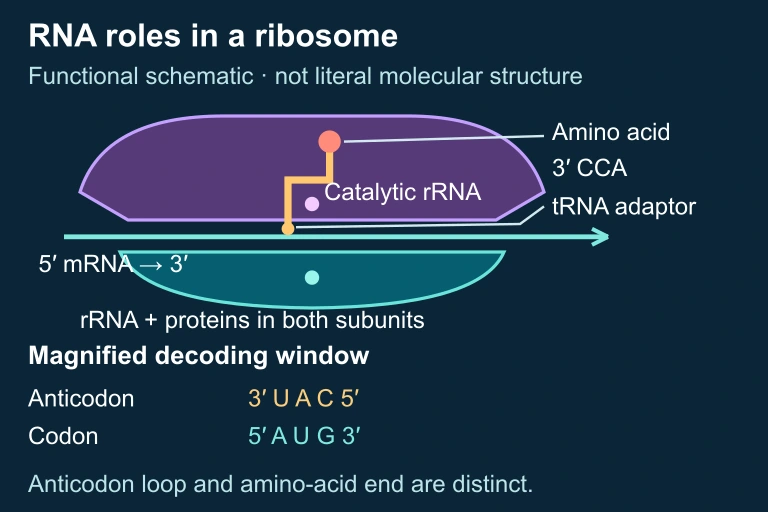
Transfer RNAtRNAAdaptor molecule with an anticodon loop and amino-acid attachment site; delivers amino acids to the ribosome.
Ribosomal RNArRNAStructural and catalytic component of the ribosome; peptidyl transferase activity catalyzes peptide bond formation.
Small nuclear RNAsnRNAComponent of the spliceosome; directs pre-mRNA splicing to remove introns.
MicroRNAmiRNAShort regulatory RNA (~22 nt) that silences gene expression by binding complementary mRNA sequences, promoting degradation or blocking translation.

Principal RNA types encountered in eukaryotic cells.
RNA roles and decoding schematicRNA roles and decoding schematic

A contextual ribosome illustration accompanies an independently authored two-subunit diagram. mRNA runs 5′ to 3′; a tRNA carries an amino acid at 3′ CCA and pairs an anticodon 3′ UAC 5′ with the codon 5′ AUG 3′.mRNA carries a message, tRNA supplies amino acids, and rRNA forms core structural and catalytic parts of ribosomes, which also contain proteins. Illustration is schematic where scale or molecular structure is simplified.

SECTION 8

Connections to Advanced Topics

A solid understanding of nucleic acid chemistry underpins numerous advanced topics you will encounter later in AP Biology and in college-level molecular biology courses. The table below maps fundamental nucleic acid concepts to their higher-level applications.

Foundational ConceptAdvanced Application
Complementary base pairingSemiconservative DNA replication; PCR primer annealing; CRISPR guide RNA targeting
5ʹ→3ʹ directionalityLeading/lagging strand synthesis; Okazaki fragments; RNA polymerase processivity
Sugar difference (ribose vs. deoxyribose)RNA world hypothesis; ribozyme catalysis; reverse transcriptase in retroviruses
H-bond strength (A-T vs. G-C)Melting temperature (Tₘ) of DNA; probe design in genomics; denaturation curves
RNA secondary structureRiboswitch regulation of gene expression; self-splicing introns; siRNA-mediated gene silencing

How nucleic acid fundamentals connect to advanced molecular biology topics.

The RNA world hypothesis is particularly noteworthy: it proposes that early life relied on RNA molecules that could both store genetic information and catalyze chemical reactions, before the evolution of DNA for storage and proteins for catalysis. The discovery of ribozymes — RNA molecules with enzymatic activity — provides experimental support for this hypothesis and underscores that the chemistry of nucleic acids extends far beyond passive information storage.

SECTION 9

Practice Problems

Question 1: CONCEPTUAL

Which component of a nucleotide is responsible for the variation in genetic information between different nucleotides in a nucleic acid strand?
  • A. The phosphate group
  • B. The pentose sugar
  • C. The nitrogenous base
  • D. The phosphodiester bond
Show answer (C)
C is correct. The nitrogenous base (A, T/U, G, or C) is the only component that varies between nucleotides in the same strand, making it the carrier of genetic information. A is wrong because the phosphate group is identical across all nucleotides. B is wrong because while the sugar differs between DNA and RNA (deoxyribose vs. ribose), within a single nucleic acid type all sugars are the same. D is wrong because the phosphodiester bond is the linkage between nucleotides and is chemically identical at each position.

Question 2: BASIC CALCULATION

Analysis of a double-stranded DNA molecule reveals that 18% of its bases are guanine. What percentage of its bases are adenine?
  • A. 18%
  • B. 32%
  • C. 36%
  • D. 64%
Show answer (B)
B is correct. By Chargaff's rules, %G = %C = 18%, so G + C = 36%. The remaining bases are A + T = 100% − 36% = 64%. Since %A = %T in dsDNA, %A = 64% ÷ 2 = 32%. A (18%) is wrong because that equals %G or %C, not %A. C (36%) is wrong because it represents the total G + C content. D (64%) is wrong because it represents the combined A + T content, not adenine alone.

Question 3: INTERMEDIATE

A researcher isolates a single-stranded RNA molecule and finds 30% adenine, 20% uracil, 25% guanine, and 25% cytosine. Which of the following best explains why this base composition does not violate Chargaff's rules?
  • A. Chargaff's rules apply only to double-stranded DNA, not single-stranded RNA.
  • B. RNA substitutes uracil for thymine, which alters the base-pairing ratios.
  • C. Intramolecular base pairing in RNA forces %A to equal %U.
  • D. RNA is too short for Chargaff's rules to apply statistically.
Show answer (A)
A is correct. Chargaff's rules (%A = %T, %G = %C) are a consequence of complementary base pairing between two antiparallel strands; they only hold for double-stranded DNA. A single-stranded molecule is not constrained to have equal amounts of complementary bases. B is wrong because the substitution of U for T does not change the pairing logic — in a double-stranded context A still pairs with U. C is wrong because although some intramolecular pairing occurs in RNA, it is local and does not constrain the overall base composition of the molecule. D is wrong because Chargaff's rules are not a statistical artifact of length but a structural consequence of strand complementarity.

Question 4: APPLIED

A student hypothesizes that increasing the GC content of a DNA molecule increases its thermal stability (melting temperature, Tₘ). Design a controlled experiment to test this hypothesis. In your response: (a) Identify the independent variable, dependent variable, and at least two controlled variables. (b) Describe the experimental procedure, including what samples you would prepare. (c) Predict the expected results if the hypothesis is correct. (d) Explain at the molecular level why GC content would affect Tₘ.
Show answer
(a) Independent variable: GC content of the DNA sample. Dependent variable: melting temperature (Tₘ). Controlled variables include DNA strand length, buffer ionic strength and pH, and heating rate. (1 pt) (b) Synthesize four double-stranded DNA oligonucleotides of identical length (e.g., 30 bp) with GC contents of approximately 20%, 40%, 60%, and 80%. Dissolve each in identical buffer, place in a UV spectrophotometer equipped with a temperature controller, and heat from 25 °C to 100 °C at a uniform rate while recording A₂₆₀. The Tₘ is the temperature at the midpoint of the sigmoidal absorbance-increase curve (hyperchromicity). Multiple replicates should be performed. (1 pt) (c) If the hypothesis is correct, samples with higher %GC will denature at higher temperatures. A graph of Tₘ versus %GC should show a positive correlation. (1 pt) (d) G-C base pairs are held together by three hydrogen bonds, whereas A-T pairs form only two. More energy is needed to break three hydrogen bonds than two, so regions rich in GC pairs resist thermal denaturation more effectively. Enhanced base-stacking interactions in GC-rich sequences also contribute. (1 pt)

Question 5: CRITICAL THINKING

A researcher extracts nucleic acid from an unknown organism and obtains the following base-composition data: Sample X: A = 31%, U = 31%, G = 19%, C = 19% Sample Y: A = 26%, T = 26%, G = 24%, C = 24% (a) Identify whether each sample is DNA or RNA. Justify your answer. (b) Determine whether each sample is single-stranded or double-stranded. Explain your reasoning using Chargaff's rules. (c) Propose one biological scenario in which an organism might possess both a double-stranded DNA genome and a separate RNA molecule with equal complementary base ratios. (d) Explain why the presence of uracil rather than thymine is functionally significant for RNA's role in gene expression.
Show answer
(a) Sample X is RNA because it contains uracil (U) rather than thymine (T). Sample Y is DNA because it contains thymine. (1 pt) (b) In Sample X, %A = %U = 31% and %G = %C = 19%, satisfying base-pair equivalence — this is consistent with double-stranded RNA (dsRNA), as found in certain viral genomes. In Sample Y, %A = %T = 26% and %G = %C = 24%, satisfying Chargaff's rules for double-stranded DNA. (1 pt) (c) A cell infected by a double-stranded RNA virus (e.g., reovirus) would contain both dsDNA (host genome) and dsRNA (viral genome). Alternatively, during RNA interference, dsRNA intermediates form from convergent transcription or synthetic siRNA introduction. (1 pt) (d) RNA uses uracil because it is energetically cheaper to produce than thymine (which requires a methylation step). More importantly, cytosine in DNA can spontaneously deaminate to form uracil; cells detect this as a mutation and repair it via uracil-DNA glycosylase. If uracil were a normal DNA base, the repair system could not distinguish deaminated cytosine from legitimate uracil, compromising genome integrity. Using thymine exclusively in DNA preserves this repair mechanism. (1 pt)

Varsity Tutors • AP Biology • Nucleic Acids