
SECTION 1
Historical Context & Motivation
The observation that offspring resemble their parents yet are never identical copies posed a fundamental puzzle for nineteenth-century biologists. Before the mechanics of cell division were understood, inheritance was explained by blending theories that could not account for the reappearance of traits across generations. The discovery of meiosis — a specialized form of cell division that halves the chromosome number and introduces genetic variation — bridged the gap between cytology and Mendelian genetics, providing a physical mechanism for the segregation and independent assortment of hereditary factors.
1866 • Mendel's Laws of Inheritance
1883 • Discovery of Meiosis
1902 • Chromosome Theory of Inheritance
1911 • Crossing Over Demonstrated
1931 • Cytological Proof of Crossing Over
The central question that meiosis answers is deceptively simple: how can sexually reproducing organisms maintain a constant chromosome number across generations while simultaneously generating the genetic variation upon which evolution depends? The answer lies in two successive divisions — meiosis I and meiosis II — that reduce the diploid chromosome complement by half and, through crossing over and independent assortment, produce gametes that are genetically unique.
SECTION 2
Core Principles of Meiosis
Meiosis is distinguished from mitosis by several defining features: one round of DNA replication is followed by two rounds of nuclear division, homologous chromosomes pair and synapse during prophase I, and the end products are four genetically distinct haploid cells rather than two genetically identical diploid cells. These features collectively serve two biological imperatives — restoring haploidy for gamete formation and maximizing genetic diversity among offspring.
Reductive Division (Meiosis I)
Equational Division (Meiosis II)
Crossing Over (Recombination)
Independent Assortment
Random Fertilization
KEY TAKEAWAY
SECTION 3
Visual Overview of Meiosis
The diagram above highlights the two critical junctures for generating genetic diversity. During Prophase I, homologous chromosomes undergo synapsis, forming tetrads (bivalents) held together by the synaptonemal complex. Non-sister chromatids exchange corresponding segments at structures called chiasmata, producing recombinant chromosomes that carry allele combinations different from either parent chromosome. At Metaphase I, each bivalent orients randomly at the metaphase plate, so the maternal and paternal homologs of one pair sort independently of those in every other pair. Together, these two mechanisms ensure that each gamete receives a unique genomic hand, even before the additional shuffling provided by fertilization.
SECTION 4
Sources of Genetic Variation — Mechanisms in Detail
Crossing Over (Intrachromosomal Recombination)
Crossing over begins during the pachytene substage of prophase I, when homologous chromosomes are fully synapsed. The enzyme SPO11 introduces double-strand breaks in the DNA, which are then repaired using the homologous non-sister chromatid as a template. This repair can result in a reciprocal exchange of genetic material. The physical manifestations of these exchanges — chiasmata — become visible at the diplotene substage and serve to hold the bivalent together until anaphase I. Because crossover events can occur at many positions along a chromosome and typically occur at least once per chromosome arm, they generate an enormous number of recombinant haplotypes. The probability that two loci will be separated by a crossover is proportional to the physical distance between them, a principle exploited in genetic mapping.
RECOMBINATION FREQUENCY
RF values range from 0% (completely linked) to 50% (unlinked or very far apart). An RF of 1% corresponds to 1 centimorgan (cM) of map distance.
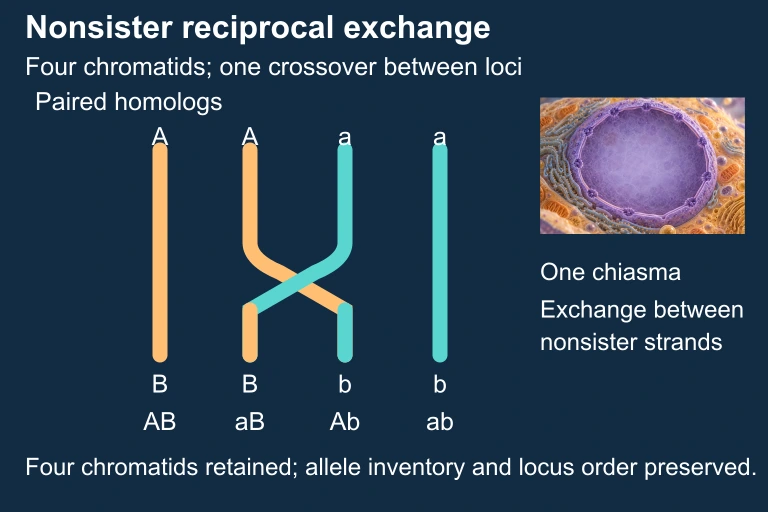 Trace the two nonsister chromatids and four resulting haplotypes.
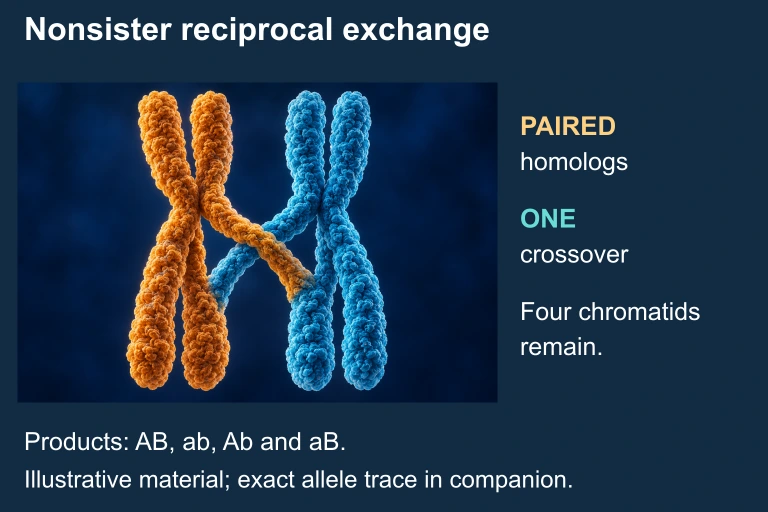 Paired homologs allow exchange between nonsister chromatids during meiotic prophase I. Illustration is schematic where scale or molecular structure is simplified.
Independent Assortment (Interchromosomal Recombination)
Each bivalent aligns at the metaphase I plate with a random orientation — the paternal homolog can face either pole. Because the orientation of one bivalent is independent of the orientation of every other, a diploid organism with n pairs of chromosomes can produce 2ⁿ different gamete combinations through independent assortment alone. For humans, with n = 23, this yields 2²³ = 8,388,608 possible combinations per gamete — and that is before crossing over is factored in.
GAMETE COMBINATIONS FROM INDEPENDENT ASSORTMENT
Where n = the haploid chromosome number. For humans, 2²³ ≈ 8.4 × 10⁶.
Random Fertilization
Random fertilization compounds the variation generated by meiosis. If each parent can produce 2ⁿ gamete types, the number of possible zygotic combinations from independent assortment alone is (2ⁿ)² = 2²ⁿ. For humans, this equals approximately 7.0 × 10¹³ genetically distinct zygotes — a number that becomes effectively infinite when crossing over is included. This combinatorial explosion is the genetic engine of sexual reproduction and a primary reason sexually reproducing populations harbor far more standing genetic variation than asexual ones.
ZYGOTIC COMBINATIONS (INDEPENDENT ASSORTMENT ONLY)
For humans: 2⁴⁶ ≈ 7.04 × 10¹³ possible diploid genotypes from independent assortment of maternal and paternal homologs alone.
SECTION 5
Meiosis versus Mitosis — A Detailed Comparison
While meiosis and mitosis both involve chromosome condensation, spindle formation, and cytokinesis, they serve fundamentally different biological roles and differ at virtually every stage. Understanding these distinctions is essential for the AP Biology exam, as questions frequently require students to identify which features are unique to meiosis and explain their significance for genetic diversity.
Two meiosis-specific events are especially important for AP Biology. First, the pairing of homologous chromosomes during prophase I has no mitotic equivalent; mitotic chromosomes never synapse or form chiasmata. Second, what separates during anaphase I of meiosis is fundamentally different from anaphase of mitosis. In mitosis, centromeres split and sister chromatids move apart. In anaphase I, centromeres remain intact; instead, the chiasmata resolve and whole homologous chromosomes (each still composed of two sister chromatids) migrate to opposite poles. It is only in anaphase II that sister chromatids separate, in a process structurally analogous to mitotic anaphase.
SECTION 6
Worked Example — Calculating Genetic Variation
Consider the following problem: A diploid organism has 2n = 14 chromosomes. (a) How many unique gamete types can independent assortment alone produce? (b) How many genetically distinct zygotes could result from random fertilization of these gametes, ignoring crossing over? (c) Explain why the actual number of genetically distinct offspring is far greater than your answer to part (b).
Genetic Variation in a 2n = 14 Organism
- 1
Step 1 — Determine the Haploid Number
The organism has 2n = 14 chromosomes, so the haploid number is n = 14 ÷ 2 = 7. This means there are 7 homologous pairs that will assort independently during meiosis I.n = 7 - 2
Step 2 — Calculate Gamete Types from Independent Assortment
Each of the 7 homologous pairs can orient in one of two ways at the metaphase I plate. Because the orientation of each pair is independent of the others, the total number of unique gamete types is 2ⁿ = 2⁷.2⁷ = 128 unique gamete types - 3
Step 3 — Calculate Zygotic Combinations from Random Fertilization
If both parents can each produce 128 different gametes, then any of the 128 sperm types can fertilize any of the 128 egg types. The number of unique diploid combinations is therefore 128 × 128 = (2⁷)² = 2¹⁴.2¹⁴ = 16,384 unique zygotic genotypes - 4
Step 4 — Account for Crossing Over
Crossing over produces recombinant chromosomes that differ from either parental homolog. Because crossovers can occur at many positions along each chromosome, the effective number of distinct chromosome variants for each pair far exceeds two. For organisms with large chromosomes and multiple crossover events per bivalent, the actual number of genetically distinct gametes is astronomically larger than 2ⁿ, making the total number of possible offspring genotypes essentially infinite in practice.Actual diversity >> 16,384 (effectively unlimited)
SECTION 7
Meiotic Errors and Their Consequences
While meiosis is a remarkably precise process, errors do occur — and their consequences can be profound. The most common meiotic error is nondisjunction, the failure of chromosomes to separate properly during anaphase I or anaphase II. Nondisjunction produces gametes with abnormal chromosome numbers, leading to aneuploidy (an extra or missing chromosome) in the resulting zygote. Understanding meiotic errors is essential because AP Biology exam questions frequently require students to trace the origin of chromosomal abnormalities back to specific stages of meiosis.
| Error Type | Stage of Origin | Consequence |
|---|---|---|
| Nondisjunction (Meiosis I) | Anaphase I — homologs fail to separate | All four gametes are abnormal: two have n+1 chromosomes, two have n−1 |
| Nondisjunction (Meiosis II) | Anaphase II — sister chromatids fail to separate | Two gametes are normal; one has n+1, one has n−1 |
| Translocation | Prophase I — aberrant crossover between non-homologous chromosomes | Segments transferred between chromosomes; may be balanced (carrier) or unbalanced (phenotypic effects) |
| Deletion / Duplication | Unequal crossing over during Prophase I | One chromatid gains extra copies of genes; the other loses them — dosage imbalance |
Common meiotic errors and their genomic consequences
KEY TAKEAWAY
SECTION 8
Meiosis in the Context of Evolution
Meiosis and sexual reproduction impose significant costs: organisms must find mates, produce two sexes (only one of which bears offspring in many species), and risk breaking apart favorable gene combinations. Despite these costs, sexual reproduction and meiosis are nearly universal among eukaryotes, suggesting that the genetic variation generated by meiosis provides a powerful selective advantage. By shuffling alleles each generation, meiosis enables populations to respond more rapidly to changing selection pressures — pathogens, climate shifts, and novel ecological challenges. This connects directly to AP Biology's Big Idea of Evolution: genetic variation is the raw material upon which natural selection acts, and meiosis is the primary cellular mechanism that generates it in sexually reproducing organisms.
| Feature | Asexual Reproduction (Mitosis) | Sexual Reproduction (Meiosis) |
|---|---|---|
| Genetic variation | Low — offspring are clones (barring mutation) | High — crossing over, independent assortment, random fertilization |
| Reproductive speed | Fast — no mate required | Slower — requires mate-finding and gamete fusion |
| Adaptation to change | Limited — population is genetically uniform | Flexible — standing variation allows rapid response to selection |
| Deleterious alleles | Accumulate irreversibly (Muller's ratchet) | Can be purged through recombination and selection |
| Evolutionary relevance | Advantageous in stable environments | Advantageous in variable or pathogen-rich environments (Red Queen hypothesis) |
Asexual vs. sexual reproduction and their evolutionary trade-offs
Looking beyond the AP curriculum, the study of meiosis connects to cutting-edge research in genome evolution, population genetics, and medical genetics. Meiotic recombination hotspots are now mapped across the human genome, informing studies of linkage disequilibrium and genome-wide association studies (GWAS). Understanding how cohesin proteins regulate chromatid cohesion during meiosis has shed light on age-related aneuploidy and conditions such as trisomy 21 (Down syndrome), whose incidence correlates with maternal age due to prolonged arrest of oocytes in prophase I. These advanced topics illustrate how the principles covered in this lesson form the foundation for modern genetic and genomic research.
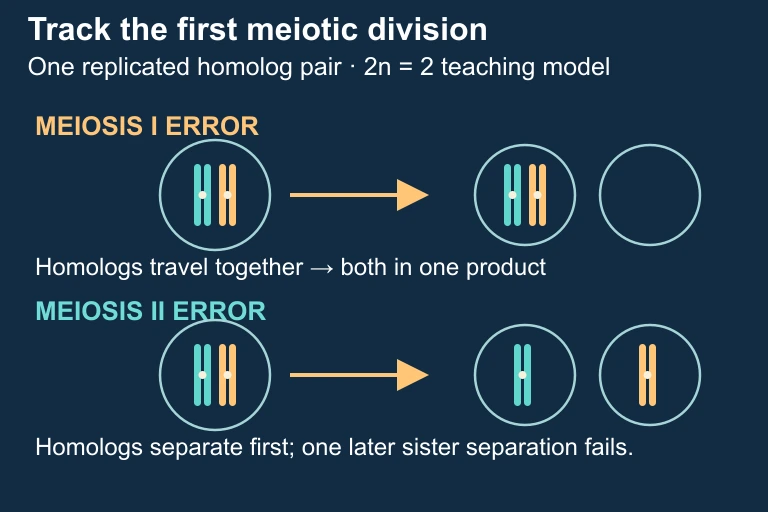 Compare first-division products.
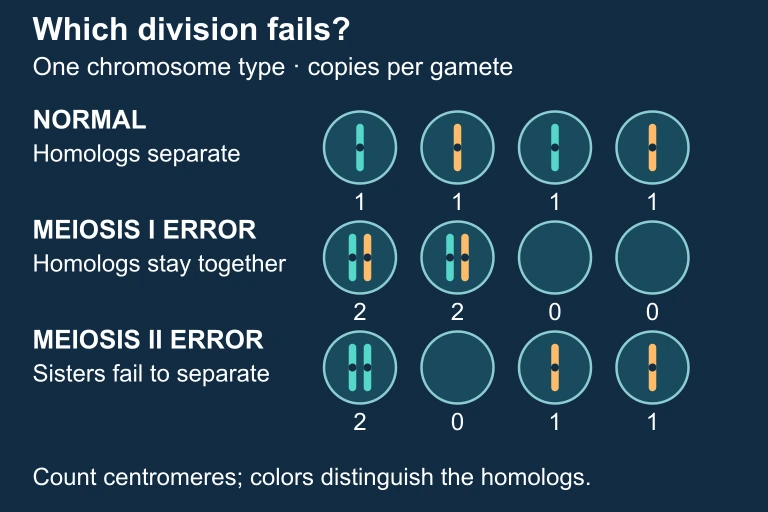 Compare four gamete copy counts.
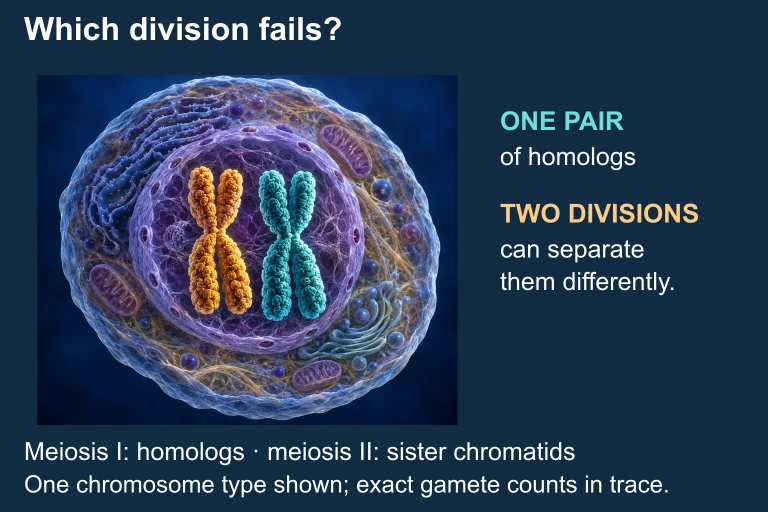 The meiotic stage at which nondisjunction occurs changes the pattern of chromosome copies among gametes. Illustration is schematic where scale or molecular structure is simplified.
SECTION 9
Practice Problems
Question 1: CONCEPTUAL
- A. Condensation of chromatin into visible chromosomes
- B. Synapsis of homologous chromosomes and formation of chiasmata
- C. Attachment of spindle microtubules to kinetochores
- D. Separation of sister chromatids at the centromere
Show answer (B)
Question 2: BASIC CALCULATION
- A. 24
- B. 4,096
- C. 16,777,216
- D. 144
Show answer (B)
Question 3: INTERMEDIATE
- A. 8%; the genes are far apart on the same chromosome
- B. 16%; the genes are on different chromosomes
- C. 16%; the genes are relatively close together on the same chromosome
- D. 8%; the genes are on different chromosomes
Show answer (C)
Question 4: APPLIED
4 ptsShow answer
Question 5: CRITICAL THINKING
4 ptsShow answer
SUMMARY
Lesson Summary
Summary
Meiosis is a specialized form of cell division that produces four genetically unique haploid cells from a single diploid precursor through two successive divisions: meiosis I (reductive division separating homologs) and meiosis II (equational division separating sister chromatids). Three mechanisms generate genetic diversity: crossing over during prophase I recombines alleles on homologous chromosomes, independent assortment at metaphase I produces 2ⁿ possible gamete combinations, and random fertilization multiplies these possibilities to (2ⁿ)² unique zygotic genotypes from independent assortment alone.
Errors in meiosis — particularly nondisjunction — lead to aneuploidy and chromosomal abnormalities. Nondisjunction in meiosis I affects all four gametes, whereas nondisjunction in meiosis II affects only two. On the AP exam, remember that meiosis is the biological basis for Mendel's laws of segregation (homologs separate in anaphase I) and independent assortment (non-homologous pairs orient randomly). The genetic variation produced by meiosis is the raw material for natural selection, connecting heredity directly to the evolutionary processes that shape biological diversity.