
SECTION 1
Historical Context & Motivation
The study of lipids stretches back centuries, intertwined with early investigations into the nature of fats, oils, and waxes. Unlike proteins and nucleic acids, lipids are not defined by a single polymerization motif; instead, they are grouped by a shared physical property—their hydrophobicity, or insolubility in water. This seemingly simple characteristic belies an extraordinary diversity of molecular structures that perform functions ranging from energy storage to hormone signaling. Understanding how scientists gradually unraveled the chemistry behind these greasy molecules reveals why lipids occupy a central place in cell biology, nutrition, and medicine.
1813 • Chevreul Analyzes Animal Fats
1884 • J.L.W. Thudichum Characterizes Brain Lipids
1925 • Gorter & Grendel Propose the Lipid Bilayer
1972 • Singer & Nicolson: Fluid Mosaic Model
2005 • Lipidomics Emerges
From Chevreul's soap-making chemistry to today's sophisticated lipidomics, a recurring question has driven lipid research: how do molecules that largely avoid water become indispensable to the water-filled environments of living cells? The answer lies in the amphipathic nature of many lipids—a dual character that enables self-assembly into bilayers, micelles, and other supramolecular architectures essential for compartmentalization, energy flux, and intercellular communication.
SECTION 2
Core Principles & Definitions
Lipids are a structurally heterogeneous class of biomolecules unified by their substantial nonpolar character and consequent solubility in organic solvents rather than water. Unlike carbohydrates, proteins, and nucleic acids, lipids are not true polymers assembled from a single repeating monomer; instead, they arise from varied biosynthetic routes and display a wide array of backbones. Despite this diversity, several core principles govern their behavior and biological significance.
Hydrophobicity & Amphipathicity
Dehydration Synthesis & Hydrolysis
Saturation & Fluidity
High Energy Density
Structural & Signaling Diversity
KEY TAKEAWAY
SECTION 3
Visual Explanation — Phospholipid & Bilayer Architecture
The diagram above captures the fundamental organizational logic of biological membranes. Each phospholipid's amphipathic architecture—a hydrophilic head joined to hydrophobic tails—drives self-assembly in water. The polar head group typically contains a phosphate esterified to a variable alcohol (choline, ethanolamine, serine, or inositol), while the two fatty acid chains may differ in length and degree of unsaturation. In the bilayer cross-section, note how the hydrophobic core creates an effective permeability barrier; small nonpolar molecules such as O2 and CO2 diffuse freely, whereas ions and large polar molecules require channel or carrier proteins for transmembrane passage.
SECTION 4
Chemical Framework — Synthesis & Energetics
The formation and breakdown of lipids follow the same condensation–hydrolysis logic shared by other biological macromolecules, but the energetic payoff of lipid oxidation is distinctive. This section examines the key chemical reactions and energetic relationships relevant to lipid biochemistry at the AP Biology level.
TRIGLYCERIDE FORMATION (DEHYDRATION SYNTHESIS)
Each fatty acid is joined to the glycerol backbone through an ester bond (−COO−), releasing one water molecule per bond. Three ester bonds form per triglyceride.
TRIGLYCERIDE HYDROLYSIS
Lipase enzymes catalyze hydrolysis in the small intestine and within adipocytes, freeing fatty acids for β-oxidation in mitochondria.
ENERGY YIELD COMPARISON
The greater energy density of fats reflects their highly reduced C−H bonds. A 16-carbon saturated fatty acid (palmitate) yields 129 ATP via complete β-oxidation and oxidative phosphorylation—far exceeding the ~36–38 ATP from one glucose molecule.
Why do lipids store more energy per gram than carbohydrates? The answer is rooted in oxidation state. In a fatty acid such as palmitic acid (C16H32O2), almost every carbon is bonded to hydrogen rather than oxygen, meaning the molecule is highly reduced. Complete oxidation of these C−H bonds to CO2 and H2O releases substantial free energy. In contrast, glucose (C6H12O6) already has many carbons partially oxidized (bonded to oxygen), leaving less energy to be extracted. Additionally, lipids are anhydrous when stored in adipose tissue, whereas glycogen binds approximately 2 g of water per gram of polysaccharide, further diluting its energy density in vivo.
AP Exam Connection
SECTION 5
Lipid Classification & Structural Diversity
Lipids are traditionally grouped into several major categories based on backbone structure and biological function. The AP Biology curriculum emphasizes fats/oils (triglycerides), phospholipids, steroids, and waxes. Understanding their structural differences is essential to predicting their distinct roles in cells.
| Lipid Class | Structure | Key Function(s) | Example(s) |
|---|---|---|---|
| Triglycerides | Glycerol + 3 fatty acids via ester bonds | Long-term energy storage; insulation; organ cushioning | Animal fat (lard), plant oil (olive oil) |
| Phospholipids | Glycerol + 2 fatty acids + phosphate head group | Major structural component of cell membranes | Phosphatidylcholine, phosphatidylserine |
| Steroids | Four fused carbon rings with variable functional groups | Membrane fluidity (cholesterol); hormonal signaling | Cholesterol, estrogen, testosterone, cortisol |
| Waxes | Long-chain fatty acid + long-chain alcohol via ester bond | Waterproof coatings; protection against desiccation | Plant leaf cuticle, beeswax, lanolin |
Comparison of major lipid classes tested on the AP Biology exam
A critical distinction for the AP exam is the relationship between fatty acid saturation and physical state. Saturated fatty acids lack carbon–carbon double bonds, allowing their hydrocarbon tails to pack tightly via van der Waals interactions; this close packing results in a higher melting point and a solid state at room temperature (think butter). Unsaturated fatty acids contain one or more cis double bonds that introduce kinks in the chain, disrupting orderly packing and lowering the melting point—hence oils remain liquid at room temperature. Trans fats are artificially produced unsaturated fats whose double bonds adopt the trans configuration, straightening the chain and mimicking saturated behavior, which contributes to cardiovascular risk.
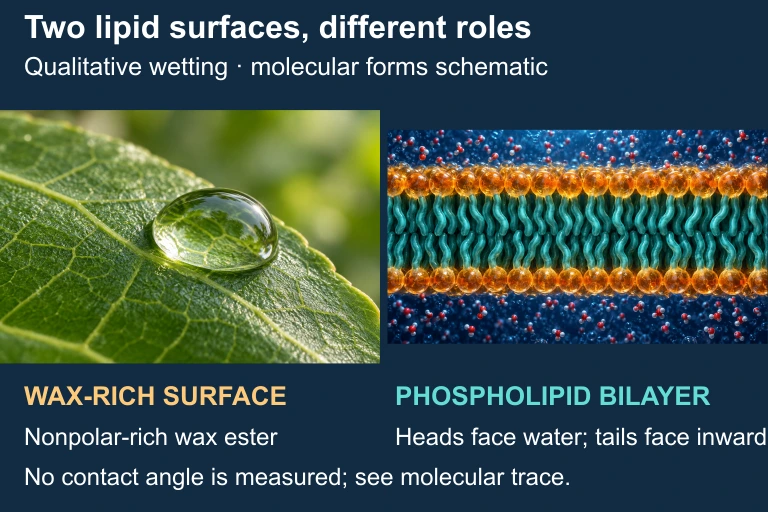 A wax-rich cuticle limits wetting, while phospholipids organize with polar heads exposed to water. Illustration is schematic where scale or molecular structure is simplified.
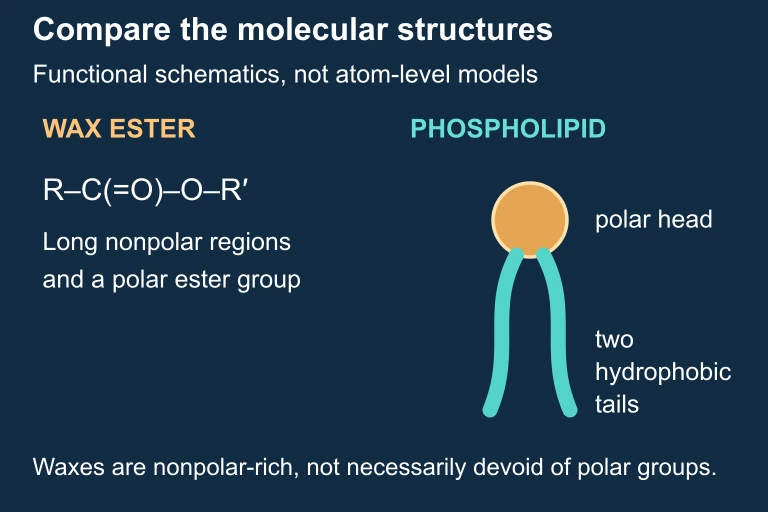 Compare a wax ester with a phospholipid head and two tails.
SECTION 6
Worked Example — Analyzing a Triglyceride
Let us walk through a problem that integrates lipid structure, dehydration synthesis, and the relationship between saturation and physical properties—all common AP exam themes.
Constructing and Analyzing a Triglyceride
- 1
Step 1 — Identify Components
A triglyceride is assembled from one glycerol molecule (a 3-carbon alcohol) and three fatty acid molecules. Suppose we are given two palmitic acid chains (16:0, saturated) and one oleic acid chain (18:1, one cis double bond at carbon 9).Reactants: 1 glycerol + 2 palmitic acid + 1 oleic acid - 2
Step 2 — Determine Bonds Formed and Water Released
Each fatty acid joins glycerol via dehydration synthesis, forming an ester bond (—COO—) and releasing one H₂O. With three fatty acids, three ester bonds form and three water molecules are produced.3 ester bonds formed; 3 H₂O released - 3
Step 3 — Predict Physical State
Two of the three fatty acid chains are fully saturated and can pack closely. However, the single oleic acid chain introduces a cis kink that partially disrupts packing. The triglyceride would likely be semi-solid at room temperature—softer than a fully saturated fat like tristearin, but not liquid like triolein.Semi-solid at ~25 °C (mixed saturation) - 4
Step 4 — Relate to Biological Function
This mixed triglyceride resembles the composition found in many animal adipose tissues and serves as a compact energy reserve. Upon hydrolysis by lipases, the released fatty acids undergo β-oxidation in the mitochondrial matrix. The two palmitic acid molecules yield roughly 129 ATP each; the oleic acid yields approximately 146 ATP, for a combined total far exceeding what the same mass of glycogen could provide.Total ATP ≈ 129 + 129 + 146 = ~404 ATP (approximate, minus activation costs)
SECTION 7
Lipids vs. Other Macromolecules
A recurring AP Biology theme is the comparison of the four major classes of biological macromolecules. While proteins, nucleic acids, and carbohydrates are true polymers built from defined monomers, lipids stand apart as a non-polymeric class unified by hydrophobicity. The table below highlights key contrasts and parallels.
| Feature | Lipids | Carbohydrates | Proteins |
|---|---|---|---|
| Monomer | Fatty acids + glycerol (not true monomers) | Monosaccharides | Amino acids |
| Bond type | Ester bond | Glycosidic bond | Peptide bond |
| Elements | C, H, O (some P, N) | C, H, O | C, H, O, N, S |
| Energy (kcal/g) | ~9 | ~4 | ~4 |
| Solubility | Hydrophobic / amphipathic | Hydrophilic | Variable (depends on R groups) |
| Primary roles | Energy storage, membranes, signaling | Quick energy, structural support | Enzymes, structure, transport, defense |
Macromolecule comparison — lipids, carbohydrates, and proteins
KEY TAKEAWAY
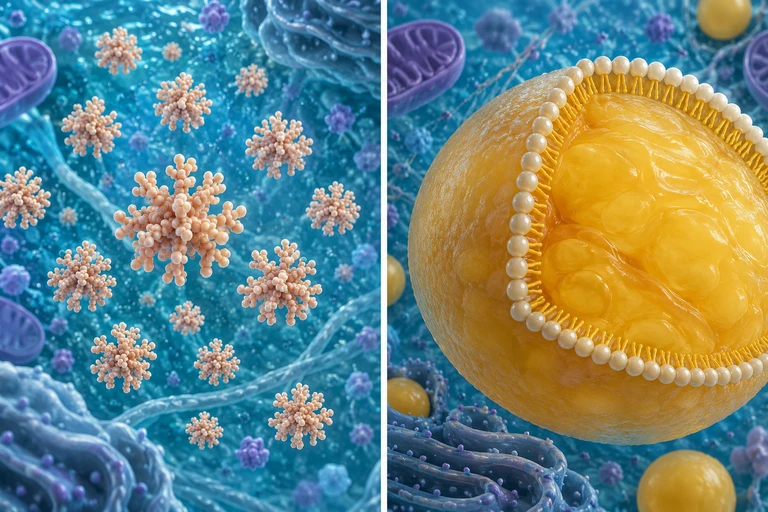 Using approximate nutritional energy densities of 4 and 9 kcal/g, 100 kcal requires 25 g of dry glycogen or 11.1 g of fat. If glycogen carries 2 g of water per gram, its total storage mass is 75 g; hydration varies.
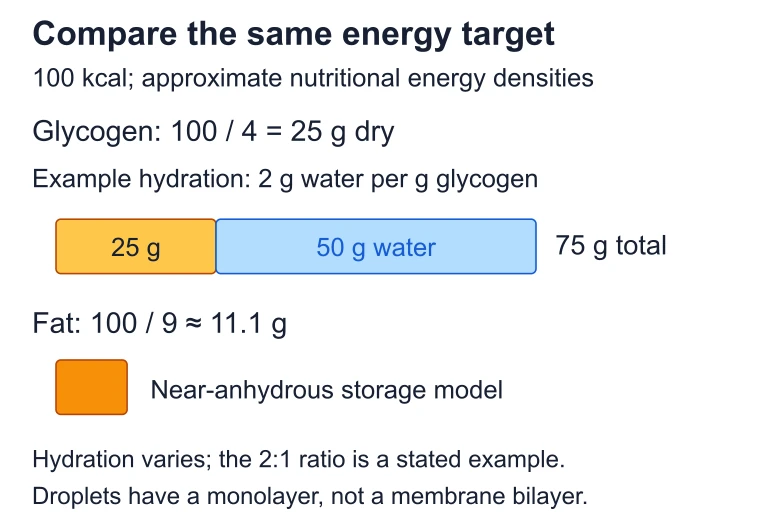 Using approximate nutritional energy densities of 4 and 9 kcal/g, 100 kcal requires 25 g of dry glycogen or 11.1 g of fat. If glycogen carries 2 g of water per gram, its total storage mass is 75 g; hydration varies.
SECTION 8
Connections to Membrane Biology & Signaling
Lipids do far more than store energy. Several advanced topics in the AP Biology curriculum—and beyond—depend on a solid understanding of lipid biochemistry. Cholesterol, phospholipid asymmetry, and lipid-based signaling molecules connect directly to units on cell structure, cell communication, and evolution.
| Core AP Concept | Advanced Extension |
|---|---|
| Phospholipid bilayer as a selectively permeable barrier | Lipid rafts—cholesterol and sphingolipid-enriched microdomains that concentrate signaling proteins and regulate membrane trafficking |
| Cholesterol modulates membrane fluidity | At high temperatures cholesterol restrains phospholipid movement; at low temperatures it prevents tight packing—acting as a fluidity buffer across temperature ranges |
| Steroid hormones as chemical signals | Because steroids are lipid-soluble, they cross the plasma membrane and bind intracellular receptors (often transcription factors), directly altering gene expression—contrasting with water-soluble signals that require surface receptors |
| Fatty acid saturation affects physical state | Organisms adjust fatty acid desaturase expression in response to temperature (homeoviscous adaptation), maintaining optimal membrane fluidity—a concept linking biochemistry to evolution and ecology |
| Lipids as energy-dense storage molecules | Eicosanoids (prostaglandins, leukotrienes) derived from 20-carbon polyunsaturated fatty acids mediate inflammation, fever, and pain—a bridge to immunology and pharmacology |
Connecting AP-level lipid concepts to advanced biology
As you progress through subsequent AP Biology units, you will encounter lipids repeatedly—in discussions of the fluid mosaic model (Unit 2), cell signaling (Unit 4), and cellular energetics (Unit 3). The concept of homeoviscous adaptation, in which ectotherms modulate membrane fatty acid composition in response to environmental temperature, exemplifies the broader AP theme that structure is intimately linked to function at every level of biological organization.
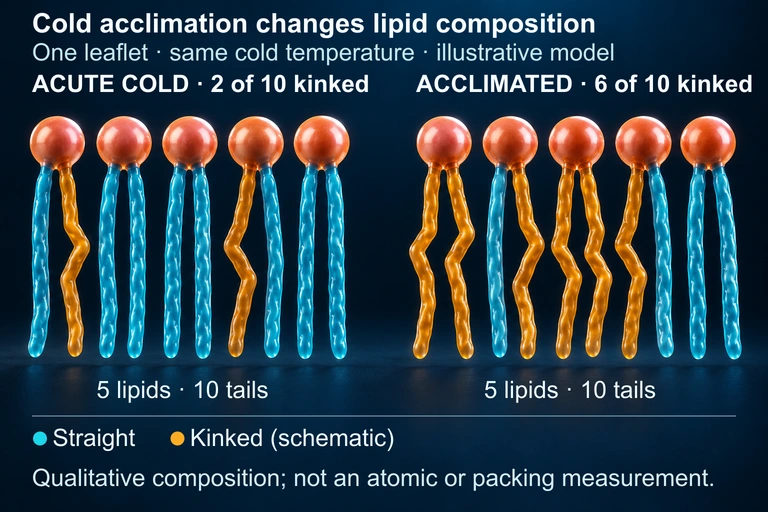 Some organisms acclimate to cold by increasing unsaturated fatty-acid content, helping maintain membrane fluidity. This qualitative composition model compares leaflets at the same cold temperature; it is not an atomic structure or packing measurement.
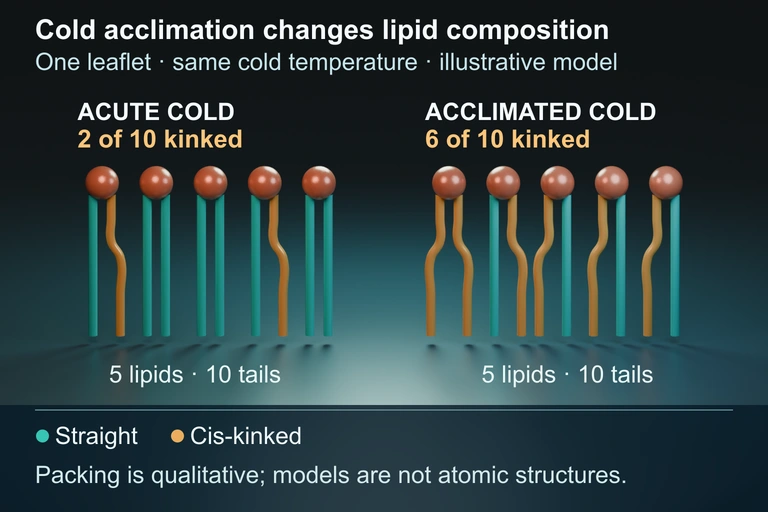 Authored geometry companion
SECTION 9
Practice Problems
Question 1: CONCEPTUAL
- A. They are polymers built from repeating monomers.
- B. They are largely hydrophobic and poorly soluble in water.
- C. They always contain a glycerol backbone.
- D. They contain nitrogen as a major element.
Show answer (B)
Question 2: BASIC CALCULATION
- A. 1
- B. 2
- C. 3
- D. 6
Show answer (C)
Question 3: INTERMEDIATE
- A. Sample X has longer carbon chains; sample Y has shorter carbon chains.
- B. Sample X has predominantly saturated fatty acids; sample Y has predominantly unsaturated fatty acids with cis double bonds.
- C. Sample X has more phosphate groups; sample Y has fewer phosphate groups.
- D. Sample X has branched fatty acid chains; sample Y has straight chains.
Show answer (B)
Question 4: APPLIED
4 ptsShow answer
Question 5: CRITICAL THINKING
4 ptsShow answer
SUMMARY
Lipids — Comprehensive Review
Summary
Lipids are a diverse class of biological molecules unified by their hydrophobic character. The four major categories—triglycerides (energy storage), phospholipids (membrane bilayers), steroids (signaling and membrane fluidity), and waxes (waterproof coatings)—differ in backbone structure but share nonpolar hydrocarbon regions. Triglycerides form via dehydration synthesis (three ester bonds, three water molecules released) and are broken down by hydrolysis. Fats yield ~9 kcal/g because their highly reduced C−H bonds store more energy than the partially oxidized bonds in carbohydrates (~4 kcal/g).
The degree of fatty acid saturation determines melting point and membrane fluidity: saturated tails pack tightly (solids), while unsaturated (cis) tails introduce kinks that prevent packing (liquids). Cholesterol acts as a fluidity buffer in animal cell membranes. Phospholipids' amphipathic nature drives spontaneous bilayer self-assembly—the structural basis of all biological membranes. Organisms adjust membrane fatty acid composition in response to temperature (homeoviscous adaptation), exemplifying the AP Biology theme that molecular structure determines biological function.