
SECTION 1
Historical Context & Motivation
The recognition that living organisms are built from a small set of large, complex molecules represents one of the foundational insights of modern biology. Throughout the nineteenth and twentieth centuries, chemists gradually moved away from the doctrine of vitalism—the idea that organic compounds required a mysterious 'life force' for their synthesis—and toward a mechanistic understanding of biological chemistry. Friedrich Wöhler's 1828 synthesis of urea from inorganic precursors cracked that philosophical door open, and subsequent decades of analytical work revealed that cells are dominated by enormous molecules now classified as macromolecules. Understanding these molecules is essential because virtually every process tested on the AP Biology exam—from gene expression to cellular respiration—depends on the properties of proteins, nucleic acids, carbohydrates, and lipids.
1828 • Wöhler Synthesizes Urea
1902 • Fischer & the Peptide Bond
1926 • Sumner Crystallizes Urease
1953 • Watson & Crick Model DNA
1958 • Starch & Glycogen Structures Resolved
These milestones converge on a central question that pervades AP Biology: how do relatively simple monomeric building blocks assemble into polymers whose emergent properties—catalysis, information storage, structural support, and energy provision—make life possible? Answering that question requires understanding the chemistry of polymerization, the four macromolecule classes, and the structure–function relationships that connect molecular shape to biological activity.
SECTION 2
Core Principles & Definitions
A macromolecule is a large, complex molecule typically assembled from smaller repeating subunits called monomers. Three of the four macromolecule classes—proteins, nucleic acids, and carbohydrates—are true polymers formed by linking monomers through covalent bonds in repeated condensation reactions. Lipids, though classified as macromolecules by convention in biology courses, are not true polymers because they are not built from a single repeating monomer unit. All four classes share a common theme: the arrangement and identity of their subunits determine their three-dimensional shape, which in turn dictates biological function.
Dehydration Synthesis
Hydrolysis
Monomers & Polymers
Structure Determines Function
KEY TAKEAWAY
SECTION 3
Visual Explanation — Dehydration Synthesis & Hydrolysis
The diagram above illustrates the reciprocal relationship that governs all macromolecule assembly and disassembly. During dehydration synthesis, the hydroxyl group (–OH) of one monomer and a hydrogen atom (–H) of a second monomer depart as a water molecule, while the remaining atoms form a new covalent bond—a peptide bond in proteins, a glycosidic linkage in carbohydrates, or a phosphodiester bond in nucleic acids. Hydrolysis reverses the process: water donates its –OH and –H back to the cleaved monomers, restoring the original functional groups. Both reactions require enzymatic catalysis under physiological conditions, and their balance determines whether a cell is net-building or net-degrading macromolecules at any given moment.
SECTION 4
The Four Classes of Macromolecules
Each macromolecule class is distinguished by the identity of its monomers, the type of covalent linkage that joins them, and the biological roles that emerge from its polymer structure. Although all four share a carbon backbone—reflecting carbon's ability to form four stable covalent bonds—their functional-group chemistry produces strikingly different properties.
Carbohydrates
Carbohydrates consist of carbon, hydrogen, and oxygen, typically in an approximate ratio of CH2O. The monomer is a monosaccharide such as glucose (C6H12O6). Monosaccharides join via glycosidic linkages to form disaccharides (e.g., sucrose, lactose) and polysaccharides (e.g., starch, glycogen, cellulose, chitin). Starch and glycogen serve as energy-storage polymers in plants and animals respectively, while cellulose and chitin are structural polysaccharides whose β-glycosidic linkages resist enzymatic hydrolysis by most organisms.
Lipids
Lipids are a diverse group united by their hydrophobic character rather than by a shared monomer. Triglycerides (fats and oils) consist of a glycerol molecule esterified to three fatty acid chains via ester bonds. Saturated fatty acids lack C=C double bonds and pack tightly (solid at room temperature), while unsaturated fatty acids contain one or more double bonds that introduce kinks (liquid at room temperature). Phospholipids replace one fatty acid with a phosphate group, generating an amphipathic molecule that self-assembles into the bilayer structure of cell membranes. Steroids such as cholesterol feature a four-ring hydrocarbon skeleton and modulate membrane fluidity.
Proteins
Proteins are polymers of amino acids linked by peptide bonds. Each amino acid has a central carbon bonded to an amino group (–NH2), a carboxyl group (–COOH), a hydrogen, and a variable R group (side chain) that determines the amino acid's chemical properties—nonpolar, polar, acidic, or basic. Twenty standard amino acids combine in different sequences (primary structure) to yield proteins that fold into secondary (α-helices, β-sheets), tertiary, and quaternary structures. Protein functions span catalysis (enzymes), transport (hemoglobin), defense (antibodies), signaling (hormones), and structural support (collagen).
Nucleic Acids
Nucleic acids—DNA and RNA—are polymers of nucleotides. Each nucleotide consists of a five-carbon sugar (deoxyribose in DNA, ribose in RNA), a phosphate group, and a nitrogenous base (adenine, guanine, cytosine, thymine in DNA; uracil replaces thymine in RNA). Nucleotides join via phosphodiester bonds between the 3ʹ hydroxyl of one sugar and the 5ʹ phosphate of the next, producing a sugar–phosphate backbone with directionality (5ʹ → 3ʹ). DNA stores hereditary information in its base sequence; RNA serves roles in transcription, translation, and regulation.
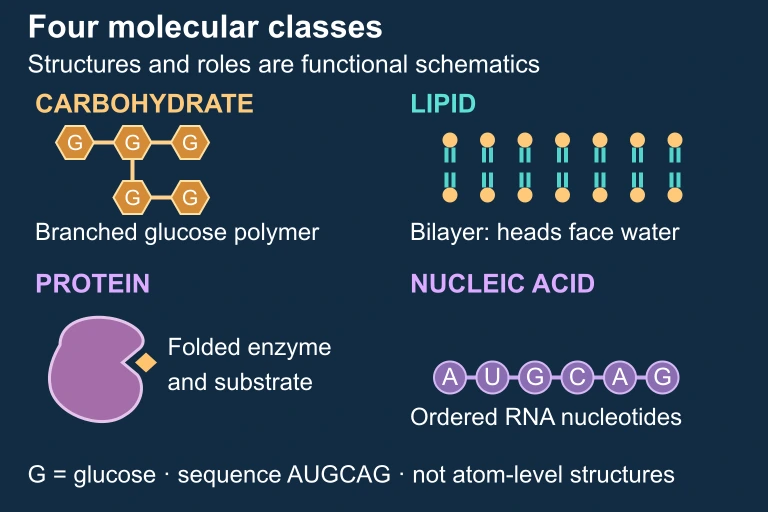 Four functional molecular schematics and the RNA sequence.
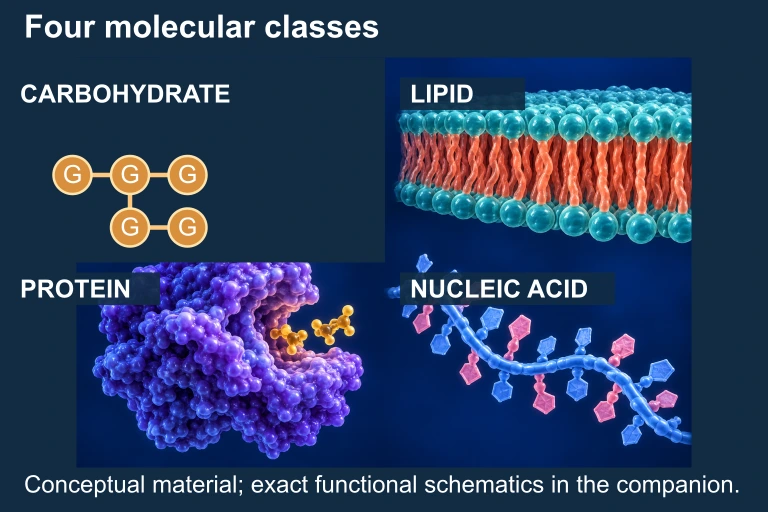 Carbohydrates, lipids, proteins and nucleic acids contribute different structures and functions within cells. Illustration is schematic where scale or molecular structure is simplified.
SECTION 5
Comparative Classification of Macromolecules
| Class | Monomer | Bond Type | Example Polymer | Primary Function(s) |
|---|---|---|---|---|
| Carbohydrate | Monosaccharide | Glycosidic | Starch, cellulose, glycogen | Energy storage, structural support |
| Lipid | Glycerol + fatty acids | Ester | Triglyceride, phospholipid | Long-term energy, membrane structure |
| Protein | Amino acid | Peptide | Hemoglobin, collagen, enzymes | Catalysis, transport, structure |
| Nucleic acid | Nucleotide | Phosphodiester | DNA, mRNA, tRNA | Genetic info storage, protein synthesis |
Summary table of macromolecule classes tested on the AP Biology exam.
SECTION 6
Worked Example — Identifying Macromolecule Structure & Function
Determining the Macromolecule Class from a Molecular Description
- 1
Step 1 — Read the Prompt
A biologist isolates a large biological molecule from a cell extract. Chemical analysis reveals it contains C, H, O, N, and S. The molecule is composed of a linear chain of 200 subunits, each with the general formula NH2–CHR–COOH, linked by bonds formed through dehydration synthesis. When heated or exposed to extreme pH, the molecule unfolds and loses its biological activity. - 2
Step 2 — Identify the Elements Present
The molecule contains C, H, O, N, and S. Carbohydrates contain only C, H, O. Lipids contain primarily C, H, O. Nucleic acids contain C, H, O, N, and P (phosphorus). Proteins contain C, H, O, N, and often S (in cysteine and methionine). The presence of sulfur without phosphorus points toward a protein.Elemental composition → protein - 3
Step 3 — Identify the Monomer
The subunit formula NH2–CHR–COOH describes an amino acid: an amino group, a central (alpha) carbon with a variable R group, and a carboxyl group. This confirms the molecule is a polypeptide.Monomer = amino acid → polypeptide chain - 4
Step 4 — Identify the Bond Type
The subunits are linked by dehydration synthesis between the carboxyl group of one amino acid and the amino group of the next. This covalent linkage is a peptide bond.Bond = peptide bond - 5
Step 5 — Explain the Loss of Function
When the molecule is heated or subjected to extreme pH, it unfolds—a process called denaturation. Denaturation disrupts the hydrogen bonds, ionic bonds, hydrophobic interactions, and disulfide bridges that maintain the protein's three-dimensional (tertiary/quaternary) structure. Since protein function depends on shape, loss of structure means loss of biological activity. Importantly, denaturation does not break peptide bonds, so the primary structure (amino acid sequence) remains intact.Answer: The molecule is a protein (polypeptide). It lost function due to denaturation, which disrupted its 3-D conformation.
SECTION 7
Energy Storage — Carbohydrates vs. Lipids
A frequently tested comparison on the AP Biology exam involves the relative advantages of storing energy as carbohydrates versus lipids. Both serve as fuel reserves, but they differ in energy density, mobilization speed, and hydration requirements, which together explain why organisms maintain both stores.
| Feature | Carbohydrates (glycogen/starch) | Lipids (triglycerides) |
|---|---|---|
| Energy density | ≈ 4 kcal/g | ≈ 9 kcal/g (more than 2× greater) |
| Mobilization speed | Rapid — quickly hydrolyzed for glucose | Slower — requires β-oxidation |
| Water of hydration | Heavily hydrated (~2 g H₂O per g glycogen) | Nearly anhydrous (hydrophobic) |
| Storage example | Glycogen in liver and muscle | Adipose tissue (fat cells) |
| Best for | Short-term, readily accessible fuel | Long-term, compact energy reserves |
Comparison of carbohydrate vs. lipid energy storage.
KEY TAKEAWAY
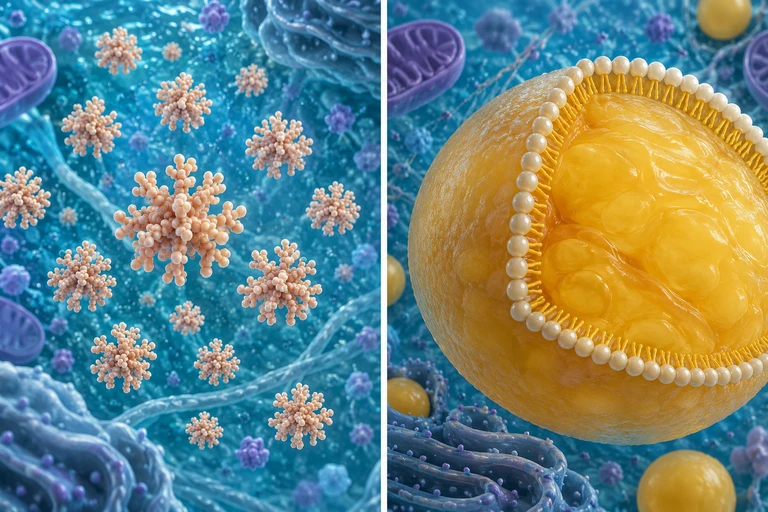 Using approximate nutritional energy densities of 4 and 9 kcal/g, 100 kcal requires 25 g of dry glycogen or 11.1 g of fat. If glycogen carries 2 g of water per gram, its total storage mass is 75 g; hydration varies.
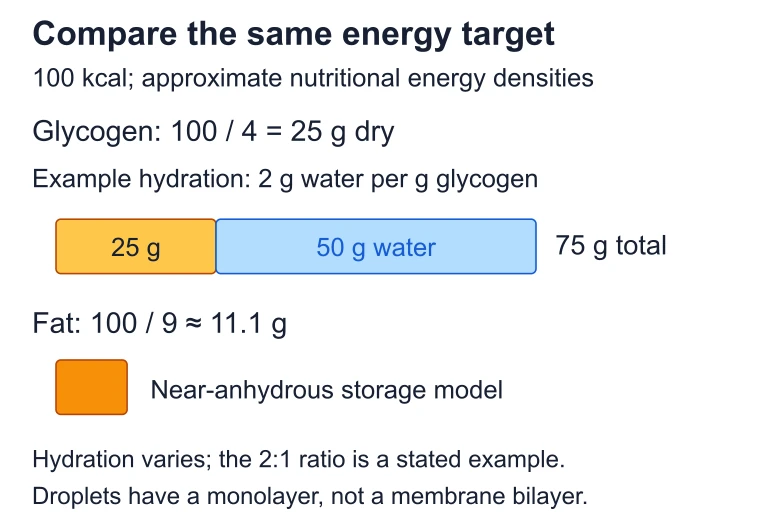 Using approximate nutritional energy densities of 4 and 9 kcal/g, 100 kcal requires 25 g of dry glycogen or 11.1 g of fat. If glycogen carries 2 g of water per gram, its total storage mass is 75 g; hydration varies.
SECTION 8
Connections to Advanced Topics
Understanding macromolecules at the introductory level provides the foundation for nearly every subsequent unit in AP Biology. The concepts of monomer identity, polymerization, and structure–function relationships scale directly into discussions of gene expression, metabolism, cell signaling, and evolution. The table below connects macromolecule fundamentals to the advanced topics you will encounter later in the course.
| Foundational Concept | Advanced Application |
|---|---|
| Nucleotide sequence in DNA | Genetic code, transcription, translation, mutations (Unit 6 – Gene Expression) |
| Protein folding & R-group interactions | Enzyme kinetics, allosteric regulation, signal transduction (Units 3 & 4) |
| Phospholipid bilayer structure | Membrane transport, cell communication, endosymbiotic theory (Units 2 & 4) |
| Glucose as a monosaccharide | Glycolysis, Krebs cycle, oxidative phosphorylation (Unit 3 – Cellular Energetics) |
| Amino acid sequence determines protein shape | Natural selection acts on phenotypes produced by proteins; molecular evidence of evolution (Unit 7) |
How introductory macromolecule concepts connect to later AP Biology units.
As you advance through AP Biology, you will continually revisit the principle that the specific arrangement of monomers determines the emergent properties of a biological polymer. A single amino acid substitution in hemoglobin causes sickle-cell disease; a point mutation in a DNA nucleotide sequence can alter an entire protein's function. These examples underscore why mastering macromolecular chemistry now will pay dividends throughout the course and on the AP exam.
SECTION 9
Practice Problems
Question 1: CONCEPTUAL
- A. Both reactions require the input of water to proceed.
- B. Dehydration synthesis breaks polymers apart, while hydrolysis builds them.
- C. Dehydration synthesis forms covalent bonds and releases water, while hydrolysis uses water to break covalent bonds.
- D. Hydrolysis is specific to proteins, while dehydration synthesis occurs in all macromolecule classes.
Show answer (C)
Question 2: BASIC CALCULATION
- A. 150
- B. 149
- C. 151
- D. 300
Show answer (B)
Question 3: INTERMEDIATE
- A. Primary structure only, because the amino acid sequence changed
- B. Tertiary structure, because hydrophobic interactions in the protein's interior are disrupted by the introduction of a charged residue
- C. Secondary structure only, because α-helices and β-sheets depend on R-group identity
- D. Quaternary structure, because the substitution prevents subunit assembly
Show answer (B)
Question 4: APPLIED
4 ptsShow answer
Question 5: CRITICAL THINKING
4 ptsShow answer
SUMMARY
Lesson Summary
Summary
Living systems are built from four classes of macromolecules: carbohydrates (monosaccharides linked by glycosidic bonds), lipids (glycerol and fatty acids joined by ester bonds, though not true polymers), proteins (amino acids linked by peptide bonds), and nucleic acids (nucleotides joined by phosphodiester bonds). Polymers are assembled by dehydration synthesis (which releases water) and broken down by hydrolysis (which consumes water).
The overarching principle is that structure determines function: the specific sequence and three-dimensional arrangement of monomers produce emergent properties—catalysis, information storage, energy provision, and membrane formation—that single monomers cannot achieve. Denaturation disrupts shape and therefore function without breaking primary covalent bonds. Mastering these fundamentals is essential because virtually every AP Biology topic—from enzyme kinetics to gene expression to cellular respiration—depends on the chemistry of these four molecular families.