

SECTION 1
Historical Context & Motivation
The concept of feedback in biology grew from the broader recognition that living systems are not static but instead dynamically self-regulating. Early physiologists noticed that organisms maintain remarkably stable internal conditions—body temperature, blood glucose, pH—despite wildly varying external environments. This observation demanded a mechanistic explanation: how does a cell or an organism "know" when a product is sufficient, or when a process should accelerate? The answer, researchers discovered, lies in the capacity of biological outputs to loop back and influence their own production, a principle that now underpins our understanding of everything from gene regulation to the cell cycle checkpoints tested on the AP Biology exam.
1865 • Claude Bernard & the "Milieu Intérieur"
1932 • Walter Cannon Coins "Homeostasis"
1953 • Jacques Monod & Allosteric Regulation
1971 • Discovery of Cell Cycle Checkpoints
1986 • Cyclin–CDK Feedback Loops Elucidated
Together, these milestones frame a central question in cell biology: How do cells use the products and consequences of their own signaling pathways to self-correct or self-amplify? Understanding feedback is essential for explaining how organisms maintain homeostasis and how disruptions—such as uncontrolled cell division in cancer—arise when feedback fails.
SECTION 2
Core Principles & Definitions
At the most fundamental level, a feedback loop exists whenever the output of a process circles back to influence the input or activity of that same process. In biology, two principal types govern cellular and organismal behavior: negative feedback, which dampens change and maintains homeostasis, and positive feedback, which amplifies a signal to drive a process toward completion. Both types are essential in cell communication and cell cycle regulation, and the AP Biology exam expects you to distinguish between them, explain their molecular mechanisms, and predict their consequences when disrupted.
Negative Feedback
Positive Feedback
Set Point
Signal Transduction Relay
Checkpoints as Feedback Nodes
KEY TAKEAWAY
SECTION 3
Visual Explanation — Feedback Loop Architecture
The diagram above highlights the structural difference between the two loop types. Both share the same basic architecture—stimulus, receptor, signal relay, effector—but the critical distinction lies in the direction of the feedback arrow. In negative feedback (left, cyan), the effector's output opposes the initial change, creating a dampening cycle that oscillates around a set point. In positive feedback (right, pink), the effector's output reinforces the initial change, creating a self-amplifying cascade. Negative feedback predominates in homeostatic regulation, whereas positive feedback operates in situations that require a rapid, committed transition, such as the burst of luteinizing hormone during ovulation or the activation of caspases during apoptosis.
SECTION 4
Molecular Mechanisms of Feedback in Cell Signaling
Negative Feedback in Signal Transduction
Many signal transduction pathways incorporate negative feedback at multiple levels to prevent runaway signaling. Consider the MAPK (mitogen-activated protein kinase) cascade: when a growth factor binds its receptor tyrosine kinase and activates Ras → Raf → MEK → ERK, the terminal kinase ERK phosphorylates upstream components such as SOS (the Ras-GEF), reducing further Ras activation. This is a classic example of end-product inhibition at the signaling level. Similarly, phosphatases are constitutively active enzymes that strip phosphate groups from signaling proteins, ensuring that pathway activity decays unless continuously re-stimulated. Receptor internalization (endocytosis of ligand-bound receptors) provides yet another layer: cells physically remove activated receptors from the surface, reducing sensitivity in a process called receptor downregulation.
Positive Feedback in the Cell Cycle
The transition from G₂ into M phase exemplifies positive feedback in the cell cycle. As Cyclin B accumulates during G₂, it binds CDK1 (also called Cdc2), forming the M-phase promoting factor (MPF). Initially, MPF is kept inactive by inhibitory phosphorylation from Wee1 kinase. However, once a small amount of active MPF appears, it activates the phosphatase Cdc25, which removes inhibitory phosphates from additional MPF complexes—and simultaneously inhibits Wee1. The result is a double positive feedback loop: more active MPF → more Cdc25 activity → even more active MPF. This creates a bistable switch that commits the cell irreversibly to mitosis once a threshold is crossed, ensuring that cells do not linger in a half-committed state between interphase and mitosis.
Negative Feedback Exits Mitosis
The same MPF that enters the cell into mitosis also sets the stage for its own destruction—a striking example of negative feedback. Active MPF triggers the anaphase-promoting complex/cyclosome (APC/C), an E3 ubiquitin ligase that tags Cyclin B for proteasomal degradation. As Cyclin B is destroyed, CDK1 loses its activating partner, MPF activity plummets, and the cell exits mitosis. This negative feedback loop resets the system, allowing Cyclin B to slowly re-accumulate for the next cycle. The oscillation of MPF activity—rising via positive feedback and falling via negative feedback—is the fundamental oscillator of the cell cycle.
AP EXAM TIP
SECTION 5
Feedback in Cell Cycle Checkpoints — A Detailed View
Each checkpoint in the cell cycle functions as a feedback-dependent quality control station. At the G₁ checkpoint (restriction point), the cell integrates growth factor signals, nutrient availability, and DNA integrity. If conditions are favorable, Cyclin D–CDK4/6 and then Cyclin E–CDK2 phosphorylate Rb, releasing E2F transcription factors that drive S-phase gene expression—a form of positive feedback that commits the cell to DNA replication. If DNA damage is detected, the tumor suppressor p53 activates transcription of p21, a CDK inhibitor that halts cycle progression—negative feedback that prevents damaged DNA from being replicated.
At the G₂ checkpoint, the cell verifies that DNA replication is complete and error-free before entering mitosis. ATM and ATR kinases detect replication stress or double-strand breaks and activate Chk1/Chk2, which inhibit Cdc25, preventing the positive feedback activation of MPF. This holds the cell in G₂ until repairs are made. At the spindle assembly checkpoint (M checkpoint), unattached kinetochores generate a "wait" signal (the mitotic checkpoint complex, MCC) that inhibits APC/C. Only when all chromosomes are bi-oriented on the spindle does the negative feedback signal from APC/C activate, triggering separase to cleave cohesin and allowing anaphase to proceed. In every case, the cell cycle uses feedback to ensure fidelity before committing to the next phase.
SECTION 6
Worked Example — Predicting Feedback Disruption
A common AP Biology question asks you to predict the cellular outcome when a specific feedback component is mutated. Let us work through a scenario: A researcher discovers a mutation that renders the Wee1 kinase constitutively active (it cannot be inhibited by MPF). What is the effect on cell cycle progression? Assume persistent Wee1 activity dominates Cdc25-mediated dephosphorylation, so inhibitory CDK1 phosphorylation remains high.
Constitutively Active Wee1 — Effect on Mitotic Entry
- 1
Step 1 — Identify the Normal Role of Wee1
Wee1 is a kinase that phosphorylates CDK1 on inhibitory residues (Tyr15), keeping the Cyclin B–CDK1 (MPF) complex inactive during G₂. Normally, as MPF begins to activate, it phosphorylates and inhibits Wee1 (part of the positive feedback loop), allowing more MPF to become active.Wee1 = inhibitor of MPF; normally silenced by MPF via positive feedback. - 2
Step 2 — Determine What the Mutation Changes
If Wee1 is constitutively active, it cannot be inhibited by MPF. The positive feedback loop (MPF → inhibit Wee1 → more active MPF) is disrupted. Under the stated assumption, persistent inhibitory CDK1 phosphorylation prevents MPF from reaching the activity threshold required for mitotic entry.Positive feedback loop is disrupted. - 3
Step 3 — Predict the Cellular Outcome
Under this assumption in the selected model, MPF cannot reach the activity threshold required for mitotic entry, so G₂ arrest is predicted. The cell cannot initiate the MPF-dependent cascade of chromosome condensation, nuclear envelope breakdown and spindle assembly. Other balances of Wee1, Cdc25 and Cyclin B activity may delay rather than absolutely prevent entry.Predicted outcome under the stated assumption: G₂ arrest. - 4
Step 4 — Connect to Broader Concepts
Positive feedback can make mitotic entry switch-like by amplifying MPF activation. Disrupting this feedback prevents the transition under the selected model's assumptions, but does not establish a universal outcome for every activity balance. Conversely, loss-of-function mutations in Wee1 can cause premature mitotic entry because inhibitory control is reduced; small dividing yeast cells gave Wee1 its name.Positive feedback supports a commitment switch; the outcome of disrupting it depends on the activity balance.
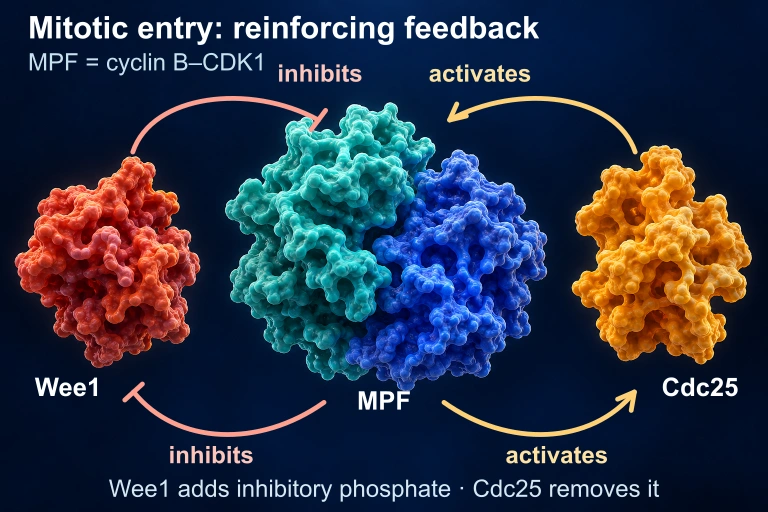 Active MPF activates Cdc25 and inhibits Wee1, reinforcing CDK1 activation. Wee1 adds an inhibitory phosphate to CDK1; Cdc25 removes it. Constitutively active Wee1 disrupts this loop; arrest is a prediction of the selected dominant-Wee1 model, not an unconditional outcome for every cell. Protein forms are generic illustrations, not measured structures or a molecular simulation; the circuit is independently authored.
SECTION 7
Negative vs. Positive Feedback — Strengths & Limitations
| Feature | Negative Feedback | Positive Feedback |
|---|---|---|
| Direction of effect | Opposes change; reduces output | Reinforces change; amplifies output |
| System behavior | Oscillation around set point; stability | Bistable switch; rapid commitment |
| Biological examples | Thermoregulation, blood glucose regulation, APC/C degradation of Cyclin B | MPF activation via Cdc25, blood clotting cascade, oxytocin during labor |
| Frequency in biology | Extremely common; most homeostatic systems | Less common; used for specific transitions |
| Requires termination signal? | Self-limiting by nature | Yes — must be shut off or runs to completion |
| Consequence of failure | Loss of homeostasis; unbounded change | Inability to make committed transitions; stalling |
Comparison of negative and positive feedback in biological systems
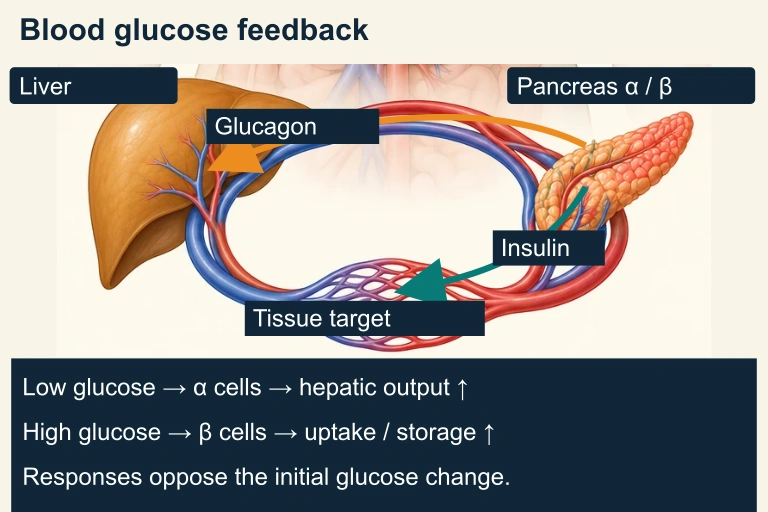 A rise in glucose stimulates beta-cell insulin and uptake or storage; a fall stimulates alpha-cell glucagon and hepatic output. These responses oppose the initial change.
KEY TAKEAWAY
SECTION 8
Feedback Dysregulation — Cancer & Beyond
Understanding feedback is not merely academic—it is directly relevant to understanding disease. Cancer can be viewed as a disease of broken feedback. Oncogenes (such as a constitutively active Ras) mimic permanent positive feedback signals that drive uncontrolled proliferation, while loss-of-function mutations in tumor suppressors (such as p53 or Rb) eliminate the negative feedback checkpoints that would normally halt division. The multi-hit hypothesis of cancer posits that multiple feedback controls must fail before a cell becomes fully malignant—reflecting the redundancy of feedback systems in normal biology.
| Normal Feedback Concept | Advanced / Clinical Connection |
|---|---|
| p53 → p21 negative feedback halts cell cycle | p53 mutation removes checkpoint → uncontrolled division in >50% of human cancers |
| Growth factor → Ras → MAPK positive relay | Constitutively active Ras (oncogene) = stuck positive signal → continuous proliferation |
| APC/C negative feedback degrades cyclins | Overexpression of cyclin D or E overwhelms APC/C → unregulated CDK activity |
| Receptor downregulation limits signal duration | EGFR mutations prevent internalization → persistent growth signals in lung cancer |
Normal feedback versus its dysregulation in cancer
Beyond cancer, feedback principles extend throughout physiology. The hypothalamic-pituitary-adrenal (HPA) axis uses cortisol-mediated negative feedback to regulate the stress response. The blood clotting cascade relies on positive feedback (thrombin activates more thrombin production) tempered by negative regulators like antithrombin and protein C. In ecology, predator-prey dynamics follow negative feedback patterns described by the Lotka–Volterra equations. Recognizing feedback as a universal organizing principle will serve you well not only on the AP exam but also in upper-division biology and biomedical courses.
SECTION 9
Practice Problems
Question 1: CONCEPTUAL
- A. It amplifies a stimulus to rapidly drive a process to completion.
- B. It reduces the output of a process when the product exceeds a set point, thereby stabilizing the variable.
- C. It permanently shuts down a signaling pathway after a single activation event.
- D. It eliminates the need for receptors in signal transduction pathways.
Show answer (B)
Question 2: BASIC CALCULATION
- A. Negative feedback: APC/C ubiquitinates Cyclin B, reducing MPF activity gradually.
- B. Positive feedback: active MPF activates Cdc25 phosphatase and inhibits Wee1 kinase, generating more active MPF.
- C. Negative feedback: p53 activates p21, which inhibits CDK1 to prevent premature mitotic entry.
- D. Positive feedback: Rb protein releases E2F transcription factors, promoting Cyclin B transcription.
Show answer (B)
Question 3: INTERMEDIATE
- A. Cells will arrest in G₂ because p53 will still activate p21 to inhibit CDK1.
- B. Cells will enter mitosis with damaged DNA because the G₂/M checkpoint cannot inhibit Cdc25, allowing premature MPF activation.
- C. Cells will undergo apoptosis immediately upon radiation exposure before reaching any checkpoint.
- D. Cells will remain in S phase because Cdc25 is required only for the G₁/S transition.
Show answer (B)
Question 4: APPLIED
4 ptsShow answer
Question 5: CRITICAL THINKING
4 ptsShow answer
SUMMARY
Lesson Summary
Summary
Feedback loops are the fundamental regulatory circuits that allow cells and organisms to maintain homeostasis and execute committed transitions. Negative feedback dampens change by having a process's output inhibit an earlier step, stabilizing variables around a set point—exemplified by APC/C-mediated Cyclin B degradation exiting cells from mitosis, or p53/p21-mediated checkpoint arrest in response to DNA damage. Positive feedback amplifies a signal to drive a rapid, irreversible switch—as seen in the MPF–Cdc25–Wee1 positive feedback loop that commits cells to mitosis.
Cell cycle checkpoints at G₁, G₂, and M phase integrate feedback from DNA damage sensors, growth factor pathways, and spindle attachment status to determine whether the cell advances, pauses, or undergoes apoptosis. Disruption of these feedback mechanisms—through oncogene activation (constitutive positive signals) or tumor suppressor loss (broken negative feedback)—underlies the uncontrolled proliferation of cancer. Mastering the logic of feedback—who signals whom, in what direction, and what happens when that signal is lost—is essential for the AP Biology exam and for understanding how living systems regulate themselves at every scale.