
SECTION 1
Historical Context & Motivation
For thousands of years, humans have shaped the organisms around them—long before anyone understood the genetic mechanisms responsible. Ancient farmers saved seeds from the most productive plants, and herders bred their strongest livestock, incrementally shifting the characteristics of entire populations over generations. This practice, which Charles Darwin would later term artificial selection, provided the conceptual scaffold upon which Darwin built his theory of evolution by natural selection. By studying how pigeon breeders could produce astonishingly diverse breeds from a single wild ancestor, Darwin recognized that nature itself could act as a selecting agent, favoring individuals best suited to their environment. Understanding artificial selection therefore illuminates not only modern agriculture and biotechnology but also the fundamental evolutionary principles tested on the AP Biology exam.
~10,000 BCE • Neolithic Agricultural Revolution
1859 • On the Origin of Species
1900–1910 • Rediscovery of Mendelian Genetics
1930s–1940s • Modern Synthesis & Quantitative Genetics
1990s–Present • Marker-Assisted & Genomic Selection
The central question artificial selection poses for biology is deceptively simple: if humans can so dramatically reshape organisms in mere centuries—producing Great Danes and Chihuahuas from the same wolf ancestor—what might millions of years of environmental pressure accomplish? Answering this question requires understanding how heritable variation, differential reproduction, and allele frequency change interact—the very mechanisms at the heart of the AP Biology curriculum.
SECTION 2
Core Principles & Definitions
Artificial selection operates through the same evolutionary logic as natural selection, but with one critical substitution: the selective agent is a human decision-maker rather than the environment. A breeder identifies individuals with a desired phenotype—higher milk yield, brighter plumage, disease resistance—and permits only those individuals to reproduce. Over successive generations, the alleles underlying the favored trait increase in frequency, while those associated with disfavored traits decline. This deceptively straightforward process rests on several foundational principles that connect genetics, heredity, and population biology.
Phenotypic Variation
Heritability
Differential Reproduction
Cumulative Generational Change
Trade-offs & Genetic Constraints
KEY TAKEAWAY
SECTION 3
Visual Explanation — From Wild Ancestor to Domesticated Varieties
The Brassica oleracea example is a favorite on the AP exam because it crystallizes several major ideas simultaneously. First, it demonstrates that phenotypic diversity can arise without speciation—all of these crops can still interbreed. Second, it shows that selection acts on existing variation: the wild ancestor already possessed alleles for variable leaf size, stem thickness, and inflorescence architecture. Humans did not create new mutations; they merely altered the frequencies of pre-existing alleles by choosing which individuals to propagate. Third, the diagram highlights that selection on different structures (leaves vs. stems vs. flowers) generates divergent lineages from a common ancestor—an analogy for adaptive radiation in natural populations.
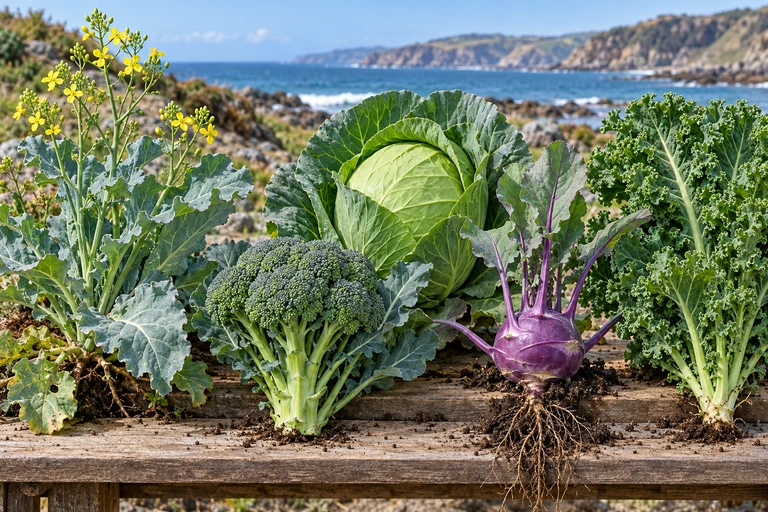 Artificial selection has emphasized different organs of Brassica oleracea: flower clusters in broccoli, the terminal bud in cabbage, an enlarged stem in kohlrabi and leaves in kale.
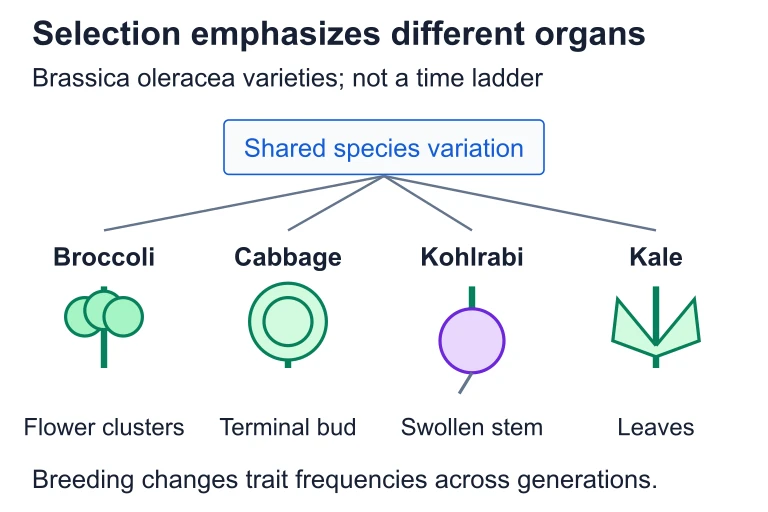 Artificial selection has emphasized different organs of Brassica oleracea: flower clusters in broccoli, the terminal bud in cabbage, an enlarged stem in kohlrabi and leaves in kale.
SECTION 4
The Genetic Mechanism — Allele Frequency Shifts
At the molecular level, artificial selection does not introduce new genetic material. Instead, it reshapes the allele frequency distribution within a population. Consider a locus with two alleles, A (associated with a desired trait) and a (associated with an undesired trait). If the breeder consistently prevents aa individuals from reproducing and favors AA and Aa genotypes, the frequency of allele A rises each generation while the frequency of a declines. When this selective pressure is sustained, the population can approach fixation for the favored allele—a state where p(A) ≈ 1.0 and p(a) ≈ 0. The quantitative framework for predicting how rapidly this shift occurs integrates heritability, selection intensity, and phenotypic variance.
THE BREEDER'S EQUATION
where R = response to selection (change in population mean between generations), h² = narrow-sense heritability (proportion of phenotypic variance due to additive genetic effects), and S = selection differential (difference between the mean phenotype of selected parents and the overall population mean).
SELECTION DIFFERENTIAL
The selection differential measures the intensity of the breeder's choice. A larger S indicates that only extreme phenotypes are permitted to breed—a more stringent selection regime that, given adequate heritability, accelerates the evolutionary response.
HERITABILITY
where VA = additive genetic variance and VP = total phenotypic variance (VA + VD + VE). Traits with high h² respond rapidly to selection; traits dominated by environmental variance (low h²) respond slowly or not at all.
CONNECTING TO THE AP EXAM
SECTION 5
Types of Artificial Selection & Classic Examples
Just as natural selection can be directional, stabilizing, or disruptive, artificial selection takes different forms depending on the breeder's goals. Understanding these modes is essential because AP Biology exam questions frequently ask students to identify the type of selection acting on a population based on shifts in phenotypic distributions.
| Selection Mode | Effect on Mean | Effect on Variance | Artificial Selection Example |
|---|---|---|---|
| Directional | Shifts toward one extreme | Often decreases (alleles fixed) | Breeding dairy cows for higher milk yield; selecting wheat for shorter stalk (Green Revolution) |
| Stabilizing | Stays approximately the same | Decreases (extremes removed) | Selecting tomatoes for uniform fruit size to fit standardized packaging |
| Disruptive | May split into two sub-means | Increases (bimodal distribution) | Dog breeding producing Chihuahuas and Great Danes from the same ancestor; ornamental goldfish varieties |
Comparison of the three modes of selection and their effects on phenotypic distributions
SECTION 6
Worked Example — Applying the Breeder's Equation
A plant breeder wants to increase the average seed oil content in a sunflower population. The current population mean is 40% oil, the narrow-sense heritability for oil content is h² = 0.50, and the breeder selects only the top-performing individuals with a mean oil content of 48%. Using the breeder's equation, we can predict the expected mean oil content in the next generation.
Predicting Response to Selection in Sunflowers
- 1
Step 1 — Identify Given Values
Population mean (μpop) = 40% oil. Mean of selected parents (μselected) = 48% oil. Narrow-sense heritability (h²) = 0.50. - 2
Step 2 — Calculate the Selection Differential (S)
S = μselected − μpop = 48% − 40% = 8 percentage points. This value quantifies how extreme the breeder's cutoff was—only parents that were 8 percentage points above average were permitted to reproduce.S = 8 percentage points - 3
Step 3 — Apply the Breeder's Equation (R = h² × S)
R = 0.50 × 8 = 4 percentage points. The response to selection tells us by how much the offspring generation's mean is expected to exceed the parental generation's mean. Because only half of the phenotypic variation is heritable (h² = 0.50), only half of the selection differential is realized as genetic gain.R = 4 percentage points - 4
Step 4 — Predict the Next Generation's Mean
New population mean = μpop + R = 40% + 4% = 44% oil. After one generation of selection, the expected mean oil content rises from 40% to 44%. If heritability remains stable and selection pressure is maintained, this gain can be compounded across successive generations.Predicted next-generation mean = 44% oil - 5
Step 5 — Interpret Biological Significance
Note that the offspring mean (44%) is intermediate between the population mean (40%) and the selected parents' mean (48%), weighted by heritability. This result embodies a central principle: selection can only act on heritable variation. The remaining 50% of the variance (due to environmental factors, dominance, and epistasis) does not respond to selection and cannot be transmitted to offspring.
SECTION 7
Strengths, Limitations & Ethical Considerations
Artificial selection has delivered spectacular successes—modern maize produces ears roughly 1,000 times larger than its teosinte ancestor, and broiler chickens now reach market weight in half the time they did in the 1950s. Yet these achievements carry inherent biological costs and raise questions that frequently appear on the AP exam. The following table contrasts the major advantages and limitations.
| Strengths | Limitations |
|---|---|
| Rapid phenotypic change—can achieve in decades what natural selection requires millennia to accomplish | Reduced genetic diversity (genetic bottleneck)—purebred populations often have very low heterozygosity |
| Predictable outcomes when heritability data are available (breeder's equation) | Selection plateau—as favorable alleles approach fixation, additive genetic variance () declines and R → 0 |
| Addresses human needs (food security, medicine, companionship) | Unintended pleiotropic effects—selecting for one trait can compromise another (e.g., brachycephalic dog breeds with respiratory distress) |
| Provides direct evidence that heritable variation + differential reproduction = evolution | Inbreeding depression—small breeding populations increase homozygosity, exposing deleterious recessive alleles |
| Can be combined with modern genomic tools for precision (marker-assisted selection) | Vulnerability to environmental change—genetically uniform monocultures are susceptible to epidemics (e.g., Irish Potato Famine, Panama disease in bananas) |
Advantages and limitations of artificial selection in biological populations
KEY TAKEAWAY
SECTION 8
Connections to Natural Selection & Modern Biotechnology
Artificial selection does not exist in a vacuum—it connects directly to the broader AP Biology framework of evolution, genetic engineering, and biodiversity. Understanding how artificial selection parallels and diverges from natural selection is a frequent exam target. Similarly, modern biotechnological approaches extend the logic of artificial selection into the molecular domain, making the comparison between traditional breeding and genetic engineering an important conceptual bridge.
| Feature | Artificial Selection | Natural Selection | Genetic Engineering |
|---|---|---|---|
| Selective agent | Human breeder | Environment (biotic + abiotic factors) | Scientist manipulating DNA directly |
| Source of variation | Pre-existing alleles (sometimes induced mutation) | Random mutation, recombination, gene flow | Transgenes, CRISPR-edited alleles, or synthetic sequences |
| Speed | Fast (years to decades) | Slow (generations to millennia) | Fastest (single generation possible) |
| Direction of selection | Human-chosen trait (may reduce fitness) | Favors traits that increase fitness in current environment | Targeted trait (precise locus) |
| Effect on diversity | Generally reduces within-population diversity; increases between-breed diversity | Maintains or increases diversity via balancing selection; reduces via directional | Can introduce novel diversity (transgenes from other species) |
| Fitness outcome | Often decreases wild fitness; optimizes for human utility | Increases fitness relative to current environment | Variable; depends on the engineered trait |
Comparison of artificial selection, natural selection, and genetic engineering
A critical distinction for the AP exam: artificial selection and natural selection both change allele frequencies through differential reproduction, making them both mechanisms of evolution. However, artificial selection is the only one that is goal-directed—natural selection has no foresight or intention. This teleological distinction is philosophically important and a frequent distractor in multiple-choice questions. Meanwhile, genetic engineering (including CRISPR-Cas9) represents the logical extension of artificial selection: rather than waiting for desired alleles to arise through recombination, scientists now introduce or edit them directly. As you study for the AP exam, recognize that the same underlying principle—heritable variation leading to differential allele transmission—unites all three approaches.
AP Exam Connection
SECTION 9
Practice Problems
Question 1: CONCEPTUAL
- A. Genetic drift is reducing genetic diversity because only a few dogs reproduce each generation.
- B. Directional artificial selection is shifting allele frequencies toward alleles that contribute to running speed.
- C. Stabilizing selection is maintaining the average running speed in the population while reducing variance.
- D. Gene flow from wild wolf populations is introducing new alleles that increase running speed.
Show answer (B)
Question 2: BASIC CALCULATION
- A. 158 g
- B. 160 g
- C. 162 g
- D. 170 g
Show answer (C)
Question 3: INTERMEDIATE
- A. The chickens have reached the biological maximum for egg production determined by fundamental physiological constraints.
- B. Favorable alleles have approached fixation, depleting the additive genetic variance () and reducing h², so R approaches zero despite a constant S.
- C. The environment has become more variable over time, causing the chickens to express a wider range of phenotypes unrelated to genotype.
- D. New deleterious mutations are being introduced at a rate that exactly offsets any gains from selection.
Show answer (B)
Question 4: APPLIED
4 ptsShow answer
Question 5: CRITICAL THINKING
4 ptsShow answer
SUMMARY
Lesson Summary — Artificial Selection
Summary
Artificial selection is the process by which humans act as the selective agent, choosing which individuals in a population reproduce based on desired phenotypic traits. This process requires three prerequisites: phenotypic variation in the trait, heritability (h²) ensuring that trait differences have a genetic basis, and differential reproduction imposed by the breeder. The breeder's equation (R = h² × S) quantifies the expected response to selection, where R is the change in the population mean, h² is narrow-sense heritability, and S is the selection differential.
Artificial selection can be directional (shifting the mean), stabilizing (reducing variance), or disruptive (favoring extremes). Classic examples include Brassica oleracea crops and dog domestication. Sustained selection can lead to a selection plateau as additive genetic variance is depleted through allele fixation, reduced genetic diversity, and inbreeding depression. For the AP exam, remember that artificial selection violates the Hardy-Weinberg equilibrium assumption of no selection, and that Darwin used it as foundational evidence for evolution by natural selection.